


Page 45 - JSOM Spring 2026
P. 45
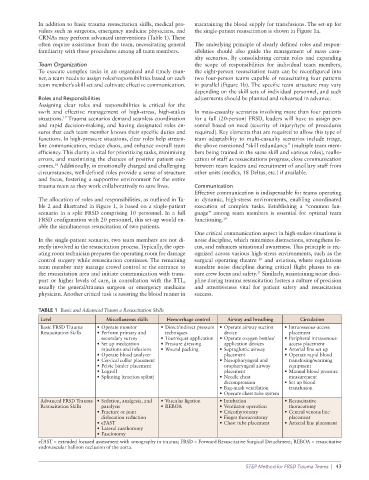
In addition to basic trauma resuscitation skills, medical pro-  maintaining the blood supply for transfusions. The set-up for
              viders such as surgeons, emergency medicine physicians, and   the single-patient resuscitation is shown in Figure 1a.
              CRNAs may perform advanced interventions (Table 1). These
              often require assistance from the team, necessitating general   The underlying principle of clearly defined roles and respon-
              familiarity with these procedures among all team members.  sibilities should also guide the management of mass casu-
                                                                 alty scenarios. By consolidating certain roles and expanding
              Team Organization                                  the scope of responsibilities for individual team members,
              To execute complex tasks in an organized and timely man-  the eight-person resuscitation team can be reconfigured into
              ner, a team needs to assign roles/responsibilities based on each   two four-person teams capable of resuscitating four patients
              team member’s skill set and cultivate effective communication.  in parallel (Figure 1b). The specific team structure may vary
                                                                 depending on the skill sets of individual personnel, and such
              Roles and Responsibilities                         adjustments should be planned and rehearsed in advance.
              Assigning  clear  roles  and  responsibilities  is  critical  for  the
              swift and effective management of high-stress, high-stakes   In mass-casualty scenarios involving more than four patients
                      17
              situations.  Trauma scenarios demand seamless coordination   for a full (20-person) FRSD, leaders will have to assign per-
              and rapid decision-making, and having designated roles en-  sonnel based on need (severity of injury/type of procedures
              sures that each team member knows their specific duties and   required). Key elements that are required to allow this type of
              functions. In high-pressure situations, clear roles help stream-  team  adaptability  to  multi-casualty  scenarios  include  triage,
              line communication, reduce chaos, and enhance overall team   the above mentioned “skill redundancy” (multiple team mem-
              efficiency. This clarity is vital for prioritizing tasks, minimizing   bers being trained in the same skill and various roles), reallo-
              errors, and maximizing the chances of positive patient out-  cation of staff as resuscitations progress, close communication
              comes.  Additionally, in emotionally charged and challenging   between team leaders and recruitment of ancillary staff from
                   18
              circumstances, well-defined roles provide a sense of structure   other units (medics, 18 Deltas, etc.) if available.
              and focus, fostering a supportive environment for the entire
              trauma team as they work collaboratively to save lives.  Communication
                                                                 Effective communication is indispensable for teams operating
              The allocation of roles and responsibilities, as outlined in Ta-  in dynamic, high-stress environments, enabling coordinated
              ble 2 and illustrated in Figure 1, is based on a single-patient   execution of complex tasks. Establishing a  “common lan-
              scenario in a split FRSD comprising 10 personnel. In a full   guage”  among  team  members  is  essential  for  optimal  team
              FRSD configuration with 20 personnel, this set-up would en-  functioning. 19
              able the simultaneous resuscitation of two patients.
                                                                 One critical communication aspect in high-stakes situations is
              In the single-patient scenario, two team members are not di-  noise discipline, which minimizes distractions, strengthens fo-
              rectly involved in the resuscitation process. Typically, the oper-  cus, and enhances situational awareness. This principle is rec-
              ating room technician prepares the operating room for damage   ognized across various high-stress environments, such as the
              control surgery while resuscitation continues. The remaining   surgical operating theatre   and aviation, where regulations
                                                                                      20
              team member may manage crowd control at the entrance to   mandate noise discipline during critical flight phases to en-
              the resuscitation area and initiate communication with trans-  sure crew focus and safety.  Similarly, maintaining noise disci-
                                                                                     21
              port or higher levels of care, in consultation with the TTL,   pline during trauma resuscitation fosters a culture of precision
              usually the general/trauma surgeon or emergency medicine   and attentiveness  vital for  patient  safety and  resuscitation
              physician. Another critical task is assisting the blood runner in   success.


              TABLE 1  Basic and Advanced Traum a Resuscitation Skills
              Level                 Miscellaneous skills  Hemorrhage control  Airway and breathing  Circulation
              Basic FRSD Trauma   • Operate monitor   • Direct/indirect pressure  • Operate airway suction   • Intraosseous-access
              Resuscitation Skills  • Perform primary and   techniques    device               placement
                                  secondary survey    • Tourniquet application  • Operate oxygen bottles/  • Peripheral intravenous-
                                 • Set up medication   • Pressure dressing  application devices  access placement
                                  injections and infusions  • Wound packing  • Supraglottic airway   • Arterial line set up
                                 • Operate blood analyzer                 placement           • Operate rapid blood
                                 • Cervical collar placement             • Nasopharyngeal and   transfusing/warming
                                 • Pelvic binder placement                oropharyngeal airway   equipment
                                 • Logroll                                placement           • Manual blood pressure
                                 • Splinting (traction splint)           • Needle chest        measurement
                                                                          decompression       • Set up blood
                                                                         • Bag-mask ventilation  transfusion
                                                                         • Operate chest tube system
              Advanced FRSD Trauma  • Sedation, analgesia, and   • Vascular ligation  • Intubation  • Resuscitative
              Resuscitation Skills  paralysis         • REBOA            • Ventilator operation  thoracotomy
                                 • Fracture or joint                     • Cricothyrotomy     • Central venous line
                                  dislocation reduction                  • Finger thoracostomy  placement
                                 • eFAST                                 • Chest tube placement  • Arterial line placement
                                 • Lateral canthotomy
                                 • Fasciotomy
              eFAST = extended focused assessment with sonography in trauma; FRSD = Forward Resuscitative Surgical Detachment; REBOA = resuscitative
              endovascular balloon occlusion of the aorta.


                                                                                 STEP Method for FRSD Trauma Teams  |  43

