


Page 49 - JSOM Spring 2026
P. 49
algorithm (e.g., contamination, unexploded ordnance, trauma   TABLE 3  Primary Survey Assessment and Examples for “Call-Outs”
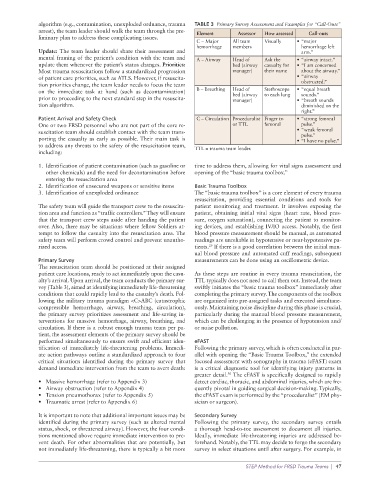
              arrest), the team leader should walk the team through the pre-  Element  Assessor  How assessed  Call-outs
              liminary plan to address these complicating issues.
                                                                 C – Major   All team   Visually  • “major
                                                                 hemorrhage  members               hemorrhage left
              Update: The team leader should share their assessment and                            arm.”
              mental framing of the patient’s condition with the team and   A – Airway  Head of   Ask the   • “airway intact.”
              update them whenever the patient’s status changes. Priorities:   bed (airway   casualty for   • “I am concerned
              Most trauma resuscitations follow a standardized progression   manager)  their name  about the airway.”
              of patient care priorities, such as ATLS. However, if resuscita-                    • “airway
              tion priorities change, the team leader needs to focus the team                      obstructed.”
              on the immediate task at hand (such as decontamination)   B – Breathing  Head of   Stethoscope   • “equal breath
                                                                                                   sounds.”
              prior to proceeding to the next standard step in the resuscita-  bed (airway   to each lung  • “breath sounds
                                                                             manager)
              tion algorithm.                                                                      diminished on the
                                                                                                   right.”
              Patient Arrival and Safety Check                   C – Circulation Proceduralist  Finger to   • “strong femoral
              One or two FRSD personnel who are not part of the core re-     or TTL    femoral     pulse.”
              suscitation team should establish contact with the team trans-                      • “weak femoral
                                                                                                   pulse.”
              porting the casualty as early as possible. Their main task is                       • “I have no pulse.”
              to address any threats to the safety of the resuscitation team,   TTL = trauma team leader.
              including:

              1.  Identification of patient contamination (such as gasoline or   time to address them, allowing for vital signs assessment and
                other chemicals) and the need for decontamination before   opening of the “basic trauma toolbox.”
                entering the resuscitation area
              2.  Identification of unsecured weapons or sensitive items  Basic Trauma Toolbox
              3.  Identification of unexploded ordinance         The “basic trauma toolbox” is a core element of every trauma
                                                                 resuscitation, providing essential conditions and tools for
              The safety team will guide the transport crew to the resuscita-  patient monitoring and treatment. It involves exposing the
              tion area and function as “traffic controllers.” They will ensure   patient, obtaining initial vital signs (heart rate, blood pres-
              that the transport crew steps aside after handing the patient   sure, oxygen saturation), connecting the patient to monitor-
              over. Also, there may be situations where fellow Soldiers at-  ing devices, and establishing IV/IO access. Notably, the first
              tempt to follow the casualty into the resuscitation area. The   blood pressure measurement should be manual, as automated
              safety team will perform crowd control and prevent unautho-  readings are unreliable in hypotensive or near-hypotensive pa-
                                                                     29
              rized access.                                      tients.  If there is a good correlation between the initial man-
                                                                 ual blood pressure and automated cuff readings, subsequent
              Primary Survey                                     measurements can be done using an oscillometric device.
              The resuscitation team should be positioned at their assigned
              patient care locations, ready to act immediately upon the casu-  As these steps are routine in every trauma resuscitation, the
              alty’s arrival. Upon arrival, the team conducts the primary sur-  TTL typically does not need to call them out. Instead, the team
              vey (Table 3), aimed at identifying immediately life-threatening   swiftly initiates the “basic trauma toolbox” immediately after
              conditions that could rapidly lead to the casualty’s death. Fol-  completing the primary survey. The components of the toolbox
              lowing the military trauma paradigm <C>ABC (catastrophic   are organized into pre-assigned tasks and executed simultane-
              compressible hemorrhage, airway, breathing, circulation),   ously. Maintaining noise discipline during this phase is crucial,
              the primary survey prioritizes assessment and life-saving in-  particularly during the manual blood pressure measurement,
              terventions for massive hemorrhage, airway, breathing, and   which can be challenging in the presence of hypotension and/
              circulation. If there is a robust enough trauma team per pa-  or noise pollution.
              tient, the assessment elements of the primary survey should be
              performed simultaneously to ensure swift and efficient iden-  eFAST
              tification of immediately life-threatening problems. Immedi-  Following the primary survey, which is often conducted in par-
              ate action pathways outline a standardized approach to four   allel with opening the “Basic Trauma Toolbox,” the extended
              critical situations identified during the primary survey that   focused assessment with sonography in trauma (eFAST) exam
              demand immediate intervention from the team to avert death:  is a critical diagnostic tool for identifying injury patterns in
                                                                 greater detail.  The eFAST is specifically designed to rapidly
                                                                           30
              •  Massive hemorrhage (refer to Appendix 3)        detect cardiac, thoracic, and abdominal injuries, which are fre-
              •  Airway obstruction (refer to Appendix 4)        quently pivotal in guiding surgical decision-making. Typically,
              •  Tension pneumothorax (refer to Appendix 5)      the eFAST exam is performed by the “proceduralist” (EM phy-
              •  Traumatic arrest (refer to Appendix 6)          sician or surgeon).

              It is important to note that additional important issues may be   Secondary Survey
              identified during the primary survey (such as altered mental   Following the primary survey, the secondary survey entails
              status, shock, or threatened airway). However, the four condi-  a thorough head-to-toe assessment to document all injuries.
              tions mentioned above require immediate intervention to pre-  Ideally, immediate life-threatening injuries are addressed be-
              vent death. For other abnormalities that are potentially, but   forehand. Notably, the TTL may decide to forgo the secondary
              not immediately life-threatening, there is typically a bit more   survey in select situations until after surgery. For example, in

                                                                                 STEP Method for FRSD Trauma Teams  |  47

