


Page 9 - JSOM Winter 2025
P. 9
Implementing Operational Skills in the Education of Com-  ONGOING SERIES
              bat Medics at the Belgian Defense: An Integrative Model:     PROLONGED CASUALTY CARE
              Waroquier and colleagues compare final theoretical and prac-  Maritime Applications of Prolonged Casualty Care Training
              tical results between EMT and non-EMT candidates (n=137)   Scenario: Burn Injury on a Destroyer During Distributed Mar-
              in the Belgian Defense’s combat medic certification program.   itime Operations: Adams and colleagues present an innovative
              These results showed that clinically exposed (EMT) candidates   approach to teaching complex operational medicine concepts
              did not demonstrate superiority in any domains or subdomains   (including Prolonged Casualty Care) to austere Role 1 mari-
              when compared to their non-EMT peers. Non-EMT candi-  time caregivers using a hypothetical scenario involving a pa-
              dates, mainly from the Belgian Special Operation Regiment, ex-  tient with severe burn injury of the torso with circumferential
              hibited equal theoretical and practical results when compared   upper extremity  after a transformer exploded in a confined
              to EMT candidates. Certain course parameters may account   space while he was working on the ship’s electrical system.
              for why the clinically exposed group did not perform better, but
              the role of intrinsic motivation and situational awareness in the   THE WORLD OF SPECIAL OPERATIONS MEDICINE
              clinically-naive group warrants further investigation.  Dig Deep! The Sub-Terranean Casualty Stabilization Points:
                                                                 Miles and colleagues explore the adaptation of medical sup-
              IN BRIEF                                           port in static warfare, focusing on the development of Subter-
              “Ruck-Truck-House-Plane” Plan Application for the Manage-  ranean Casualty Stabilization Points (ST CSP) by the Armed
              ment of Combat-Related Wound Infections and Prevention of   Forces of Ukraine. The authors recommend Western militaries
              Multidrug-Resistant Organism Spread in Prolonged Field Care   consider similar adaptations in future conflicts, as they enable
              Scenarios: Pasquier and colleagues introduce a “Ruck-Truck-  damage  control  resuscitation  and  damage  control  surgery
              House-Plane” model for infection control and wound manage-  close to the front lines, significantly reducing the time from
              ment in the Prolonged Casualty Care (Role 1) environment and   injury to surgery.
              beyond. This original approach includes practical procedures
              and decision-making from point of injury to tertiary care trans-
              fer. It emphasizes early decontamination, phased surgical care,
              remote microbial diagnostics, and antimicrobial stewardship to
              reduce morbidity and mortality in modern warfare.

              CASE REPORT
              Infective Endocarditis: Severe Complication from a Common
              Procedure: Maurice and colleagues present the case of a 26-
              year-old  Army Officer with fever, skin lesions, and pain at
              his IV site following a recent hospitalization for heat injury
              while participating in Special Forces Assessment and Selection.
              While infective endocarditis is rare in otherwise healthy sol-
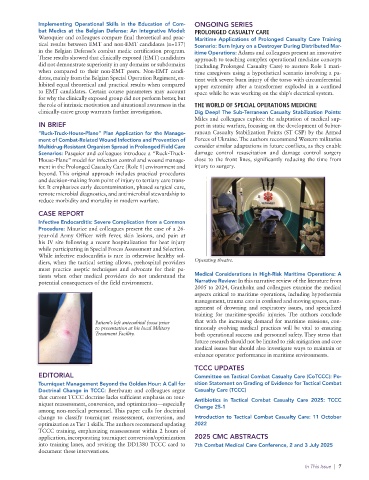
              diers, when the tactical setting allows, prehospital providers   Operating theatre.
              must practice  aseptic techniques  and advocate  for their pa-
              tients when other medical providers do not understand the   Medical Considerations in High-Risk Maritime Operations: A
              potential consequences of the field environment.   Narrative Review: In this narrative review of the literature from
                                                                 2005 to 2024, Granholm and colleagues examine the medical
                                                                 aspects critical to maritime operations, including hypothermia
                                                                 management, trauma care in confined and moving spaces, man-
                                                                 agement  of drowning and  respiratory  issues,  and  specialized
                                                                 training  for  maritime-specific  injuries.  The  authors  conclude
                                Patient’s left antecubital fossa prior   that  with  the  increasing  demand  for  maritime  missions,  con-
                                to presentation at his local Military   tinuously evolving medical practices will be vital to ensuring
                                Treatment Facility.              both operational success and personnel safety. They stress that
                                                                 future research should not be limited to risk mitigation and core
                                                                 medical issues but should also investigate ways to maintain or
                                                                 enhance operator performance in maritime environments.
                                                                 TCCC UPDATES
              EDITORIAL                                          Committee on Tactical Combat Casualty Care (CoTCCC): Po-
              Tourniquet Management Beyond the Golden Hour: A Call for   sition Statement on Grading of Evidence for Tactical Combat
              Doctrinal Change in TCCC:  Beerbaum and colleagues argue   Casualty Care (TCCC)
              that current TCCC doctrine lacks sufficient emphasis on tour-  Antibiotics in Tactical Combat Casualty Care 2025: TCCC
              niquet reassessment, conversion, and optimization—especially   Change 25-1
              among non-medical personnel. This paper calls for doctrinal
              change to classify tourniquet reassessment, conversion, and   Introduction to Tactical Combat Casualty Care: 11 October
              optimization as Tier 1 skills. The authors recommend updating   2022
              TCCC training, emphasizing reassessment within 2 hours of
              application, incorporating tourniquet conversion/optimization   2025 CMC ABSTRACTS
              into training lanes, and revising the DD1380 TCCC card to   7th Combat Medical Care Conference, 2 and 3 July 2025
              document these interventions.

                                                                                                     In This Issue  |  7

