


Page 12 - JSOM Winter 2025
P. 12
Invasion in  World  War II, the U.S.  Army evacuated over   and restore homeostasis. At the tactical level, the physics of
          65,000 casualties by land, air, and sea across the English Chan-  resuscitation (restoring homeostasis, preventing hypothermia,
          nel to England, leveraging networks of existing ports and air-  mitigating coagulopathy, and deterring acidosis) and mechan-
          ports, landing ship tanks (LST), trains, aircraft, and ground   ics of injury (penetrating trauma, burn and blast injuries) has a
                    6
          MEDEVAC.  Meanwhile, the Allies in the Pacific theater faced   significant impact on saving lives. At the operational and stra-
          less-than-ideal conditions. The area was dominated by a vast   tegic levels, physics will determine the time, space, and flow
          ocean dotted with thick jungle, poor road conditions, and   required for casualty movement across the continuum of care;
          rocky terrain that favored Japanese defenders. Casualty num-  this is where CASEVAC plays an important role. Finally, re-
          bers at Iwo Jima and Okinawa surpassed 18,000, and over-  source and risk analysis will determine the approach or action
          all casualty rates exceeded the invasion of Normandy during   (or non-action) required to perform a function. In the case of
                  7
          Iwo Jima.  The Battle of Saipan resulted in higher casualty   casualty survivability, with all other factors considered, such
          rates, nearing 20%, with 14,111 of 71,034 personnel killed,   as risk to mission and risk force, action favors inaction.
                           6
          wounded, or missing.  Under these demanding conditions, the
          Navy employed multi-modal CASEVAC, using rubber boats,   During a large-scale combat operation, mass casualty inci-
          Navy light tankers, flying boat planes, half-tracks, tanks, and   dents will be frequent and exceed the resources necessary to
          motor torpedo boats  to evacuate casualties  in rugged  ter-  evacuate patients to definitive care in the time required to
                                     6
          rain or areas with heavy fighting.  Until the islands’ airfields   maximize  patient  survival.  Other  considerations  are  oper-
          were secure, many patients were evacuated by LST from the   ations or circumstances where large volumes of patients are
          beachheads, often without medical equipment or markings,   created and a mismatch between patient carrying capacity
          to hospital ships, then taken by hospital ship for several days   and volume occurs. For example, past division and corps-level
          or evacuated by air, sometimes over 2,400 miles.  This exten-  exercises conducted by the U.S.  Army’s Mission Command
                                                6
          sive evacuation network required regulated patient movement   Training Program (MCTP) averaged 50-55,000 casualties per
          from the tactical level to the strategic level to ensure the right   100,000 personnel assigned over 8 days across multiple ex-
          resources were available to evacuate large numbers of casual-  ercises.  This high volume of casualties would require a di-
                                                                  11
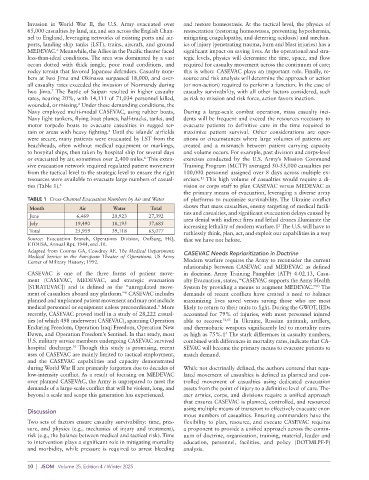
          ties (Table 1). 6                                  vision or corps staff to plan CASEVAC versus MEDEVAC as
                                                             the primary means of evacuation, leveraging a diverse array
          TABLE 1  Cross-Channel Evacuation Numbers by Air and Water  of platforms to maximize survivability. The Ukraine conflict
           Month           Air        Water       Total      shows that mass casualties, enemy targeting of medical facili-
           June           6,469       20,923      27,392     ties and casualties, and significant evacuation delays caused by
                                                             area denial with indirect fires and lethal drones illuminate the
           July           19,490      18,195      37,685     increasing lethality of modern warfare.1  The U.S. will have to
                                                                                            2
           Total          25,959      39,118      65,077     ruthlessly think, plan, act, and exploit our capabilities in a way
          Source: Evacuation Branch, Operations Division, OofSurg, HQ,   that we have not before.
            ETOUSA, Annual Rpt, 1944, encl.10.
          Adapted from Cosmas GA, Cowdrey AE. The Medical Department:   CASEVAC Needs Reprioritization in Doctrine
          Medical Service in the European  Theater of Operations.  US Army
          Center of Military History; 1992.                  Modern warfare requires the Army to reconsider the current
                                                             relationship between CASEVAC and MEDEVAC as defined
          CASEVAC is one of the three forms of patient move-  in doctrine.  Army  Training Pamphlet (ATP) 4-02.13, Casu-
          ment ( CASEVAC, MEDEVAC, and strategic evacuation   alty Evacuation, states, “CASEVAC supports the Army Health
          [ STRATEVAC]) and is defined as the  “unregulated move-  System by providing a means to augment MEDEVAC.”  The
                                                                                                        13
          ment of casualties aboard any platform.”  CASEVAC includes   demands  of recent conflicts  have  created  a need  to  balance
                                          8
          planned and unplanned patient movement and may not include   maximizing lives saved versus saving those who are most
          medical personnel or equipment unless precoordinated.  More   likely to return to their units to fight. During the GWOT, IEDs
                                                     9
          recently, CASEVAC proved itself in a study of 28,222 casual-  accounted for 79% of injuries, with most personnel injured
          ties (of which 498 underwent CASEVAC), spanning Operation   able  to  recover. 14,15   In  Ukraine,  Russian  antitank,  artillery,
          Enduring Freedom, Operation Iraqi Freedom, Operation New   and thermobaric weapons significantly led to mortality rates
          Dawn, and Operation Freedom’s Sentinel. In that study, most   as high as 75%.1  The stark differences in casualty numbers,
                                                                           4
          U.S. military service members undergoing CASEVAC survived   combined with differences in mortality rates, indicate that CA-
          hospital discharge.  Though this study is promising, recent   SEVAC will become the primary means to evacuate patients to
                         10
          uses of CASEVAC are mainly limited to tactical employment,   match demand.
          and  the  CASEVAC  capabilities  and  capacity  demonstrated
          during World War II are primarily forgotten due to decades of   While not doctrinally defined, the authors contend that regu-
          low-intensity conflict. As a result of focusing on MEDEVAC   lated movement of casualties is defined as planned and con-
          over planned CASEVAC, the Army is unprepared to meet the   trolled  movement  of  casualties  using  dedicated  evacuation
          demands of a large-scale conflict that will be violent, long, and   assets from the point of injury to a definitive level of care. The-
          beyond a scale and scope this generation has experienced.  ater armies, corps, and divisions require a unified approach
                                                             that ensures CASEVAC is planned, controlled, and resourced
          Discussion                                         using multiple means of transport to effectively evacuate enor-
                                                             mous numbers of casualties. Ensuring commanders have the
          Two sets of factors ensure casualty survivability: time, pres-  flexibility to plan, resource, and execute CASEVAC requires
          sure, and physics (e.g., mechanics of injury and treatment),   a proponent to provide a unified approach across the contin-
          risk (e.g., the balance between medical and tactical risk). Time   uum of doctrine, organization, training, material, leader and
          to intervention plays a significant role in mitigating mortality   education, personnel, facilities, and policy (DOTMLPF-P)
          and morbidity, while pressure is required to arrest bleeding   analysis.

          10  |  JSOM   Volume 25, Edition 4 / Winter 2025

