


Page 8 - JSOM Winter 2025
P. 8
FEATURE ARTICLES                                   A Prospective Comparison of SAM IO versus EZ-IO Insertion
          The Chicken, Fox, and Grain: Solving the Problem of  CASEVAC:    Time and Usability During Simulated Vascular Access: Stiglitz
          Barbee and Causey argue that the U.S. Army’s current casualty   and colleagues conducted a randomized prospective trial with
          evacuation (CASEVAC) strategy is inadequate for managing   106 EMS clinicians to compare the EZ-IO and SAM IO for
          large-scale  conflicts, particularly  when casualties overwhelm   intraosseous (IO) access by examining insertion times and user
          evacuation capabilities. They present three concepts and three   preferences. The researchers report that the EZ-IO had a faster
          recommendations to set conditions for future CASEVAC.   insertion time compared to the SAM IO, but the time differ-
          Overall, the authors advocate a whole of force approach,   ence was unlikely to have any meaningful impact on patient
          through which the Army can streamline command and control   outcomes. Although participant responses indicated a prefer-
          and leverage emerging technology, like artificial intelligence   ence for the EZ-IO, most felt confident using the SAM IO—a
          and unmanned autonomous systems, to enhance its capacity   less costly and manually powered driver—in an EMS setting.
          and capability to evacuate casualties.
          Plastic Packaging Wrap for Patient Packaging: In this arti-
          cle, Thompson and colleagues describe how plastic packaging
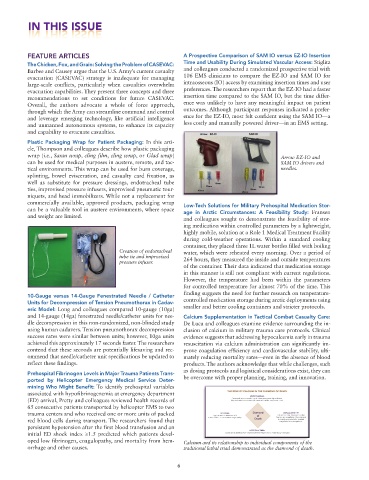
          wrap (i.e., Saran wrap, cling film, cling wrap, or Glad wrap)                      Arrow EZ-IO and
          can be used for medical purposes in austere, remote, and tac-                      SAM IO drivers and
          tical environments. This wrap can be used for burn coverage,                       needles.
          splinting,  bowel evisceration,  and casualty  card  fixation,  as
          well as substitute for pressure dressings, endotracheal tube
          ties, improvised pressure infusers, improvised pneumatic tour-
          niquets, and head immobilizers. While not a replacement for
          commercially available, approved products, packaging wrap   Low-Tech Solutions for Military Prehospital Medication Stor-
          can be a valuable tool in austere environments, where space   age in Arctic Circumstances: A Feasibility Study:  Fransen
          and weight are limited.                            and colleagues sought to demonstrate the feasibility of stor-
                                                             ing medication within controlled parameters by a lightweight,
                                                             highly mobile, solution at a Role 1 Medical Treatment Facility
                                                             during cold-weather operations.  Within a standard cooling
                                                             container, they placed three 1L water bottles filled with boiling
                                        Creation of endotracheal   water, which were reheated every morning. Over a period of
                                        tube tie and improvised   264 hours, they measured the inside and outside temperatures
                                        pressure infuser.
                                                             of the container. Their data indicated that medication storage
                                                             in this manner is still not compliant with current regulations.
                                                             However,  the temperature  had  been within  the parameters
                                                             for controlled temperature for almost 70% of the time. This
          10-Gauge versus 14-Gauge Fenestrated Needle / Catheter    finding suggests the need for further research on temperature-
          Units for Decompression of Tension Pneumothorax in Cadav-  controlled medication storage during arctic deployments using
          eric Model: Long and colleagues compared 10-gauge (10ga)   smaller and better cooling containers and stricter protocols.
          and 14-gauge (14ga) fenestrated needle/catheter units for nee-  Calcium Supplementation in Tactical Combat Casualty Care:
          dle decompression in this non-randomized, non-blinded study   De Luca and colleagues examine evidence surrounding the in-
          using human cadavers. Tension pneumothorax decompression   clusion of calcium in military trauma care protocols. Clinical
          success rates were similar between units; however, 10ga units   evidence suggests that addressing hypocalcemia early in trauma
          achieved this approximately 17 seconds faster. The researchers   resuscitation via calcium administration can significantly im-
          contend that these seconds are potentially lifesaving and rec-  prove coagulation efficiency and cardiovascular stability, ulti-
          ommend that needle/catheter unit specifications be updated to   mately reducing mortality rates—even in the absence of blood
          reflect these findings.                            products. The authors acknowledge that while challenges, such
                                                             as dosing protocols and logistical considerations exist, they can
          Prehospital Fibrinogen Levels in Major Trauma Patients Trans-
          ported  by  Helicopter  Emergency  Medical  Service  Deter-  be overcome with proper planning, training, and innovation.
          mining Who Might Benefit: To identify prehospital variables
          associated with hypofibrinogenemia at emergency department       THE ROLE OF CALCIUM IN THE DIAMOND OF DEATH
          (ED) arrival, Pretty and colleagues reviewed health records of           HYPOTHERMIA:
          65 consecutive patients transported by helicopter EMS to two
          trauma centers and who received one or more units of packed    ACIDOSIS:  Diamond
                                                                                     of
          red blood cells during transport. The researchers found that              Death
          persistent hypotension after the first blood transfusion and an
          initial ED shock index ≥1.5 predicted which patients devel-              HYPOCALCEMIA:
          oped low fibrinogen, coagulopathy, and mortality from hem-  Calcium and its relationship to individual components of the
          orrhage and other causes.                          traditional lethal triad demonstrated as the diamond of death.


                                                           6

