


Page 14 - JSOM Winter 2025
P. 14
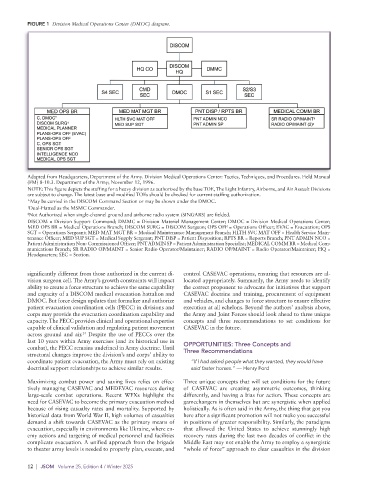
FIGURE 1  Division Medical Operations Center (DMOC) diagram.


          Adapted from Headquarters, Department of the Army. Division Medical Operations Center: Tactics, Techniques, and Procedures. Field Manual
          (FM) 8-10.3. Department of the Army; November 12, 1996.
          NOTE: This figure depicts the staffing for a heavy division as authorized by the base TOE, The Light Infantry, Airborne, and Air Assault Divisions
          are subject to change. The latest base and modified TOEs should be checked for current staffing authorization.
          *May be carried in the DISCOM Command Section or may be shown under the DMOC.
          † Dual-Hatted as the MSMC Commander.
          ‡ Not Authorized when single-channel ground and airborne radio system (SINGARS) are fielded.
          DISCOM = Division Support Command; DMMC = Division Materiel Management Center; DMOC = Division Medical Operations Center;
          MED OPS BR = Medical Operations Branch; DISCOM SURG = DISCOM Surgeon; OPS OFF = Operations Officer; EVAC = Evacuation; OPS
          SGT = Operations Sergeant; MED MAT MGT BR = Medical Maintenance Management Branch; HLTH SVC MAT OFF = Health Service Main-
          tenance Officer; MED SUP SGT = Medical Supply Sergeant; PNT DISP = Patient Disposition; RPTS BR = Reports Branch; PNT ADMIN NCO =
          Patient Administration Non- Commissioned Officer; PNT ADMIN SP = Patient Administration Specialist; MEDICAL COMM BR = Medical Com-
          munications Branch; SR RADIO OP/MAINT = Senior Radio Operator/Maintainer; RADIO OP/MAINT = Radio Operator/Maintainer; HQ =
          Headquarters; SEC = Section.


          significantly different from those authorized in the current di-  control CASEVAC operations, ensuring that resources are al-
          vision surgeon cell. The Army’s growth constraints will impact   located appropriately. Summarily, the Army needs to identify
          ability to create a force structure to achieve the same capability   the correct proponent to advocate for initiatives that support
          and capacity of a DISCOM medical evacuation battalion and   CASEVAC doctrine and training, procurement of equipment
          DMOC. But force design updates that formalize and authorize   and vehicles, and changes to force structure to ensure effective
          patient evacuation coordination cells (PECC) in divisions and   execution at all echelons. Beyond the authors’ analysis above,
          corps may provide the evacuation coordination capability and   the Army and Joint Forces should look ahead to three unique
          capacity. The PECC provides clinical and operational expertise   concepts and three recommendations to set conditions for
          capable of clinical validation and regulating patient movement     CASEVAC in the future.
                            24
          across ground and air.  Despite the use of PECCs over the
          last 10 years within Army exercises (and its historical use in   OPPORTUNITIES: Three Concepts and
          combat), the PECC remains undefined in Army doctrine. Until   Three Recommendations
          structural changes improve the division’s and corps’ ability to
          coordinate patient evacuation, the Army must rely on existing   “If I had asked people what they wanted, they would have
          doctrinal support relationships to achieve similar results.  said faster horses.” — Henry Ford

          Maximizing  combat  power  and  saving  lives  relies  on  effec-  Three unique concepts that will set conditions for the future
          tively managing CASEVAC and MEDEVAC resources during   of CASEVAC are creating asymmetric outcomes, thinking
          large-scale  combat  operations.  Recent  WFXs  highlight  the   differently, and having a bias for action. These concepts are
          need for CASEVAC to become the primary evacuation method   gamechangers in themselves but are synergistic when applied
          because of rising casualty rates and mortality. Supported by   holistically. As is often said in the Army, the thing that got you
          historical data from World War II, high volumes of casualties   here after a significant promotion will not make you successful
          demand a shift towards CASEVAC as the primary means of   in positions of greater responsibility. Similarly, the paradigms
          evacuation, especially in environments like Ukraine, where en-  that allowed the United States to achieve stunningly high
          emy actions and targeting of medical personnel and facilities   recovery rates during the last two decades of conflict in the
          complicate evacuation. A unified approach from the brigade   Middle East may not enable the Army to employ a synergistic
          to theater army levels is needed to properly plan, execute, and   “whole of force” approach to clear casualties in the division

          12  |  JSOM   Volume 25, Edition 4 / Winter 2025

