


Page 51 - 2023 SMOG Digital
P. 51
Cardiac


                    PEDIATRIC ALS and BLS

                               INDICATORS
                          Indicators of Potential Need for Cardiopulmonary Support
                 •  Breathing
                     o  Irregular Respirations or  >60 breaths/min
                     o  Labored Breathing (Retractions, Nasal Flaring, Grunting, Pursing of Lips, Tripod Positioning, ↓Ability to
                       Speak)
                 •  Heart  Rate Ranges (especially if associated with poor perfusion)
                     o  <2 Years Old: <80/min or  >180/min
                     o  >2 Years Old: <60/min or  >160/min
                 •  Poor Perfusion with Weak or Absent Distal Pulses
                     o  Cyanosis
                     o  ↓O2 Sat
                 •  Altered Mental Status
                     o  GCS <8, Weak Cry, Unusual Irritability, Altered Responsiveness, Lethargy, or Failure to Respond to Painful
                       Stimulus
                 •  Seizures, Fever with Petechiae, Trauma, and/or Burns >10% Body Surface Area
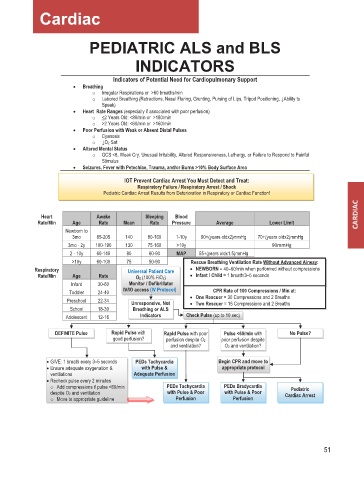
                            IOT Prevent Cardiac Arrest You Must Detect and Treat:
                               Respiratory Failure / Respiratory Arrest / Shock
                        Pediatric Cardiac Arrest Results from Deterioration in Respiratory or Cardiac Function!
          Heart       Awake      Sleeping   Blood
         Rate/Min   Age   Rate   Mean   Rate   Pressure   Average   Lower Limit
               Newborn to
                 3mo   85-205  140   80-160  1-10y  90+(years oldx2)mmHg   70+(years oldx2)mmHg
                3mo - 2y   100-190  130   75-160  >10y      90mmHg
                2 - 10y   60-140  80   60-90  MAP   55+(years oldx1.5)mmHg
                 >10y  60-100  75   50-90  Rescue Breathing Ventilation Rate Without Advanced Airway:


         Respiratory         Universal Patient Care   • NEWBORN = 40–60/min when performed without compressions
         Rate/Min   Age   Rate   O2 (100% FiO2)   • Infan   t / Child = 1 breath/3–5 seconds

                Infant   30-60  Monitor / Defibrillator
                Toddler   24-40  IV/IO access (IV Protocol)      CPR Rate of 100 Compressions / Min at:
                Preschool   22-34  Unresponsive, Not   • One Rescuer = 30 Compressions and 2 Breaths


                                          • Two Rescuer = 15 Compressions and 2 Breaths
                School   18-30  Breathing or ALS

               Adolescent   12-16  Indicators    Check Pulse (up to 10 sec)


             DEFINITE Pulse   Rapid Pulse with   Rapid Pulse with poor   Pulse <60/min with   No Pulse?
                          good perfusion?   perfusion despite O2   poor perfusion despite
                                      and ventilation?   O2 and ventilation?
           • GIVE: 1 breath every 3–5 seconds  PEDs Tachycardia   Begin CPR and move to
           • Ensure adequate oxygenation &   with Pulse &   appropriate protocol
            ventilations      Adequate Perfusion
           • Recheck pulse every 2 minutes
            o Add compressions if pulse <60/min   PEDs Tachycardia   PEDs Bradycardia   Pediatric
            despite O2 and ventilation   with Pulse & Poor   with Pulse & Poor   Cardiac Arrest
            o Move to appropriate guideline  Perfusion   Perfusion
                                                                        51

