


Page 49 - 2023 SMOG Digital
P. 49
Cardiac


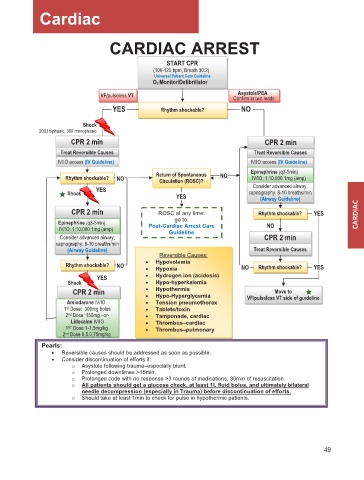
                         CARDIAC ARREST


                                     START CPR
                                  (100-120 bpm, Breath 30:2)
                                   Universal Patient Care Guideline
                                  O2  Monitor/Defibrillator
                                                     Asystole/PEA
                       VF/pulseless VT              Confirm in two leads
                          YES       Rhythm shockable?   NO
                   Shock
          200J biphasic, 360 monophasic
                CPR 2 min                                  CPR 2 min
              Treat Reversible Causes                   Treat Reversible Causes
              IV/IO access (IV Guideline)               IV/IO access (IV Guideline)
                                   Return of Spontaneous   NO  Epinephrine (q3-5min)
               Rhythm shockable?   NO  Circulation (ROSC)?   IV/IO: 1:10,000 1mg (amp)
                      YES                               Consider advanced airway,
                Shock                                  capnography: 8-10 breaths/min
                                       YES                (Airway Guideline)
                 CPR 2 min         ROSC at any time:     Rhythm shockable?   YES
              Epinephrine (q3-5min)    go to:              NO
              IV/IO: 1:10,000 1mg (amp)   Post-Cardiac Arrest Care
                                      Guideline
              Consider advanced airway,                    CPR 2 min
             capnography: 8-10 breaths/min
                (Airway Guideline)                      Treat Reversible Causes
                                    Reversible Causes:
               Rhythm shockable?   NO  • •  Hypovolemia  NO  Rhythm shockable?   YES
                                   Hypoxia
                      YES        •  Hydrogen ion (acidosis)
                Shock            •  Hypo-hyperkalemia
                 CPR 2 min       • •  Hypothermia            Move to
                                   Hypo-Hyperglycemia
                Amiodarone IV/IO   •  Tension pneumothorax  VF/pulseless VT side of guideline
               1 st  Dose:  300mg bolus   •  Tablets/toxin
               2 nd  Dose: 150mg –or-   •  Tamponade, cardiac
                Lidocaine IV/IO   •  Thrombus–cardiac
               1 ST  Dose 1-1.5mg/kg   •  Thrombus–pulmonary
               2 nd  Dose 0.5.0.75mg/kg
          Pearls:
            •  Reversible causes should be addressed as soon as possible.
            •  Consider discontinuation of efforts if:
                 o  Asystole following trauma–especially blunt.
                 o  Prolonged downtimes >15min.
                 o  Prolonged code with no response >3 rounds of medications, 30min of resuscitation.
                 o  All patients should get a glucose check, at least 1L fluid bolus, and ultimately bilateral
                   needle decompression (especially in Trauma) before discontinuation of efforts.
                 o  Should take at least 1min to check for pulse in hypothermic patients.

                                                                        49

