


Page 131 - 2022 Ranger Medic Handbook
P. 131
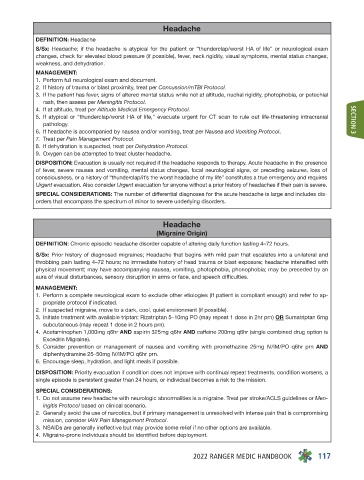
Headache
         DEFINITION: Headache
         S/Sx:  Headache; if the headache is atypical for the patient or “thunderclap/worst HA of life” or neurological exam
         changes, check for elevated blood pressure (if possible), fever, neck rigidity, visual symptoms, mental status changes,
         weakness, and dehydration.
         MANAGEMENT:
         1.  Perform full neurological exam and document.
         2.  If history of trauma or blast proximity, treat per Concussion/mTBI Protocol.
         3.  If the patient has fever, signs of altered mental status while not at altitude, nuchal rigidity, photophobia, or petechial
          rash, then assess per Meningitis Protocol.
         4.  If at altitude, treat per Altitude Medical Emergency Protocol.
         5.  If atypical or “thunderclap/worst HA of life,” evacuate urgent for CT scan to rule out life-threatening intracranial   SECTION 3
          pathology.
         6.  If headache is accompanied by nausea and/or vomiting, treat per Nausea and Vomiting Protocol.
         7.  Treat per Pain Management Protocol.
         8.  If dehydration is suspected, treat per Dehydration Protocol.
         9.  Oxygen can be attempted to treat cluster headache.
         DISPOSITION: Evacuation is usually not required if the headache responds to therapy. Acute headache in the presence
         of fever, severe nausea and vomiting, mental status changes, focal neurological signs, or preceding seizures, loss of
         consciousness, or a history of “thunderclap/it’s the worst headache of my life” constitutes a true emergency and requires
         Urgent evacuation. Also consider Urgent evacuation for anyone without a prior history of headaches if their pain is severe.
         SPECIAL CONSIDERATIONS: The number of differential diagnoses for the acute headache is large and includes dis-
         orders that encompass the spectrum of minor to severe underlying disorders.

                                     Headache
                                   (Migraine Origin)
         DEFINITION: Chronic episodic headache disorder capable of altering daily function lasting 4–72 hours.
         S/Sx: Prior history of diagnosed migraines; Headache that begins with mild pain that escalates into a unilateral and
         throbbing pain lasting 4–72 hours; no immediate history of head trauma or blast exposure; headache intensified with
         physical movement; may have accompanying nausea, vomiting, photophobia, phonophobia; may be preceded by an
         aura of visual disturbances, sensory disruption in arms or face, and speech difficulties.
         MANAGEMENT:
         1.  Perform a complete neurological exam to exclude other etiologies (If patient is compliant enough) and refer to ap-
          propriate protocol if indicated.
         2.  If suspected migraine, move to a dark, cool, quiet environment (if possible).
         3.  Initiate treatment with available triptan: Rizatriptan 5–10mg PO (may repeat 1 dose in 2hr prn) OR Sumatriptan 6mg
          subcutaneous (may repeat 1 dose in 2 hours prn).
         4.  Acetaminophen 1,000mg q6hr AND aspirin 325mg q6hr AND caffeine 200mg q6hr (single combined drug option is
          Excedrin Migraine).
         5.  Consider prevention or management of nausea and vomiting with promethazine 25mg IV/IM/PO q6hr prn  AND
          diphen hydramine 25–50mg IV/IM/PO q6hr prn.
         6.  Encourage sleep, hydration, and light meals if possible.
         DISPOSITION: Priority evacuation if condition does not improve with continual repeat treatments, condition worsens, a
         single episode is persistent greater than 24 hours, or individual becomes a risk to the mission.
         SPECIAL CONSIDERATIONS:
         1.  Do not assume new headache with neurologic abnormalities is a migraine. Treat per stroke/ACLS guidelines or Men-
          ingitis Protocol based on clinical scenario.
         2.  Generally avoid the use of narcotics, but if primary management is unresolved with intense pain that is compromising
          mission, consider IAW Pain Management Protocol.
         3.  NSAIDs are generally ineffective but may provide some relief if no other options are available.
         4.  Migraine-prone individuals should be identified before deployment.

                                           2022 RANGER MEDIC HANDBOOK  117

