


Page 126 - 2022 Ranger Medic Handbook
P. 126
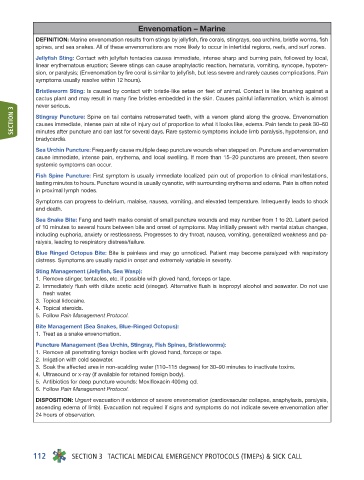
Envenomation – Marine
         DEFINITION: Marine envenomation results from stings by jellyfish, fire corals, stingrays, sea urchins, bristle worms, fish
         spines, and sea snakes. All of these envenomations are more likely to occur in intertidal regions, reefs, and surf zones.
         Jellyfish Sting: Contact with jellyfish tentacles causes immediate, intense sharp and burning pain, followed by local,
         linear erythematous eruption; Severe stings can cause anaphylactic reaction, hematuria, vomiting, syncope, hypoten-
         sion, or paralysis; (Envenomation by fire coral is similar to jellyfish, but less severe and rarely causes complications. Pain
         symptoms usually resolve within 12 hours).
         Bristleworm Sting: Is caused by contact with bristle-like setae on feet of animal. Contact is like brushing against a
         cactus plant and may result in many fine bristles embedded in the skin. Causes painful inflammation, which is almost
         never serious.
    SECTION 3  Stingray Puncture: Spine on tail contains retroserrated teeth, with a venom gland along the groove. Envenomation
         causes immediate, intense pain at site of injury out of proportion to what it looks like, edema. Pain tends to peak 30–60
         minutes after puncture and can last for several days. Rare systemic symptoms include limb paralysis, hypotension, and
         bradycardia.
         Sea Urchin Puncture: Frequently cause multiple deep puncture wounds when stepped on. Puncture and envenomation
         cause immediate, intense pain, erythema, and local swelling. If more than 15–20 punctures are present, then severe
         systemic symptoms can occur.
         Fish Spine Puncture: First symptom is usually immediate localized pain out of proportion to clinical manifestations,
         lasting minutes to hours. Puncture wound is usually cyanotic, with surrounding erythema and edema. Pain is often noted
         in proximal lymph nodes.
         Symptoms can progress to delirium, malaise, nausea, vomiting, and elevated temperature. Infrequently leads to shock
         and death.
         Sea Snake Bite: Fang and teeth marks consist of small puncture wounds and may number from 1 to 20. Latent period
         of 10 minutes to several hours between bite and onset of symptoms. May initially present with mental status changes,
         including euphoria, anxiety or restlessness. Progresses to dry throat, nausea, vomiting, generalized weakness and pa-
         ralysis, leading to respiratory distress/failure.
         Blue Ringed Octopus Bite: Bite is painless and may go unnoticed. Patient may become paralyzed with respiratory
         distress. Symptoms are usually rapid in onset and extremely variable in severity.
         Sting Management (Jellyfish, Sea Wasp):
         1.  Remove stinger, tentacles, etc. if possible with gloved hand, forceps or tape.
         2.  Immediately flush with dilute acetic acid (vinegar). Alternative flush is isopropyl alcohol and seawater. Do not use
          fresh water.
         3.  Topical lidocaine.
         4.  Topical steroids.
         5.  Follow Pain Management Protocol.
         Bite Management (Sea Snakes, Blue-Ringed Octopus):
         1.  Treat as a snake envenomation.
         Puncture Management (Sea Urchin, Stingray, Fish Spines, Bristleworms):
         1.  Remove all penetrating foreign bodies with gloved hand, forceps or tape.
         2.  Irrigation with cold seawater.
         3.  Soak the affected area in non-scalding water (110–115 degrees) for 30–90 minutes to inactivate toxins.
         4.  Ultrasound or x-ray (if available for retained foreign body).
         5.  Antibiotics for deep puncture wounds: Moxifloxacin 400mg qd.
         6.  Follow Pain Management Protocol.
         DISPOSITION: Urgent evacuation if evidence of severe envenomation (cardiovascular collapse, anaphylaxis, paralysis,
         ascending edema of limb). Evacuation not required if signs and symptoms do not indicate severe envenomation after
         24 hours of observation.


        112      SECTION 3   TACTICAL MEDICAL EMERGENCY PROTOCOLS (TMEPs) & SICK CALL

