


Page 132 - 2022 Ranger Medic Handbook
P. 132
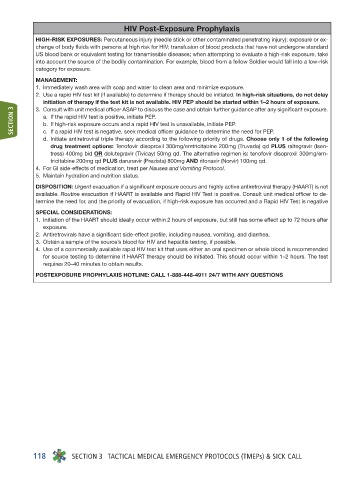
HIV Post-Exposure Prophylaxis
         HIGH-RISK EXPOSURES: Percutaneous injury (needle stick or other contaminated penetrating injury); exposure or ex-
         change of body fluids with persons at high risk for HIV; transfusion of blood products that have not undergone standard
         US blood bank or equivalent testing for transmissible diseases; when attempting to evaluate a high-risk exposure, take
         into account the source of the bodily contamination. For example, blood from a fellow Soldier would fall into a low-risk
         category for exposure.
         MANAGEMENT:
         1.  Immediately wash area with soap and water to clean area and minimize exposure.
         2.  Use a rapid HIV test kit (if available) to determine if therapy should be initiated. In high-risk situations, do not delay
          initiation of therapy if the test kit is not available. HIV PEP should be started within 1–2 hours of exposure.
         3.  Consult with unit medical officer ASAP to discuss the case and obtain further guidance after any significant exposure.
    SECTION 3  a.  If the rapid HIV test is positive, initiate PEP.
          b.  If high-risk exposure occurs and a rapid HIV test is unavailable, initiate PEP.
          c.  If a rapid HIV test is negative, seek medical officer guidance to determine the need for PEP.
          d.  Initiate antiretroviral triple therapy according to the following priority of drugs. Choose only 1 of the following
            drug treatment options: Tenofovir disoproxil 300mg/emtricitabine 200mg (Truvada) qd PLUS raltegravir (Isen-
            tress) 400mg bid OR dolutegravir (Tivicay) 50mg qd. The alternative regimen is: tenofovir disoproxil 300mg/em-
            tricitabine 200mg qd PLUS darunavir (Prezista) 800mg AND ritonavir (Norvir) 100mg qd.
         4.  For GI side-effects of medication, treat per Nausea and Vomiting Protocol.
         5.  Maintain hydration and nutrition status.
         DISPOSITION: Urgent evacuation if a significant exposure occurs and highly active antiretroviral therapy (HAART) is not
         available. Routine evacuation if HAART is available and Rapid HIV Test is positive. Consult unit medical officer to de-
         termine the need for, and the priority of evacuation, if high-risk exposure has occurred and a Rapid HIV Test is negative
         SPECIAL CONSIDERATIONS:
         1.  Initiation of the HAART should ideally occur within 2 hours of exposure, but still has some effect up to 72 hours after
          exposure.
         2.  Antiretrovirals have a significant side-effect profile, including nausea, vomiting, and diarrhea.
         3.  Obtain a sample of the source’s blood for HIV and hepatitis testing, if possible.
         4.  Use of a commercially available rapid HIV test kit that uses either an oral specimen or whole blood is recommended
          for source testing to determine if HAART therapy should be initiated. This should occur within 1–2 hours. The test
          requires 20–40 minutes to obtain results.
         POSTEXPOSURE PROPHYLAXIS HOTLINE: CALL 1-888-448-4911 24/7 WITH ANY QUESTIONS


        118      SECTION 3   TACTICAL MEDICAL EMERGENCY PROTOCOLS (TMEPs) & SICK CALL

