


Page 116 - 2022 Ranger Medic Handbook
P. 116
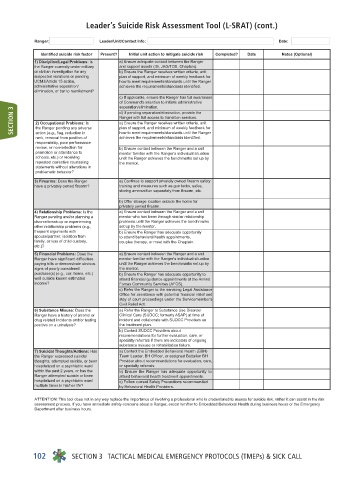
Leader’s Suicide Risk Assessment Tool (L-SRAT) (cont.)
                             LEADER'S SUICIDE RISK ASSESSMENT TOOL (L-SRAT)
         Ranger:       Leader/Unit/Contact Info:              Date:
          Identified suicide risk factor  Present?  Initial unit action to mitigate suicide risk  Completed?  Date  Notes (Optional)
         1) Discipline/Legal Problems: Is   a) Ensure adequate contact between the Ranger
         the Ranger currently under military   and support assets (IG, JAG/TDS, Chaplain).
         or civilian investigation for any   b) Ensure the Ranger receives written criteria, unit
         suspected violations or pending   plan of support, and minimum of weekly feedback for
         UCMJ/Article 15 action,   how to meet requirements/standards until the Ranger
         administrative separation/  achieves the requirements/standards identified.
         elimination, or bar to reenlistment?
                           c) If applicable, ensure the Ranger has full awareness
                           of Command's intention to initiate administrative
                           separation/elimination.
    SECTION 3  2) Occupational Problems: Is   d) If pending separation/elimination, provide the
                           Ranger with full access to transition services.
                           a) Ensure the Ranger receives written criteria, unit
         the Ranger pending any adverse
                           plan of support, and minimum of weekly feedback for
         action (e.g., flag, reduction in
         rank, removal from position of   how to meet requirements/standards until the Ranger
                           achieves the requirements/standards identified.
         responsibility, poor performance
         review, or non-selection for   b) Ensure contact between the Ranger and a unit
         promotion or attendance to   mentor familiar with the Ranger’s individual situation
         schools, etc.) or receiving   until the Ranger achieves the benchmarks set up by
         repeated corrective counseling   the mentor.
         statements without alterations in
         problematic behavior?
         3) Firearms: Does the Ranger   a) Continue to support privately owned firearm safety
         have a privately owned firearm?  training and measures such as gun locks, safes,
                           storing ammunition separately from firearm, etc.
                           b) Offer storage location outside the home for
                           privately owned firearm.
         4) Relationship Problems: Is the   a) Ensure contact between the Ranger and a unit
         Ranger pending and/or planning a   mentor who has been through similar relationship
         divorce/break-up or experiencing   problems until the Ranger achieves the benchmarks
         other relationship problems (e.g.,   set up by the mentor.
         frequent arguments with   b) Ensure the Ranger has adequate opportunity
         spouse/partner, isolation from   to attend behavioral health appointments,
         family, or loss of child custody,   couples therapy, or meet with the Chaplain.
         etc.)?
         5) Financial Problems: Does the   a) Ensure contact between the Ranger and a unit
         Ranger have significant difficulties   mentor familiar with the Ranger’s individual situation
         paying bills or demonstrate obvious   until the Ranger achieves the benchmarks set up by
         signs of poorly considered   the mentor.
         purchase(s) (e.g., car, home, etc.)   b) Ensure the Ranger has adequate opportunity to
         well outside known estimated   attend financial guidance appointments at the Armed
         income?           Forces Community Services (AFCS).
                           c) Refer the Ranger to the servicing Legal Assistance
                           Office for assistance with potential financial relief and
                           stay of court proceedings under the Servicemember's
                           Civil Relief Act.
         6) Substance Misuse: Does the   a) Refer the Ranger to Substance Use Disorder
         Ranger have a history of alcohol or   Clinical Care (SUDCC; formerly ASAP) at time of
         drug related incidents and/or testing   incident and collaborate with SUDCC Providers on
         positive on a urinalysis?  the treatment plan.
                           b) Contact SUDCC Providers about
                           recommendations for further evaluation, care, or
                           specialty referrals if there are indicators of ongoing
                           substance misuse or rehabilitation failure.
         7) Suicidal Thoughts/Actions: Has   a) Contact the Embedded Behavioral Health (EBH)
         the Ranger expressed suicidal   Team Leader, BH Officer, or assigned Battalion BH
         thoughts, attempted suicide, or been   Provider about recommendations for evaluation, care,
         hospitalized on a psychiatric ward   or specialty referrals.
         within the past 2 years, or has the   b) Ensure  the  Ranger  has  adequate  opportunity  to
         Ranger attempted suicide or been   attend behavioral health treatment appointments.
         hospitalized on a psychiatric ward   c) Follow current Safety Precautions recommended
         multiple times in his/her life?  by Behavioral Health Providers.
         ATTENTION: This tool does not in any way replace the importance of involving a professional who is credentialed to assess for suicide risk, rather it can assist in the risk
         assessment process. If you have immediate safety concerns about a Ranger, escort him/her to Embedded Behavioral Health during business hours or the Emergency
         Department after business hours.
                                                                  Version: 20160925
        102      SECTION 3   TACTICAL MEDICAL EMERGENCY PROTOCOLS (TMEPs) & SICK CALL

