


Page 120 - 2022 Ranger Medic Handbook
P. 120
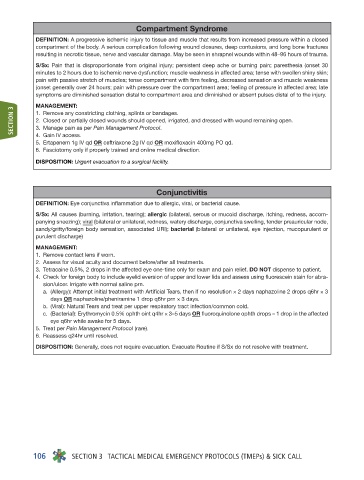
Compartment Syndrome
         DEFINITION: A progressive ischemic injury to tissue and muscle that results from increased pressure within a closed
         compartment of the body. A serious complication following wound closures, deep contusions, and long bone fractures
         resulting in necrotic tissue, nerve and vascular damage. May be seen in shrapnel wounds within 48–96 hours of trauma.
         S/Sx: Pain that is disproportionate from original injury; persistent deep ache or burning pain; paresthesia (onset 30
         minutes to 2 hours due to ischemic nerve dysfunction; muscle weakness in affected area; tense with swollen shiny skin;
         pain with passive stretch of muscles; tense compartment with firm feeling, decreased sensation and muscle weakness
         (onset generally over 24 hours; pain with pressure over the compartment area; feeling of pressure in affected area; late
         symptoms are diminished sensation distal to compartment area and diminished or absent pulses distal of to the injury.
         MANAGEMENT:
    SECTION 3  2.  Closed or partially closed wounds should opened, irrigated, and dressed with wound remaining open.
         1.  Remove any constricting clothing, splints or bandages.
         3.  Manage pain as per Pain Management Protocol.
         4.  Gain IV access.
         5.  Ertapenem 1g IV qd OR ceftriaxone 2g IV qd OR moxifloxacin 400mg PO qd.
         6.  Fasciotomy only if properly trained and online medical direction.
         DISPOSITION: Urgent evacuation to a surgical facility.


                                   Conjunctivitis
         DEFINITION: Eye conjunctiva inflammation due to allergic, viral, or bacterial cause.
         S/Sx: All causes (burning, irritation, tearing); allergic (bilateral, serous or mucoid discharge, itching, redness, accom-
         panying sneezing); viral (bilateral or unilateral, redness, watery discharge, conjunctiva swelling, tender preauricular node,
         sandy/gritty/foreign body sensation, associated URI); bacterial (bilateral or unilateral, eye injection, mucopurulent or
         purulent discharge)
         MANAGEMENT:
         1.  Remove contact lens if worn.
         2.  Assess for visual acuity and document before/after all treatments.
         3.  Tetracaine 0.5%, 2 drops in the affected eye one-time only for exam and pain relief. DO NOT dispense to patient.
         4.  Check for foreign body to include eyelid eversion of upper and lower lids and assess using fluorescein stain for abra-
          sion/ulcer. Irrigate with normal saline prn.
          a.  (Allergy): Attempt initial treatment with Artificial Tears, then if no resolution × 2 days naphazoline 2 drops q6hr × 3
            days OR naphazoline/pheniramine 1 drop q6hr prn × 3 days.
          b.  (Viral): Natural Tears and treat per upper respiratory tract infection/common cold.
          c.  (Bacterial): Erythromycin 0.5% ophth oint q4hr × 3–5 days OR fluoroquinolone ophth drops – 1 drop in the affected
            eye q6hr while awake for 5 days.
         5.  Treat per Pain Management Protocol (rare).
         6.  Reassess q24hr until resolved.
         DISPOSITION: Generally, does not require evacuation. Evacuate Routine if S/Sx do not resolve with treatment.


        106      SECTION 3   TACTICAL MEDICAL EMERGENCY PROTOCOLS (TMEPs) & SICK CALL

