


Page 112 - 2022 Ranger Medic Handbook
P. 112
Assessment & Management of Suicidal Risk (cont.)

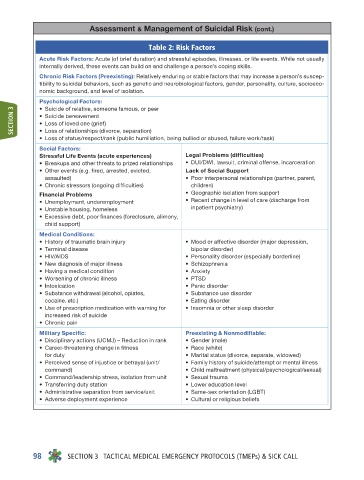
                                 Table 2: Risk Factors
          Acute Risk Factors: Acute (of brief duration) and stressful episodes, illnesses, or life events. While not usually
          internally derived, these events can build on and challenge a person’s coping skills.
          Chronic Risk Factors (Preexisting): Relatively enduring or stable factors that may increase a person’s suscep-
          tibility to suicidal behaviors, such as genetic and neurobiological factors, gender, personality, culture, socioeco-
          nomic background, and level of isolation.
          Psychological Factors:
          •  Suicide of relative, someone famous, or peer
    SECTION 3  •  Suicide bereavement
          •  Loss of loved one (grief)
          •  Loss of relationships (divorce, separation)
          •  Loss of status/respect/rank (public humiliation, being bullied or abused, failure work/task)
          Social Factors:
          Stressful Life Events (acute experiences)  Legal Problems (difficulties)
          •  Breakups and other threats to prized relationships  •  DUI/DWI, lawsuit, criminal offense, incarceration
          •  Other events (e.g. fired, arrested, evicted,   Lack of Social Support
           assaulted)                    •  Poor interpersonal relationships (partner, parent,
          •  Chronic stressors (ongoing difficulties)  children)
          Financial Problems             •  Geographic isolation from support
          •  Unemployment, underemployment  •  Recent change in level of care (discharge from
          •  Unstable housing, homeless    inpatient psychiatry)
          •  Excessive debt, poor finances (foreclosure, alimony,
           child support)
          Medical Conditions:
          •  History of traumatic brain injury  •  Mood or affective disorder (major depression,
          •  Terminal disease              bipolar disorder)
          •  HIV/AIDS                    •  Personality disorder (especially borderline)
          •  New diagnosis of major illness  •  Schizophrenia
          •  Having a medical condition  •  Anxiety
          •  Worsening of chronic illness  •  PTSD
          •  Intoxication                •  Panic disorder
          •  Substance withdrawal (alcohol, opiates,    •  Substance use disorder
           cocaine, etc.)                •  Eating disorder
          •  Use of prescription medication with warning for   •  Insomnia or other sleep disorder
           increased risk of suicide
          •  Chronic pain
          Military Specific:             Preexisting & Nonmodifiable:
          •  Disciplinary actions (UCMJ) – Reduction in rank  •  Gender (male)
          •  Career-threatening change in fitness    •  Race (white)
           for duty                      •  Marital status (divorce, separate, widowed)
          •  Perceived sense of injustice or betrayal (unit/  •  Family history of suicide/attempt or mental illness
           command)                      •  Child maltreatment (physical/psychological/sexual)
          •  Command/leadership stress, isolation from unit  •  Sexual trauma
          •  Transferring duty station   •  Lower education level
          •  Administrative separation from service/unit  •  Same-sex orientation (LGBT)
          •  Adverse deployment experience  •  Cultural or religious beliefs


        98      SECTION 3   TACTICAL MEDICAL EMERGENCY PROTOCOLS (TMEPs) & SICK CALL

