


Page 63 - JSOM Fall 2025
P. 63
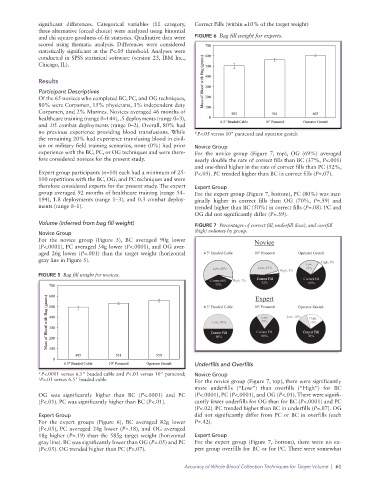
FIGURE 4  Operator gestalt method.


                                 FIGURE 2  6.5" Beaded cable
                                 method.
                                 Note: Prior to initiating the fill, the
                                 BC tie is wrapped around the mid-
                                 line (middle) of the donor bag and
                                 secured like a common zip tie. The
                                 pre-marking ensures that the BC is
                                 secured at 6.5" As the bag fills, it
                                 forms an hourglass shape.


          10" Paracord
          For the PC method, a flexible 10" PC is periodically wrapped   Note: Two cues inform the user when collection is complete: First,
          around the midline (belly) of the collection bag without apply-  observed dimpling of the bag liner when the bag is laid flat (LEFT).
          ing pull or compression pressure. In this way, PC is a passive   Second, when the bag is held up, an air-fluid level is above the corners
          (non-restrictive) method for determining bag fills (in contrast   of the bag (RIGHT).
          to the BC method, which actively restricts bag fills). The inter-
          val between assessments is determined by the operator, rather   6.  The participant indicated that the blood bag was appropri-
          than predefined time periods, as fill rates vary greatly between   ately filled by clamping off the tube with the kit hemostat.
          donors. The collection is complete when the PC ends meet   7.  The blood bag was placed on the digital scale by the Valky-
          without overlap  (Figure 3). The PC is the collection method   rie course instructor, and the weight was recorded.
                      16
          recommended in Emergency War Surgery, 5th Edition.
                                                             Following each donation, the volunteer moved from the chair
                                                             to a supine position on the ground for transfusion as the next
                                                             step in Valkyrie training. Donations that exceeded 36 minutes
                                                             were coded as failures per course requirements, as were fail-
          FIGURE 3  10" paracord method.
                                                             ures to draw or fill the donor bag. Such failure cases were
                                                             excluded from the analysis.
          Note:  A flexible 10" paracord is
          periodically wrapped around the
          midline (belly) of the collection bag              Steps 1–7 were repeated for the remaining techniques, so that
          without applying pull or compres-                  each participant applied BC, PC, and OG in a randomized se-
          sion pressure. The collection is com-              quence. Participants completed an exit survey after completing
          plete when the paracord ends meet                  all three rounds of data collection.
          without overlap.
                                                             Measured Variables
                                                             The primary outcome variable of fill category (correct fill,
          Operator Gestalt                                   underfill, overfill) was based on blood volume. Blood volume
          The OG method is purely visual. Two cues inform the user   was not directly measured but was inferred from the direct
          when collection is complete: First, observed dimpling of the   measurement of the mass (weight) of the blood and the blood
          bag liner when the bag is laid flat (Figure 4, left), and second,   bag. The blood bag weighs 112g, and 450mL of blood weighs
          when the bag is held up, an air-fluid level above the corners of   473g, giving a total target weight of 585g (473g+112g). Ap-
          the bag 17,18  (Figure 4, right).                  plying the ±10% tolerance results in an acceptable range of
                                                             526.5–643.5g. Attempts were scored as correct fills (526.5–
                                                             643.5g), underfills (<526.5g), or overfills (>643.5g). As men-
          Data Collection                                    tioned in the Discussion, it is not known whether the underfill
          Station Preparation                                or overfill levels observed here would lead to adverse patient
          Each station was prepared with one chair, one digital scale,   outcomes; therefore, these findings should be interpreted as
          and  one  Valkyrie  LTOWB  Whole  Blood  Administration  Set   accuracy measures rather than direct indicators of clinical risk.
          (Figure 1). Each station included one volunteer donor, one su-
          perviser and a standardized data collection sheet.  Surveys included: demographics and ratings of confidence (1
                                                             to 5 scale); accuracy, ease of use, and use in the real world
          Data Collection Steps                              (three alternative forced choice); use in a combat zone (reluc-
          1.  The volunteer was seated in the station chair, adjacent to a   tantly = 1, willingly = 2, eagerly = 3); and open-ended items.
            digital scale.
          2.  The participant was informed which technique they would   Design and Analysis
            use on that round.                               This study employed a within-subjects design in that each par-
          3.  The  participant  retrieved  the  blood  bag  kit  from  their   ticipant applied the BC, PC, and OG techniques in a random-
            backpack.                                        ized order using a mirrored Latin square.
          4.  The participant acquired venous access at the antecubital
            vein site of the volunteer’s preferred arm.      Scaled measures (blood volume, user ratings) were analyzed us-
          5.  The participant monitored the blood fill.      ing ANOVA, with pairwise comparisons to localize statistically

          60  |  JSOM   Volume 25, Edition 3 / Fall 2025

