


Page 62 - JSOM Fall 2025
P. 62
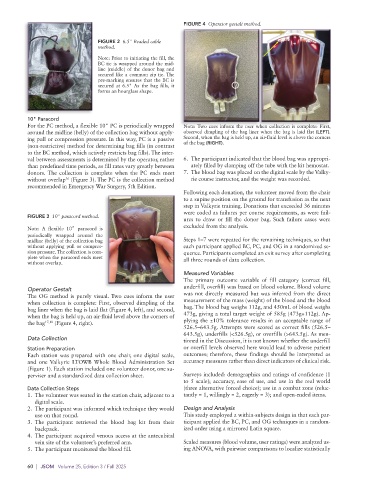
a pre-marked heavyweight zip tie that is secured around the   ruptured lines), particularly among novices. Because the purpose
              middle of the blood bag prior to donation to actively restrict   of this study was to contrast BC, PC, and OG techniques in a
              the total volume. For the PC method, the user uses the 10"   within-subjects design, only novices with complete data (for BC,
              length as a flexible ruler by periodically wrapping the PC   PC, and OG) were included in the analysis (65 of 104, 63%).
              around the belly of the donor bag until the ends of the PC
              meet. The OG method involves periodic bag inspection; the   Expert group participants (n=10) were certified  Valkyrie
              bag is considered filled when the corners dimple with the bag   course instructors. All were Fleet Marine Force Corpsmen and
              flat, and when held up, the air-fluid line is above the corners   Combat Trauma Management Instructors who were screened
              of the bag. Currently, no technique is preferred over another in   and hand-selected by the Navy Education and Training Office.
              Valkyrie training, and the choice of which technique to employ   Each then completed the extensive Valkyrie training progres-
              in operational environments is operator-dependent, largely be-  sion to become a certified instructor. All 10 experts completed
              cause it is unclear which technique is superior in filling blood   BC, PC, and OG techniques without failure and were therefore
              bags to the target volume.                         included in the analysis.

              Therefore, to fill this important knowledge gap and towards   Materials
              preserving the life of the traumatically wounded warfighter in
              need of safe WBB donation, the objective of this study was to   Blood Draw Kit
              contrast BC, PC, and OG techniques in volume (mass), correct   Components of the single-use Valkyrie LTOWB Whole Blood
              fills (to 585g ±10%), underfills, and overfills, as well as user   Administration Set are displayed in Figure 1.  The compo-
              ratings and assessments in both novice and expert groups.  nents were provided by Combat Medical (Harrisburg, NC).
                                                                 This kit was created at the request of Dr. Wier and the 1st
                                                                   Marine  Division in 2019 as a cost-saving measure, providing a
              Methods
                                                                 comprehensive one-stop kit for handling FWB in the field. As
              Setting and Sample                                 shown, it includes record cards and labels, hemostat, isopropyl
              Study data were collected in an outdoor setting at Marine   alcohol prep pads, a 450mL bag containing 63mL of Citrate
              Corps Base Camp Pendleton, California.  This study was   Phosphate Dextrose anticoagulant, an integrated draw needle,
              granted exempt status as a process-improvement project by   and blood tubing with an in-line filter. Note that the 10" PC
              the Clinical Investigation Department and Institutional Review   and beaded cable are labeled near the top-center of Figure 1.
              Board of Naval Medical Center San Diego, San Diego, Cal-
              ifornia (Reference CIP# NMCSD-PI-2022-04-28).  Approval   Beaded Cable
              for public release was granted by the Public Affairs Office at   BC is designed to actively restrict the total volume collected
              Naval Medical Center San Diego and the 1st Marine Division.  from the donor to one unit. Prior to initiating the fill, the BC
                                                                 tie is wrapped around the midline (middle) of the donor bag
              Novice group participants (n=65) were individuals who were   and secured like a common zip tie. The pre-marking (indicated
              not previously qualified in conducting prehospital whole blood   by the arrow, top-center of Figure 1) ensures that the BC is se-
              transfusions and were enrolled as students in one of three iter-  cured at 6.5.” In this context, the midline is determined by op-
              ations of Valkyrie between March and November 2022. Each   erator estimation. As the bag fills, it forms an hourglass shape
              novice was required to attempt blood draws using BC, PC, and   (Figure 2). Once the bag is no longer filling it is considered
              OG techniques. Blood draws sometimes fail for reasons unre-  complete. BC is the collection method recommended by the
              lated to bag volume measurement (e.g., intravenous access or   2017 Ranger Study. 14

              FIGURE 1  Equipment included in the Valkyrie Low-Titer O Whole Blood administration set.


              Note: LEFT IMAGE: LEFT TO RIGHT: Restriction band, 450cc donor bag with CDP anticoagulant (TOP ROW); clamp, gauze, blood Y-tubing with
              filter (MIDDLE ROW); test tubes, Eldon card, two alcohol swabs, elastic venous tourniquets, Tegaderm, two 18G catheters, chlorhexidine swab,
              gloves (BOTTOM ROW). RIGHT IMAGE: As packaged.

                                                             Accuracy of Whole Blood Collection Techniques for Target Volume  |  59

