


Page 26 - JSOM Summer 2025
P. 26
oxygen is not lost because, during expiration, it is channeled   the continuous O  flow from the NC secures gas cleaning in-
                                                                           2
          and trapped into the additional tubes of the system. As a result,   side the DTM trunks’ dead space.  This phenomenon could
          at the end of the expiration, a complementary O  volume equiv-  minimize the risk of CO  re-inhalation. The O  volume accu-
                                                                                                 2
                                                                                2
                                              2
          alent to the volume of the Trunks is captured inside. During   mulated in the DTM dead space equals the product of the O
                                                                                                            2
          the subsequent inhalation, the patient inhales the accumulated   flow rate and the expiratory time. Therefore, a low O  flow rate
                                                                                                     2
          O  volume in the additional tubes, supplementing the O  flow   and/or a short expiratory time could limit the CO  cleaning in
                                                                                                    2
           2
                                                     2
          originating from the NC (Figure 3). Consequently, compared   the DTM trunks. The trunk’s length must be adapted to the
          to NC, the FIO  is increased when the DTM is associated    patient’s size (20cm for an adult height 180cm and 10cm for
                       2
          with the NC.                                       an adult 160cm height). Further, clinical and blood gas status
                                                             must be reevaluated regularly, especially if the patient’s con-
          The DTM performs better with higher O  flow rates (the maxi-  sciousness deteriorates.  The temperature difference between
                                         2
          mum O  flow rate is 6L per minute [LPM], in theory) and long   exhaled air (±36°C) and atmospheric air (±21°C) creates a
                2
          expiratory times.                                  thermal transfer by conduction (according to Fourier’s law of
                                                             physics), facilitating CO  removal from the DTM.  Inevitable
                                                                                                    30
                                                                                2
          One trunk length of 15–20cm is needed for an adult of ap-  air leaks around the mask allow CO  to escape, limiting its ac-
                                                                                         2
          proximately 175cm tall. The minimal O  flow rate is usually   cumulation inside the mask. The CO  concentration difference
                                                                                         2
                                          2
          around 2LPM, with a theoretical maximum limit of 6LPM   between the inside of the mask (±5%) and the atmospheric air
          O . 19–24  In situations with limited reserves, the DTM can help   (0.03%) also contributes to an exponential dilution effect of
           2
          spare O  for the same target FIO  value. 16,17     CO  in the immediate surrounding atmosphere of the DTM.
                2                  2                            2
                                                             Several studies, including with COPD patients, confirmed the
                                                             very low CO  re-inhalation rate with DTM. 16,28,29
          Discussion                                                   2
          This literature review found that DTM enhanced O  volume   Advantages and Disadvantages of DTM
                                                   2
          with reduced O loss and higher pulmonary O  diffusion rates   The advantages of DTM can be summarized as follows:
                      2
                                              2
          (Table 1).
                                                             •  Even after the removal of the DTM, O  continues to be
                                                                                               2
          Controlling Oxygen Delivery                          delivered via the NC.
          Oxygen is a potent medication, but inadequate dosage can be   •  The patient can receive aerosol therapy simultaneously with
          deleterious, while higher dosage can lead to severe complica-  oxygen therapy.
          tions. In certain chronic respiratory conditions, oxygen supple-  •  Using an aerosol mask as the basic structure of the DTM
          mentation can unexpectedly cause some degree of hypercapnia,   prevents the need to create openings in the sides of the
                                                   25
          although the clinical significance of this is uncertain.  Exces-  mask, as is the case with an NRM, thus avoiding the po-
          sive O  administration can cause coronary vasoconstriction,   tential risk of injury for the healthcare professional from
               2
          with the possible complication of acute heart failure. 26,27  An   cutting the mask with scissors.
          O  surplus may increase systemic vascular resistance, poten-
           2
          tially enhancing the right ventricular afterload and reducing   The disadvantage of the DTM is that sometimes the trunks are
          the cardiac output. 26                             inserted too far into the holes of the mask; as a result, small
                                                             wounds may appear on the nose.
          Minimizing Elevated PaCO  Values
                                2
          Compared to classical oxygen systems, DTM has been shown   Perspectives and Future Studies
          to provide high levels of oxygenation while minimizing the   Complementary efficacy and safety studies of the DTM are
          risk of elevated PaCO  (only a few mmHg) despite its substan-  needed. First, regarding the appropriate settings of use, addi-
                           2
          tial dead space (approximately 250mL in adults for the mask   tional evidence must be generated with a particular interest
          and trunks). 16,28,29                              in trauma casualties in a prehospital setting. Second, the use
                                                             of DTM in specific penetrating, blunt, or blast lung traumas
          This very low rate of CO  re-inhalation can be explained by   should be investigated.  Third, complementary studies and
                              2
          several concomitant mechanisms. During the expiratory phase,   trials should be conducted with specific patient populations,
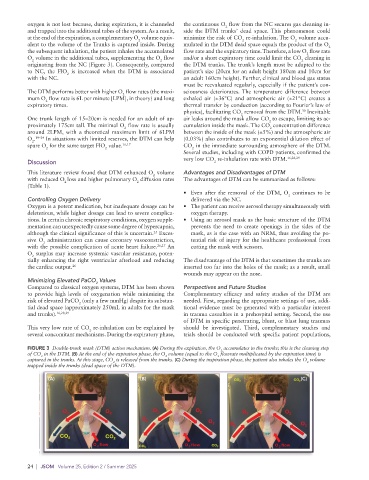
          FIGURE 3  Double-trunk mask (DTM) action mechanism. (A) During the expiration, the O  accumulates in the trunks; this is the cleaning step
                                                                         2
          of CO  in the DTM. (B) At the end of the expiration phase, the O  volume (equal to the O  flowrate multiplicated by the expiration time) is
              2
                                                                        2
                                                       2
          captured in the trunks. At this stage, CO  is released from the trunks. (C) During the inspiration phase, the patient also inhales the O  volume
                                                                                                     2
                                      2
          trapped inside the trunks (dead space of the DTM).
                 (A)                           (B)                                                 (C)


          24  |  JSOM   Volume 25, Edition 2 / Summer 2025

