


Page 15 - JSOM Summer 2025
P. 15
donated blood in the past 60 days. For the purposes of this   and ultimately reached and held a temperature of 5.4°C from
              study, no blood typing was performed, TTDs were assessed   1100–1500hrs on 31 October 2024 using a APRU 6L Auton-
              for using only MODs and Genesis (EMR) screening, and there   omous Portable Refrigeration Unit (Delta Development Team,
              was never a planned protocol for this blood to be transfused   Tucson, AZ). Unit 3 was held in the APRU for the duration
              autologously or otherwise.                         of testing at a constant temperature between 4.1 and 4.7°C.
                                                                 On day 1 of testing, all temperatures were recorded every hour
              Using a standard 18Gx1 ¼ safety IV catheter and saline lock,   from 1100 until 1500hrs ensuring all units reached the appro-
              3 units of FWB were drawn from the three subjects. Blood was   priate storage range. On each following day, all temperatures
              collected  and  stored  in  Fenwal  Blood-Pack  Unit  bags.  Each   were recorded at 0800, 1300, and 1500hrs. When unit 1 was
              unit consists of a primary container with 63mL of citrate-   taken out for training, it was placed in the BloodBoxx and
              phosphate-dextrose (CPD) solution containing 1.66g sodium   monitored every hour on the hour until it was returned to the
              citrate (dihydrate) USP, 1.61g dextrose (monohydrate) USP,   SO-LOW refrigerator. Data were collected on all units to in-
              188mg citric acid (anhydrous) USP, 140mg monobasic sodium   clude temperature, times, and methods of storage. Additionally,
              phosphate (monohydrate) USP (lot number FM24B20022   the APRU inherently records and reports internal temperature
              EXP Date 27 February). The alkalinity of pH may have been   continuously, including if power is lost, indicating that the unit
              adjusted with sodium hydroxide. Each collection bag was   is no longer at the desired temperature range.
              filled to between 440–450mL weighed on a digital scale (Tay-
              lor, Oak Brook, IL) at the time of collection. Each unit was   Results
              drawn at 1020hrs on 31 October 2024 and put into one of
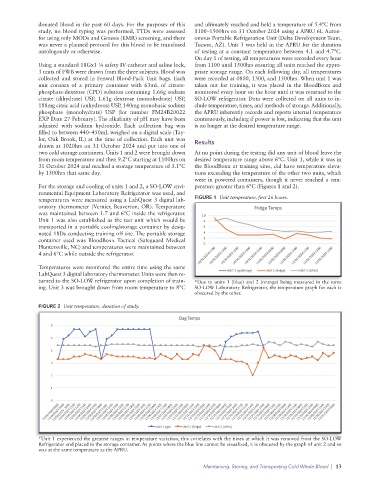
              two cold storage containers. Units 1 and 2 were brought down   At no point during the testing did any unit of blood leave the
              from room temperature and then 9.2°C starting at 1100hrs on   desired temperature range above 6°C. Unit 1, while it was in
              31 October 2024 and reached a storage temperature of 3.1°C   the BloodBoxx at training sites, did have temperature eleva-
              by 1500hrs that same day.                          tions exceeding the temperature of the other two units, which
                                                                 were in powered containers, though it never reached a tem-
              For the storage and cooling of units 1 and 2, a SO-LOW envi-  perature greater than 6°C (Figures 1 and 2).
              ronmental Equipment Laboratory Refrigerator was used, and
              temperatures were measured using a LabQuest 3 digital lab-  FIGURE 1  Unit temperature, first 26 hours.
              oratory thermometer (Vernier, Beaverton, OR). Temperature
              was maintained between 1.7 and 6°C inside the refrigerator.
              Unit 1 was also established as the test unit which would be
              transported in a portable cooling/storage container by desig-
              nated 18Ds conducting training off site. The portable storage
              container used was BloodBoxx Tactical (Safeguard Medical
              Huntersville, NC) and temperatures were maintained between
              4 and 6°C while outside the refrigerator.

              Temperatures were monitored the entire time using the same
              LabQuest 3 digital laboratory thermometer. Units were then re-
              turned to the SO-LOW refrigerator upon completion of train-  *Due to units 1 (blue) and 2 (orange) being measured in the same
              ing. Unit 3 was brought down from room temperature to 8°C   SO-LOW Laboratory Refrigerator, the temperature graph for each is
                                                                 obscured by the other.

              FIGURE 2  Unit temperature, duration of study.


              *Unit 1 experienced the greatest ranges in temperature variation, this correlates with the times at which it was removed from the SO-LOW
              Refrigerator and placed in the storage container. At points where the blue line cannot be visualized, it is obscured by the graph of unit 2 and so
              was at the same temperature as the APRU.

                                                                   Maintaining, Storing, and Transporting Cold Whole Blood  |  13

