


Page 10 - JSOM Summer 2025
P. 10
FEATURE ARTICLES                                   described diagnostic applications, while 44% pertained to proce-
          In Cold Blood: A Feasibility Study on Maintaining, Storing,   dural applications. Based on these findings, the author concludes
          and Transporting Cold Whole Blood by a Special Forces Unit:   that ultrasound education for Special Operation medics should
          Danell and colleagues conducted a feasibility study (n=3) to deter-  align with the unique mission requirements of individual units,
          mine whether a Special Forces Battalion would be able to main-  with an increased emphasis on procedure-based training.
          tain, store, and transport FDA-approved cold-stored whole blood
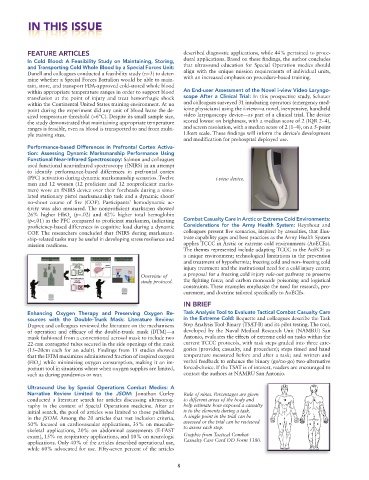
          within appropriate temperature ranges in order to support blood   An End-user Assessment of the Novel i-view Video Laryngo-
          transfusion at the point of injury and treat hemorrhagic shock   scope After a Clinical Trial: In this prospective study, Schauer
          within the Continental United States training environment. At no   and colleagues surveyed 31 intubating operators (emergency med-
          point during the experiment did any unit of blood leave the de-  icine physicians) using the i-view—a novel, inexpensive, handheld
          sired temperature threshold (>6°C). Despite its small sample size,   video laryngoscopy device—as part of a clinical trial. The device
          the study demonstrated that maintaining appropriate temperature   scored lowest on brightness, with a median score of 2 (IQR 2–4),
          ranges is feasible, even as blood is transported to and from multi-  and screen resolution, with a median score of 2 (1–4), on a 5-point
          ple training sites.                                Likert scale. These findings will inform the device’s development
                                                             and modification for prehospital deployed use.
          Performance-based Differences in Prefrontal Cortex Activa-
          tion:  Assessing Dynamic Marksmanship  Performance Using
          Functional Near-Infrared Spectroscopy: Salmon and colleagues
          used functional near-infrared spectroscopy (fNIRS) in an attempt
          to identify performance-based differences in prefrontal cortex
          (PFC) activation during dynamic marksmanship scenarios. Twelve   i-view device.
          men and 12 women (12 proficient and 12 nonproficient marks-
          men) wore an fNIRS device over their foreheads during a simu-
          lated stationary pistol marksmanship task and a dynamic shoot/
          no-shoot course of fire (COF). Participants’ hemodynamic ac-
          tivity was also measured. The nonproficient marksmen showed
          26% higher HbO  (p=.02) and 42% higher total hemoglobin
                        2
          (p<.01) in the PFC compared to proficient marksmen, indicating   Combat Casualty Care in Arctic or Extreme Cold Environments:
            proficiency-based differences in cognitive load during a dynamic   Considerations for the Army  Health System:  Reynhout and
          COF. The researchers concluded that fNIRS during marksman-  colleagues present five scenarios, inspired by casualties, that illus-
          ship-related tasks may be useful in developing stress resilience and   trate capability gaps and best practices as the Army Health System
          mission readiness.                                 applies TCCC in Arctic or extreme cold environments (AoECEs).
                                                             The themes represented include adapting TCCC to the AoECE as
                                                             a unique environment; technological limitations in the prevention
                                                             and treatment of hypothermia; freezing cold and non–freezing cold
                                                             injury treatment and the institutional need for a cold injury center;
                                               Overview of   a proposal for a freezing cold injury rule-out pathway to preserve
                                               study protocol.  the fighting force; and carbon monoxide poisoning and logistical
                                                             constraints. These examples emphasize the need for research, pro-
                                                             curement, and doctrine tailored specifically to AoECEs.
                                                             IN BRIEF
          Enhancing  Oxygen  Therapy  and  Preserving  Oxygen  Re-  Task Analysis Tool to Evaluate Tactical Combat Casualty Care
          sources with the Double-Trunk Mask: Literature Review:   in the Extreme Cold: Bequette and colleagues describe the Task
          Duprez and colleagues reviewed the literature on the mechanisms   Step Analysis Tool-Binary (TSAT-B) and its pilot testing. The tool,
          of operation and efficacy of the double-trunk mask (DTM)—a   developed by the Naval Medical Research Unit (NAMRU) San
          mask fashioned from a conventional aerosol mask to include two   Antonio, evaluates the effects of extreme cold on tasks within the
          22-mm corrugated tubes secured in the side openings of the mask   current TCCC protocols, with task steps graded into three cate-
          (15–20cm each for an adult). Findings from 15 studies showed   gories (provider, casualty, and procedure); steps timed and hand
          that the DTM maximizes administered fraction of inspired oxygen   temperature measured before and after a task; and written and
          (FIO ) while minimizing oxygen consumption, making it an im-  verbal feedback to enhance the binary (go/no-go) two-alternative
             2
          portant tool in situations where when oxygen supplies are limited,   forced-choice. If the TSAT is of interest, readers are encouraged to
          such as during pandemics or war.                   contact the authors at NAMRU San Antonio.
          Ultrasound Use by Special Operations Combat Medics: A
          Narrative Review Limited to the  JSOM:  Jonathan Curley   Rule of nines. Percentages are given
          conducted a literature search for articles discussing ultrasonog-  to different areas of the body and
          raphy in the context of Special Operations medicine.  After an   help estimate how exposed a casualty
          initial search, the pool of articles was limited to those published   is to the elements during a task.
          in the JSOM. Among the 20 articles that met inclusion criteria,   A single point in the trial can be
          50% focused on cardiovascular applications, 35% on musculo-  assessed or the trial can be reviewed
                                                             to assess each step.
          skeletal applications, 20% on abdominal assessments (E-FAST
          exam), 15% on respiratory applications, and 10% on neurologic   Graphic from Tactical Combat
          applications. Only 40% of the articles described operational use,   Casualty Care Card DD Form 1380.
          while 60% advocated for use. Fifty-seven percent of the articles

                                                           8

