


Page 11 - JSOM Summer 2025
P. 11
CASE REPORTS                                       PROLONGED CASUALTY CARE
              Use of an Intraoral Neuroprosthesis for the Treatment of   Maritime Applications of Prolonged Casualty Care: Drown-
              Posttraumatic Stress Disorder (PTSD)-Associated Nocturnal   ing and Hypothermia on an Amphibious Warship: Less and
              Behavior Disorder: Case Series of Four Patients: Moeller and   colleagues detail two hypothetical drowning and hypothermia pa-
              Davidson revisited four veterans treated with a custom-designed,   tient scenarios to present an innovative approach to teaching com-
              intraoral neuroprosthesis for disruptive nocturnal behaviors   plex operational medicine concepts, including the management of
              (DNBs) associated with PTSD / traumatic brain injury. Sleep part-  hypothermia and acute respiratory distress syndrome, as well as
              ners observed complete or near-complete resolution of DNBs in all   Prolonged Casualty Care to austere Role 1 maritime caregivers
              cases, while patients reported improvements in sleep quality, oral   using the Joint Trauma System PCC Clinical Practice Guidelines
              posture, temporomandibular joint conditions, rest, and overall   (CPGs) and other standard references.
              well-being. This device shows promise as a non-pharmacological
              intervention to enhance mission readiness and improve treatment   THERE I WAS
              compliance in PTSD-associated DNB.                 GWOT Lessons Learned: Metal in Africa: Cantong and col-
                                                                 leagues provide a first-hand account of how a medic managed the
              Undersea and Hyperbaric Medicine: Case Studies and Re-  care of a Special Forces Operator with a retained intra-articular
              view:  Day and colleagues present three cases of divers who   round from marksmanship during deployment to AFRICOM. The
              experienced different dive-related medical events: arterial gas   article focuses on lessons learned for optimal care and preserva-
              embolism; subconjunctival hemorrhage from barotrauma due to   tion of functional movement.
              mask squeeze; and middle ear barotrauma, with recovery compli-
              cated by migraine headaches, which had initially raised concerns   UNCONVENTIONAL MEDICINE
              for type II (neurogenic) decompression sickness. The authors stress   Proof of Concept: Is Small-scale Production of Diethyl Ether
              that, as the types and presentations of dive injuries are vast, it is   for Anesthetic Use Possible?: In this proof of concept study,
              particularly important for Special Operations providers to have a   Dhanjal and colleagues demonstrate how relatively pure diethyl
              general awareness of the causes, symptoms, and treatments for the   ether (Et O) can be produced and isolated on a small scale us-
                                                                       2
              most common and most severe dive injuries.         ing an acid-catalyzed dehydration reaction with fractional distil-
                                                                 lation. While further investigation is needed to ensure reliability
                                                                 and safety, this study offers initial insight into the small-scale pro-
                                                                 duction of Et O, a once used anesthetic agent, which may still be
                                                                          2
                                                                 useful in resource-limited settings, such as disasters, conflict, and
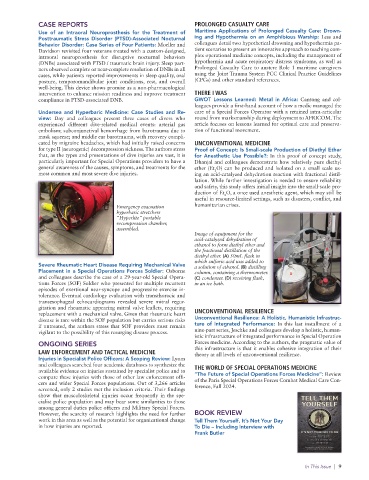
                                       Emergency evacuation      humanitarian crises.
                                       hyperbaric stretchers
                                       “Hyperlite” portable
                                       recompression chamber,
                                       assembled.
                                                                 Image of equipment for the
                                                                 acid-catalyzed dehydration of
                                                                 ethanol to form diethyl ether and
                                                                 the fractional distillation of the
                                                                 diethyl ether. (A) 50mL flask in
                                                                 which sulfuric acid was added to
              Severe Rheumatic Heart Disease Requiring Mechanical Valve   a solution of ethanol. (B) distilling
              Placement in a Special Operations Forces Soldier: Osborne   column, containing a thermometer.
              and colleagues describe the case of a 29-year-old Special Opera-  (C) condenser. (D) receiving flask,
              tions Forces (SOF) Soldier who presented for multiple recurrent   in an ice bath.
              episodes of exertional near-syncope and progressive exercise in-
              tolerance. Eventual cardiology evaluation with transthoracic and
              transesophageal echocardiograms revealed severe mitral regur-
              gitation and rheumatic appearing mitral valve leaflets, requiring   UNCONVENTIONAL RESILIENCE
              replacement with a mechanical valve. Given that rheumatic heart
              disease is rare within the SOF population but carries serious risks   Unconventional Resilience: A Holistic, Humanistic Infrastruc-
              if untreated, the authors stress that SOF providers must remain   ture of Integrated Performance:  In this last installment of a
              vigilant to the possibility of this resurging disease process.  nine-part series, Jeschke and colleagues develop a holistic, human-
                                                                 istic infrastructure of integrated performance in Special Operation
              ONGOING SERIES                                     Forces medicine. According to the authors, the pragmatic value of
              LAW ENFORCEMENT AND TACTICAL MEDICINE              this infrastructure is that it enables cohesive integration of their
                                                                 theory at all levels of unconventional resilience.
              Injuries in Specialist Police Officers: A Scoping Review: Lyons
              and colleagues searched four academic databases to synthesize the   THE WORLD OF SPECIAL OPERATIONS MEDICINE
              available evidence on injuries sustained by specialist police and to   “The Future of Special Operations Forces Medicine”: Review
              compare these injuries with those of other law enforcement offi-  of the Paris Special Operations Forces Combat Medical Care Con-
              cers and wider Special Forces populations. Out of 3,266 articles   ference, Fall 2024.
              screened, only 2 studies met the inclusion criteria. Their findings
              show that musculoskeletal injuries occur frequently in the spe-
              cialist police population and may bear some similarities to those
              among general duties police officers and Military Special Forces.
              However, the scarcity of research highlights the need for further   BOOK REVIEW
              work in this area as well as the potential for organizational change   Tell Them Yourself, It’s Not Your Day
              in how injuries are reported.                      To Die – Including Interview with
                                                                 Frank Butler


                                                                                                     In This Issue  |  9

