


Page 42 - JSOM Spring 2025
P. 42
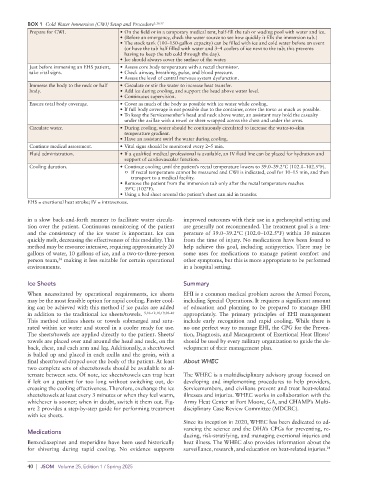
BOX 1  Cold Water Immersion (CWI) Setup and Procedure 1,16,33
           Prepare for CWI.             • On the field or in a temporary medical tent, half-fill the tub or wading pool with water and ice.
                                        • (Before an emergency, check the water source to see how quickly it fills the immersion tub.)
                                        • The stock tank (100–150-gallon capacity) can be filled with ice and cold water before an event
                                          (or have the tub half filled with water and 3–4 coolers of ice next to the tub; this prevents
                                          having to keep the tub cold through the day).
                                        • Ice should always cover the surface of the water.
           Just before immersing an EHS patient,   • Assess core body temperature with a rectal thermistor.
           take vital signs.            • Check airway, breathing, pulse, and blood pressure.
                                        • Assess the level of central nervous system dysfunction.
           Immerse the body to the neck or half   • Circulate or stir the water to increase heat transfer.
           body.                        • Add ice during cooling, and support the head above water level.
                                        • Continuous supervision.
           Ensure total body coverage.  • Cover as much of the body as possible with ice water while cooling.
                                        • If full body coverage is not possible due to the container, cover the torso as much as possible.
                                        • To keep the Servicemember’s head and neck above water, an assistant may hold the casualty
                                          under the axillae with a towel or sheet wrapped across the chest and under the arms.
           Circulate water.             • During cooling, water should be continuously circulated to increase the water-to-skin
                                          temperature gradient.
                                        • Have an assistant swirl the water during cooling.
           Continue medical assessment.  • Vital signs should be monitored every 2–5 min.
           Fluid administration.        • If a qualified medical professional is available, an IV fluid line can be placed for hydration and
                                          support of cardiovascular function.
           Cooling duration.            • Continue cooling until the patient’s rectal temperature lowers to 39.0–39.2°C (102.0–102.5°F).
                                             o If rectal temperature cannot be measured and CWI is indicated, cool for 10–15 min, and then
                                            transport to a medical facility.
                                        • Remove the patient from the immersion tub only after the rectal temperature reaches
                                          39°C (102°F).
                                        • Using a bed sheet around the patient’s chest can aid in transfer.
          EHS = exertional heat stroke; IV = intravenous.

          in a slow back-and-forth manner to facilitate water circula-  improved outcomes with their use in a prehospital setting and
          tion over the patient. Continuous monitoring of the patient   are generally not recommended. The treatment goal is a tem-
          and the consistency of the ice water is important. Ice can   perature of 39.0–39.2°C (102.0–102.5°F) within 30 minutes
          quickly melt, decreasing the effectiveness of this modality. This   from the time of injury. No medications have been found to
          method may be resource intensive, requiring approximately 20   help achieve this goal, including antipyretics. There may be
          gallons of water, 10 gallons of ice, and a two-to-three-person   some  uses  for  medications  to  manage  patient  comfort  and
                    34
          person team,  making it less suitable for certain operational   other symptoms, but this is more appropriate to be performed
          environments.                                      in a hospital setting.

          Ice Sheets                                         Summary
          When  necessitated  by  operational  requirements,  ice  sheets   EHI is a common medical problem across the Armed Forces,
          may be the most feasible option for rapid cooling. Faster cool-  including Special Operations. It requires a significant amount
          ing can be achieved with this method if ice packs are added   of  education  and planning  to  be  prepared  to  manage EHI
          in addition to the traditional ice sheets/towels.  5,10–12,18,19,38–40    appropriately.  The  primary  principles  of  EHI  management
          This method utilizes sheets or towels submerged and satu-  include early recognition and rapid cooling.  While there is
          rated within ice water and stored in a cooler ready for use.   no one perfect way to manage EHI, the CPG for the Preven-
                                                                                                            1
          The sheets/towels are applied directly to the patient. Sheets/  tion, Diagnosis, and Management of Exertional Heat Illness
          towels are placed over and around the head and neck, on the   should be used by every military organization to guide the de-
          back, chest, and each arm and leg. Additionally, a sheet/towel   velopment of their management plan.
          is balled up and placed in each axilla and the groin, with a
          final sheet/towel draped over the body of the patient. At least   About WHEC
          two complete sets of sheets/towels should be available to al-
          ternate between sets. Of note, ice sheets/towels can trap heat   The WHEC is a multidisciplinary advisory group focused on
          if left on a patient for too long without switching out, de-  developing and implementing procedures to help providers,
          creasing the cooling effectiveness. Therefore, exchange the ice   Servicemembers, and civilians prevent and treat heat-related
          sheets/towels at least every 3 minutes or when they feel warm,   illnesses and injuries. WHEC works in collaboration with the
          whichever is sooner; when in doubt, switch it them out. Fig-  Army Heat Center at Fort Moore, GA, and CHAMP’s Multi-
          ure 2 provides a step-by-step guide for performing treatment   disciplinary Case Review Committee (MDCRC).
          with ice sheets.
                                                             Since its inception in 2020, WHEC has been dedicated to ad-
                                                             vancing the science and the DHA’s CPGs for preventing, re-
          Medications
                                                             ducing, risk-stratifying, and managing exertional injuries and
          Benzodiazepines and meperidine have been used historically   heat illness. The WHEC also provides information about the
          for  shivering  during rapid  cooling.  No evidence  supports   surveillance, research, and education on heat-related injuries. 28

          40  |  JSOM   Volume 25, Edition 1 / Spring 2025

