


Page 41 - JSOM Spring 2025
P. 41
While there are multiple established methods to perform rapid   of the legs from ankles to the groin, and ice packs placed over
              cooling in a variety of settings, two cooling methods have been   major arteries of the neck, axilla, and groin. Ideally, indus-
              proven to meet the established optimal cooling rate with zero   trial fans are also used to assist convection. An advantage to
              mortality when used promptly: cold water immersion (CWI)   the Quantico method is the ease of patient transfer given the
              and the Quantico method. 5,10–12,14,18,19,25  However, both CWI   use of a stretcher; however, it generally requires more person-
              and the Quantico method are noted to be very resource in-  nel than CWI. A four-to-five-person team is required for the
              tensive, which is not always feasible in an operational set-  Quantico method. Responsibilities include airway manage-
              ting. A single EHS patient can require approximately 75–100   ment, bilateral ice massage to legs (distal to proximal direc-
              pounds of ice, 60–80 gallons of water, and a 150-gallon tub to   tion, ankle to groin, and starting back at ankle), monitoring
              be treated via CWI. Other highly effective interventions when   core temperature, vitals, and vascular access if indicated, and
              CWI and the Quantico method are not available or impracti-  documentation. The senior medical provider positions them-
              cal include tarp-assisted cooling with oscillation (TACO) and   selves  to manage  the  patient most  appropriately,  normally
              the ice sheet method. Table 1 describes a series of “good, better,   with airway management, or at the head of the patient.
              best practices” that organizations should consider when evalu-
              ating their EHI treatment plans.
                                                                 Alternative Cooling Strategies
              CWI The best-established treatment for rapid cooling in EHS   CWI and the Quantico method are considered the standard of
              is CWI. 5,10–21,31,32  The patient is submersed below the neck in   treatment for EHS. This is assuming ideal conditions. However,
              ice water, while ensuring that their legs and torso are fully   this may not always be possible given the mission- constrained
              submersed. A sheet wrapped behind the patient’s back, under   environments  of  the  Special  Operations  community.  The
              the armpits, is useful to ensure that their head does not get   most important principle behind “cool first, cool fast” is that
              submerged and for easier transport out of the tub. A tree-to-  some cooling is better than none, which may require impro-
              four-person team is required for CWI. Responsibilities include   vising, adapting, and overcoming constraints and limitations
              airway management, continuous ice water agitation, monitor-  to provide rapid cooling to an EHI patient. When distance
              ing core temperature, vitals, and vascular access if indicated,   is a consideration, mobile heat  treatment platforms may  be
              and documentation.  The senior medical provider positions   the solution, bringing the treatment to the patient. Treatment
              themselves to manage the patient most appropriately, nor-  methods that require less resources (i.e., less water or ice, no
              mally with airway management or ice water agitation. Box 1   tub) may be the best or only feasible solution. Two alternative
              provides a step-by-step guide for performing CWI.  cooling strategies, the TACO method and ice sheets method,
                                                                 are discussed below.
              Quantico Method (Ice Water Dousing with
              Ice Massage and Ice Packs)                         TACO
              The Quantico method has a slightly slower cooling rate as   In the TACO method, 5,10,18,1934–37  ice and water are placed to-
              compared to CWI, but it is a proven alternative.  5,10,12,14,17,25  A   gether with a patient in a waterproof tarp or body bag and
              mesh litter/stretcher (i.e., Talon) is placed on top of a tub/pool   the patient is then gently oscillated back and forth in the ice
              with continuous ice water dousing to the trunk, ice massage   water, in the tarp/body bag. A litter can be utilized, and moved

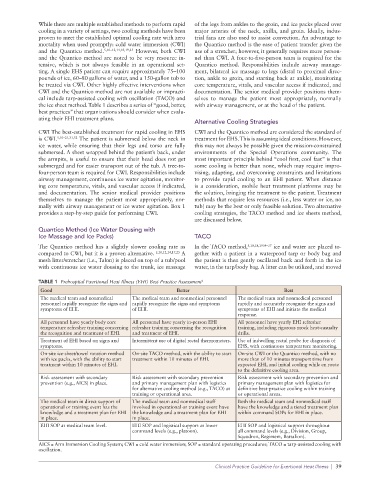
              TABLE 1  Prehospital Exertional Heat Illness (EHI) Best Practice Assessment 1
              Good                                         Better                             Best
              The medical team and nonmedical   The medical team and nonmedical personnel   The medical team and nonmedical personnel
              personnel rapidly recognize the signs and  rapidly recognize the signs and symptoms    rapidly and accurately recognize the signs and
              symptoms of EHI.              of EHI.                            symptoms of EHI and initiate the medical
                                                                               response.
              All personnel have yearly body core   All personnel have yearly in-person EHI   All personnel have yearly EHI refresher
              temperature refresher training concerning  refresher training concerning the recognition   training, including rigorous mock heat-casualty
              the recognition and treatment of EHI.  and treatment of EHI.     drills.
              Treatment of EHI based on signs and   Intermittent use of digital rectal thermometers.  Use of indwelling rectal probe for diagnosis of
              symptoms.                                                        EHS, with continuous temperature monitoring.
              On-site ice-sheet/towel rotation method   On-site TACO method, with the ability to start   On-site CWI or the Quantico method, with no
              with ice packs, with the ability to start   treatment within 10 minutes of EHI.  more than of 10 minutes transport time from
              treatment within 10 minutes of EHI.                              expected EHI, and initial cooling while en route
                                                                               to the definitive cooling area.
              Risk assessment with secondary   Risk assessment with secondary prevention   Risk assessment with secondary prevention and
              prevention (e.g., AICS) in place.  and primary management plan with logistics   primary management plan with logistics for
                                            for alternative cooling method (e.g., TACO) at   definitive best-practice cooling within training
                                            training or operational area.      or operational areas.
              The medical team in direct support of   The medical team and nonmedical staff   Both the medical team and nonmedical staff
              operational or training event has the   involved in operational or training event have   have the knowledge and a tiered treatment plan
              knowledge and a treatment plan for EHI  the knowledge and a treatment plan for EHI    within command SOPs for EHI in place.
              in place.                     in place.
              EHI SOP at medical team level.  EHI SOP and logistical support at lower   EHI SOP and logistical support throughout
                                            command levels (e.g., platoon).    all command levels (e.g., Division, Group,
                                                                               Squadron, Regiment, Battalion).
              AICS = Arm Immersion Cooling System; CWI = cold water immersion; SOP = standard operating procedures; TACO = tarp-assisted cooling with
              oscillation.

                                                                       Clinical Practice Guideline for Exertional Heat Illness  |  39

