


Page 40 - JSOM Spring 2025
P. 40
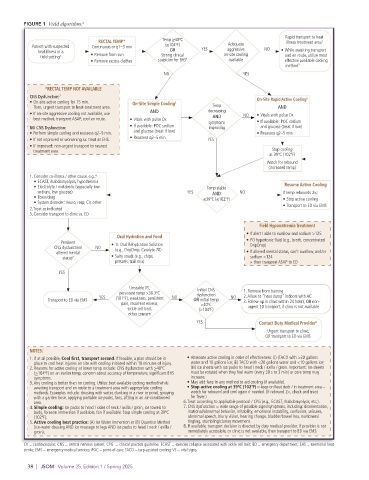
FIGURE 1  Field algorithm. 1

                                                                                              Rapid transport to heat
                                 RECTAL TEMP*         Temp ≥40ºC                              illness treatment area 1
            Patient with suspected  Continuous or q1–3 min  (≥104ºF)  YES   Adequate    NO
                                                                           aggressive
             heat illness in a                           OR               on-site cooling    • While awaiting transport
              field setting 1  • Remove from sun      Strong clinical                         and en route, utilize most
                               • Remove excess clothes  suspicion for EHS 2  available        effective available cooling
                                                                                              method 3
                                                       NO                       YES

                *RECTAL TEMP NOT AVAILABLE
           CNS Dysfunction: 7                                                        On-Site Rapid Active Cooling 5
           • On-site active cooling for 15 min.   On-Site Simple Cooling 4
            Then, urgent transport to heat-treatment area.            Temp                  AND
           • If on-site aggressive cooling not available, use   AND  decreasing  NO  • Vitals with pulse Ox
                                                                       AND
            best method, transport ASAP, cool en route.  • Vitals with pulse Ox  symptoms    • If available: POC sodium
           NO CNS Dysfunction:             • If available: POC sodium   improving     and glucose (treat if low)
           • Perform simple cooling and reassess q2–5 min.  and glucose (treat if low)  • Reassess q2–5 min
           • If not improved or worsening sx: treat as EHS.  • Reassess q2–5 min  YES
           • If improved: non-urgent transport to nearest
            treatment area.                                                               Stop cooling
                                                                                         at 39ºC (102ºF)
                                                                                        Watch for rebound
                                                                                         (increased temp)
           1. Consider co-illness / other cause, e.g., 6
            • ECAST, rhabdomyolysis, hypothermia
            • Electrolyte / metabolic (especially low                Temp stable              Resume Active Cooling
             sodium, low glucose)                             YES     AND      NO            If temp rebounds 2×:
            • Toxin/drug                                           ≤39ºC (≤102ºF)            • Stop active cooling
            • System disorder: neuro, resp, CV, other
           2. Treat as indicated                                                             • Transport to ED via EMS
           3. Consider transport to clinic vs. ED
                                                                                      Field Hyponatremia Treatment
                                                                                  • If alert / able to swallow and sodium >125
                                       Oral Hydration and Food
                     Persisent       • 1L Oral Rehydration Solution               • PO hypertonic fluid (e.g., broth, concentrated
                   CNS dysfunction/   NO  (e.g., DripDrop, Ceralyte 70)            DripDrop)
                   altered mental                                                 • If altered mental status, can’t swallow, and/or
                     status 7        • Salty snack (e.g., chips,                   sodium <124
                                       pretzels, trail mix)                          o then transport ASAP to ED
                    YES

                                           Unstable VS,           Initial CNS
                                        persistent temp >38.3ºC    dysfunction   1. Remove from training
                                 YES   (101ºF), weakness, persistent    NO  NO   2. Allow to “heat dump” indoors with AC
                 Transport to ED via EMS                        OR initial temp   3.  Follow-up in clinic within 24 hours, OR non-
                                         pain, recurrent emesis,   >40ºC
                                           sickle cell trait,     (>104ºF)        urgent ED transport, if clinic is not available
                                           other concern
                                                                 YES                  Contact Duty Medical Provider 8
                                                                                        Urgent transport to clinic,
                                                                                        OR transport to ED via EMS

           NOTES:
           1.  If at all possible, Cool first, transport second. If feasible, a plan should be in   • Alternate active cooling in order of effectiveness: (i) (TACO with >20 gallons
            place to cool heat injuries on site with cooling initiated within 10 minutes of injury.  water and 10 gallons ice; (ii) TACO with <20 gallons water and <10 gallons ice;
           2.  Reasons for active cooling at lower temp include: CNS dysfunction with >40ºC   (iii) ice sheets with ice packs to head / neck / axilla / groin. Important: Ice sheets
            (>104ºF) on an earlier temp, concern about accuracy of temperature, significant EHS   must be rotated when they feel warm (every 30 s to 3 min) or core temp may
            symptoms.                                          increase.
           3.  Any cooling is better than no cooling. Utilize best available cooling method while   • May add fans to any method to aid cooling (if available).
            awaiting transport and en route to a treatment area with appropriate cooling   • Stop active cooling at 39ºC (102ºF) – keep on heat deck / in treatment area –
            methods. Examples include: dousing with water, dunking in a river or pond, spraying   watch for rebound and cool again if needed. (If rebound 2×, check and treat
            with a garden hose, applying portable ice packs, fans, sitting in an air-conditioned   for fever.)
            area.                                            6.  Treat according to applicable protocol / CPG (e.g., ECAST, rhabdomyolysis, etc.).
           4.  Simple cooling: Ice packs to head / sides of neck / axilla / groin, ice towels to   7.  CNS dysfunction = wide range of possible signs/symptoms, including: disorientation,
            body, forearm immersion if available, fan if available. Stop simple cooling at 39ºC   irrational/abnormal behavior, irritability, emotional instability, confusion, seizures,
            (102ºF).                                          abnormal speech, blurry vision, hearing change, bladder/bowel loss, numbness/
           5.  Active cooling best practice: (A) Ice Water Immersion or (B) Quantico Method   tingling, stumbling/clumsy movement.
            (ice-water dousing AND ice massage to legs AND ice packs to head / neck / axilla /    8.  If available, transport decision is directed by duty medical provider. If provider is not
            groin).                                           immediately accessible, or clinic is not available, then transport to ED via EMS.
         CV = cardiovascular; CNS = central nervous system; CPG  = clinical practice guideline; ECAST = exercise collapse associated with sickle cell trait; ED = emergency department; EHS = exertional heat
         stroke; EMS = emergency medical services; POC = point-of-care; TACO = tarp-assisted cooling; VS = vital signs.

          38  |  JSOM   Volume 25, Edition 1 / Spring 2025

