


Page 61 - JSOM Winter 2023
P. 61
All data were analyzed using SPSS version 23 (IBM, https://  and higher procedural confidence (7/35). The top three major
              www.ibm.com/products/spss-statistics). Differences were con-  concerns were excessive time used (9/35), possibility of over-
              sidered statistically significant at the p<.05 threshold. Results   insertion/patient injury (8/35), and needlestick risk (5/35). The
              are reported as means (M)  and 95% confidence  intervals   top three suggested changes in ALD were further training to
              (95% CI).                                          reduce the need for airway identifying adjunct (5/35), modify
                                                                 to prevent needlestick (3/35), and shorter needle (3/35).
              Results
                                                                 Study Group 2 (10 SOF)
              Study Group 1 (35 HM)                              The SC first-attempt success rate was 90% after 20 procedures
              The SC first-attempt success rate was 90% after a total of 70   were performed. Two participants required two attempts for
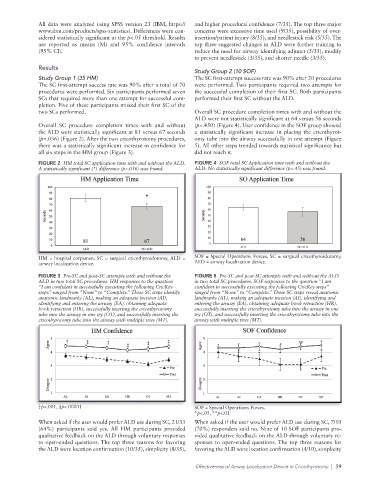
              procedures were performed. Six participants performed seven   the successful completion of their first SC. Both participants
              SCs that required more than one attempt for successful com-  performed their first SC without the ALD.
              pletion. Five of these participants missed their first SC of the
              two SCs performed.                                 Overall SC procedure completion times with and without the
                                                                 ALD were not statistically significant at 64 versus 56 seconds
              Overall  SC procedure  completion  times with  and  without   (p=.450) (Figure 4). User confidence in the SOF group showed
              the ALD were statistically significant at 81 versus 67 seconds     a statistically significant increase in placing the cricothyrot-
              (p=.036) (Figure 2). After the two cricothyrotomy procedures,   omy tube into the airway successfully in one attempt (Figure
              there was a statistically significant increase in confidence for   5). All other steps trended towards statistical significance but
              all six steps in the HM group (Figure 3).          did not reach it.

              FIGURE 2  HM total SC application time with and without the ALD.   FIGURE 4  SOF total SC Application time with and without the
              A statistically significant (*) difference (p=.036) was found.  ALD. No statistically significant difference (p=.45) was found.


              HM = hospital corpsmen, SC = surgical cricothyroidotomy, ALD =   SOF = Special Operations Forces, SC = surgical cricothyroidotomy,
              airway localization device.                        ALD = airway localization device.

              FIGURE 3  Pre-SC and post-SC attempts with and without the   FIGURE 5  Pre-SC and post-SC attempts with and without the ALD
              ALD in two total SC procedures. HM responses to the question   in two total SC procedures. SOF responses to the question “I am
              “I am confident in successfully executing the following CricKey   confident in successfully executing the following CricKey steps”
              steps” ranged from “None” to “Complete.” These SC steps identify   ranged from “None” to “Complete.” These SC steps reveal anatomic
              anatomic landmarks (AL), making an adequate incision (AI),   landmarks (AL), making an adequate incision (AI), identifying and
              identifying and entering the airway (EA), obtaining adequate   entering the airway (EA), obtaining adequate hook retraction (HR),
              hook retraction (HR), successfully inserting the cricothyrotomy   successfully inserting the cricothyrotomy tube into the airway in one
              tube into the airway in one try (OT), and successfully inserting the   try (OT), and successfully inserting the cricothyrotomy tube into the
              cricothyrotomy tube into the airway with multiple tries (MT).  airway with multiple tries (MT).


              †p<.001, ‡p<.00001                                 SOF = Special Operations Forces.
                                                                 *p<.05, **p<.01
              When asked if the user would prefer ALD use during SC, 21/33   When asked if the user would prefer ALD use during SC, 7/10
              (64%) participants said yes.  All HM participants provided   (70%) responders said no. Nine of 10 SOF participants pro-
              qualitative feedback on the ALD through voluntary responses   vided qualitative feedback on the ALD through voluntary re-
              to open-ended questions. The top three reasons for favoring   sponses to open-ended questions. The top three reasons for
              the ALD were location confirmation (10/35), simplicity (8/35),   favoring the ALD were location confirmation (4/10), simplicity

                                                                 Effectiveness of Airway Localization Device in Cricothyrotomy  |  59

