


Page 54 - JSOM Winter 2023
P. 54
ensure early detection and treatment. Moreover, the proposed   to  psychotherapy and  cognitive  rehabilitation may  be  effec-
          classification system does not account for the possibility that   tive in treating Operators with both blast-induced mTBI and
                                                                                    85
          symptoms may emerge weeks to years after RBE, resulting in   chronic symptoms from RBE.  As we await disease- modifying
          misattribution of symptoms to other sources. We therefore an-  therapies, these multidisciplinary treatment programs may
          ticipate that this diagnostic classification system will require   currently be the most effective way to treat Operators who
          iterative revisions as more information about the temporal   experience cognitive, psychological, and physical symptoms
          dynamics of rBBI becomes available and as new tools are de-  after blast exposure. However, randomized controlled trials in
          veloped to measure concurrent exposures.           large numbers of SOF personnel have not yet been performed.
                                                             Hence, multidisciplinary, individualized treatment programs
          Proposal for a Diagnostic Risk Assessment Matrix   require further evaluation before they can be endorsed by clin-
          Once individual Operators are classified into one of the above   ical guidelines.
          four groups, we advocate for the implementation of a Risk
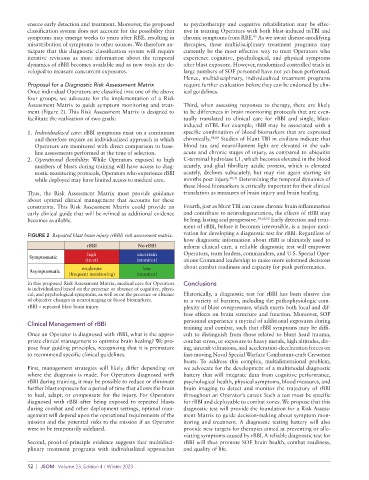
          Assessment Matrix to guide symptom monitoring and treat-  Third, when assessing responses to therapy, there are likely
          ment (Figure 2). This Risk Assessment Matrix is designed to   to be differences in brain monitoring protocols that are even-
          facilitate the realization of two goals:           tually translated to clinical care for rBBI and single, blast-
                                                             induced mTBI. For example, rBBI may be associated with a
          1.  Individualized care: rBBI symptoms exist on a continuum   specific combination of blood biomarkers that are expressed
            and therefore require an individualized approach in which   chronically. 88,89  Studies of blunt TBI in civilians indicate that
            Operators are monitored with direct comparison to base-  blood tau and neurofilament light are elevated in the sub-
            line assessments performed at the time of selection.  acute and chronic stages of injury, as compared to ubiquitin
          2.  Operational flexibility:  While Operators exposed to high   C-terminal hydrolase L1, which becomes elevated in the blood
            numbers of blasts during training will have access to diag-  acutely, and glial fibrillary acidic protein, which is elevated
            nostic monitoring protocols, Operators who experience rBBI   acutely, declines  subacutely, but may rise again starting six
            while deployed may have limited access to medical care.  months post-injury. 90,91  Determining the temporal dynamics of
                                                             these blood biomarkers is critically important for their clinical
          Thus, the Risk  Assessment Matrix must provide guidance   translation as measures of brain injury and brain healing.
          about  optimal clinical  management  that  accounts  for these
          constraints.  This Risk  Assessment Matrix could provide an   Fourth, just as blunt TBI can cause chronic brain inflammation
          early clinical guide that will be refined as additional evidence   and contribute to neurodegeneration, the effects of rBBI may
          becomes available.                                 be long-lasting and progressive. 34,35,92  Early detection and treat-
                                                             ment of rBBI, before it becomes irreversible, is a major moti-
          FIGURE 2  Repeated blast brain injury (rBBI) risk assessment matrix.  vation for developing a diagnostic test for rBBI. Regardless of
                                                             how diagnostic information about rBBI is ultimately used to
                             rBBI             No rBBI        inform clinical care, a reliable diagnostic test will empower
                              high            uncertain      Operators, team leaders, commanders, and U.S. Special Oper-
           Symptomatic
                             (treat)          (monitor)      ations Command leadership to make more informed decisions
           Asymptomatic     moderate            low          about combat readiness and capacity for peak performance.
                        (frequent monitoring)  (monitor)
          In this proposed Risk Assessment Matrix, medical care for Operators   Conclusions
          is individualized based on the presence or absence of cognitive, physi-
          cal, and psychological symptoms, as well as on the presence or absence   Historically, a diagnostic test for rBBI has been elusive due
          of objective changes in neuroimaging or blood biomarkers.  to a variety of barriers, including the pathophysiologic com-
          rBBI = repeated blast brain injury.                plexity of blast overpressure, which exerts both focal and dif-
                                                             fuse effects on brain structure and function. Moreover, SOF
          Clinical Management of rBBI                        personnel experience a myriad of additional exposures during
                                                             training and combat, such that rBBI symptoms may be diffi-
          Once an Operator is diagnosed with rBBI, what is the appro-  cult to distinguish from those related to blunt head trauma,
          priate clinical management to optimize brain healing? We pro-  combat stress, or exposure to heavy metals, high altitudes, div-
          pose four guiding principles, recognizing that it is premature   ing, aircraft vibrations, and acceleration-deceleration forces on
          to recommend specific clinical guidelines.         fast-moving Naval Special Warfare Combatant-craft Crewmen
                                                             boats.  To  address  this  complex,  multidimensional  problem,
          First,  management  strategies  will likely  differ depending  on   we advocate for the development of a multimodal diagnostic
          where the diagnosis is made. For Operators diagnosed with   battery that will integrate data from cognitive performance,
          rBBI during training, it may be possible to reduce or eliminate   psychological health, physical symptoms, blood measures, and
          further blast exposure for a period of time that allows the brain   brain imaging to detect and monitor the trajectory of rBBI
          to  heal, adapt,  or compensate  for the  injury. For   Operators   throughout an Operator’s career. Such a test must be specific
          diagnosed with rBBI after being exposed to repeated blasts   for rBBI and deployable to combat zones. We propose that this
          during combat and other deployment settings, optimal man-  diagnostic test will provide the foundation for a Risk Assess-
          agement will depend upon the operational requirements of the   ment Matrix to guide decision-making about symptom mon-
          mission and the potential risks to the mission if an Operator   itoring and treatment. A diagnostic testing battery will also
          were to be temporarily sidelined.                  provide new targets for therapies aimed at preventing or alle-
                                                             viating symptoms caused by rBBI. A reliable diagnostic test for
          Second, proof-of-principle  evidence  suggests that  multidisci-  rBBI will thus promote SOF brain health, combat readiness,
          plinary treatment programs with individualized approaches   and quality of life.

          52  |  JSOM   Volume 23, Edition 4 / Winter 2023

