


Page 33 - JSOM Summer 2023
P. 33
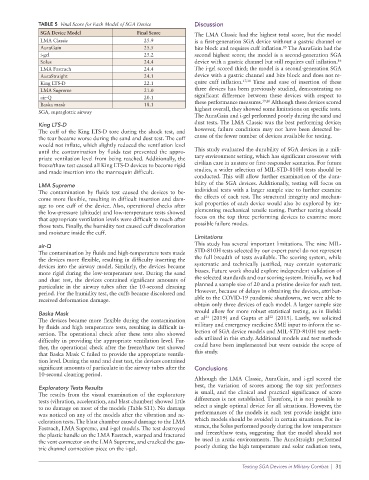
TABLE 5  Final Score for Each Model of SGA Device  Discussion
              SGA Device Model                Final Score        The LMA Classic had the highest total score, but the model
              LMA Classic                       25.9             is a first-generation SGA device without a gastric channel or
              AuraGain                          25.5             bite block and requires cuff inflation.  The AuraGain had the
                                                                                              15
              i-gel                             25.2             second highest score; the model is a second-generation SGA
                                                                                                               16
              Solus                             24.4             device with a gastric channel but still requires cuff inflation.
              LMA Fastrach                      24.4             The i-gel scored third; the model is a second-generation SGA
              AuraStraight                      24.1             device with a gastric channel and bite block and does not re-
              King LTS-D                        22.1             quire cuff inflation. 17,18  Time and ease of insertion of these
              LMA Supreme                       21.0             three devices has been previously studied, demonstrating no
              air-Q                             20.1             significant  difference  between  these devices  with respect  to
                                                                                       19,20
              Baska mask                        18.1             these performance measures.   Although these devices scored
              SGA, supraglottic airway                           highest overall, they showed some limitations on specific tests.
                                                                 The AuraGain and i-gel performed poorly during the sand and
              King LTS-D                                         dust tests. The LMA Classic was the best performing device;
              The cuff of the King LTS-D tore during the shock test, and   however, failure conditions may not have been detected be-
              the tear became worse during the sand and dust test. The cuff   cause of the fewer number of devices available for testing.
              would not inflate, which slightly reduced the ventilation level
              until the contamination by fluids test prevented the appro-  This study evaluated the durability of SGA devices in a mili-
              priate ventilation level from being reached. Additionally, the   tary environment setting, which has significant crossover with
              freeze/thaw test caused all King LTS-D devices to become rigid   civilian care in austere or first-responder scenarios. For future
              and made insertion into the mannequin difficult.   studies, a wider selection of MIL-STD-810H tests should be
                                                                 conducted. This will allow further examination of the dura-
              LMA Supreme                                        bility of the SGA devices. Additionally, testing will focus on
              The contamination by fluids test caused the devices to be-  individual tests with a larger sample size to further examine
              come more flexible, resulting in difficult insertion and dam-  the effects of each test. The structural integrity and mechan-
              age to one cuff of the device. Also, operational checks after   ical properties of each device would also be explored by im-
              the low-pressure (altitude) and low-temperature tests showed   plementing mechanical tensile testing. Further testing should
              that appropriate ventilation levels were difficult to reach after   focus on the top three performing devices to examine more
              those tests. Finally, the humidity test caused cuff discoloration   possible failure modes.
              and moisture inside the cuff.
                                                                 Limitations
              air-Q                                              This study has several important limitations. The nine MIL-
              The contamination by fluids and high-temperature tests made   STD-810H tests selected by our expert panel do not represent
              the devices more flexible, resulting in difficulty inserting the   the full breadth of tests available. The scoring system, while
              devices into the airway model. Similarly, the devices became   systematic and technically justified, may contain systematic
              more rigid during the low-temperature test. During the sand   biases. Future work should explore independent validation of
              and dust test, the devices contained significant amounts of   the selected standards and our scoring system. Initially, we had
              particulate in the airway tubes after the 10-second cleaning   planned a sample size of 20 and a pristine device for each test.
              period. For the humidity test, the cuffs became discolored and   However, because of delays in obtaining the devices, attribut-
              received deformation damage.                       able to the COVID-19 pandemic shutdowns, we were able to
                                                                 obtain only three devices of each model. A larger sample size
              Baska Mask                                         would allow for more robust statistical testing, as in Bielski
                                                                    21
                                                                                         22
              The devices became more flexible during the contamination   et al  (2019) and Gupta et al  (2015). Lastly, we solicited
              by fluids and high temperature tests, resulting in difficult in-  military and emergency medicine SME input to inform the se-
              sertion. The operational check after these tests also showed   lection of SGA device models and MIL-STD-810H test meth-
              difficulty in providing the appropriate ventilation level. Fur-  ods utilized in this study. Additional models and test methods
              ther, the operational check after the freeze/thaw test showed   could have been implemented but were outside the scope of
              that Baska Mask C failed to provide the appropriate ventila-  this study.
              tion level. During the sand and dust test, the devices contained
              significant amounts of particulate in the airway tubes after the   Conclusions
              10-second cleaning period.
                                                                 Although the LMA Classic, AuraGain, and i-gel scored the
              Exploratory Tests Results                          best, the variation of scores among the top six performers
              The results from the visual examination of the exploratory   is small, and the clinical and practical significance of score
              tests (vibration, acceleration, and blast chamber) showed little   differences is not established. Therefore, it is not possible to
              to no damage on most of the models (Table S11). No damage   select a single optimal device for all situations. However, the
              was noticed on any of the models after the vibration and ac-  performances of the models in each test provide insight into
              celeration tests. The blast chamber caused damage to the LMA   which models should be avoided in certain situations. For in-
              Fastrach, LMA Supreme, and i-gel models. The test destroyed   stance, the Solus performed poorly during the low temperature
              the plastic handle on the LMA Fastrach, warped and fractured   and freeze/thaw tests, suggesting that the model should not
              the vent connector on the LMA Supreme, and cracked the gas-  be used in arctic environments. The AuraStraight performed
              tric channel connection piece on the i-gel.        poorly during the high temperature and solar radiation tests,

                                                                                Testing SGA Devices in Military Combat  |  31

