


Page 23 - JSOM Spring 2023
P. 23
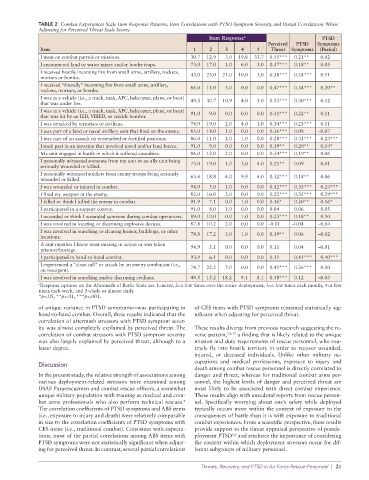
TABLE 2  Combat Experiences Scale Item Response Patterns, Item Correlations with PTSD Symptom Severity, and Partial Correlations When
              Adjusting for Perceived Threat Scale Scores
                                                                     Item Response a                      PTSD
                                                                                         Perceived  PTSD  Symptoms
              Item                                              1    2     3    4    5    Threat  Symptoms  (Partial)
              I went on combat patrols or missions.            30.7  12.9  3.0  19.8  33.7  0.51***  0.21**  0.02
              I encountered land or water mines and/or booby traps.  73.0  17.0  1.0  6.0  3.0  0.37***  0.18**  0.05
              I received hostile incoming fire from small arms, artillery, rockets,   43.0  23.0  21.0  10.0  3.0  0.38***  0.24***  0.11
              mortars or bombs.
              I received “friendly” incoming fire from small arms, artillery,   86.0  11.0  3.0  0.0  0.0  0.47***  0.34***  0.20**
              rockets, mortars, or bombs.
              I was in a vehicle (i.e., a truck, tank, APC, helicopter, plane, or boat)   49.5  30.7  10.9  4.0  5.0  0.53***  0.30***  0.12
              that was under fire.
              I was in a vehicle (i.e., a truck, tank, APC, helicopter, plane, or boat)   91.0  9.0  0.0  0.0  0.0  0.31***  0.22**  0.11
              that was hit by an IED, VBIED, or suicide bomber.
              I was attacked by terrorists or civilians.       74.0  19.0  2.0  4.0  1.0  0.34***  0.23***  0.11
              I was part of a land or naval artillery unit that fired on the enemy.  85.0  14.0  1.0  0.0  0.0  0.36***  0.08  –0.07
              I was part of an assault on entrenched or fortified positions.  86.0  11.0  2.0  1.0  0.0  0.28***  0.31***  0.23***
              I took part in an invasion that involved naval and/or land forces.  91.0  9.0  0.0  0.0  0.0  0.19**  0.20**  0.14*
              My unit engaged in battle in which it suffered casualties.  86.0  12.0  2.0  0.0  0.0  0.34***  0.19**  0.06
              I personally witnessed someone from my unit or an ally unit being   73.0  19.0  1.0  3.0  4.0  0.21**  0.09  0.01
              seriously wounded or killed.
              I personally witnessed soldiers from enemy troops being seriously   63.4  18.8  4.0  9.9  4.0  0.32***  0.18**  0.06
              wounded or killed.
              I was wounded or injured in combat.              94.0  5.0   1.0  0.0  0.0  0.32***  0.33***  0.24***
              I fired my weapon at the enemy.                  82.0  16.0  2.0  0.0  0.0  0.22***  0.35***  0.29***
              I killed or think I killed the enemy in combat.  91.9  7.1   0.0  1.0  0.0  0.16*  0.20**   0.16*
              I participated in a support convoy.              91.0  8.0   1.0  0.0  0.0  0.04   0.06     0.05
              I wounded or think I wounded someone during combat operations.  89.0  10.0  0.0  1.0  0.0  0.23***  0.18**  0.10
              I was involved in locating or disarming explosive devices.  87.8  10.2  2.0  0.0  0.0 –0.01  –0.04  –0.04
              I was involved in searching or clearing homes, buildings, or other
              locations.                                       78.8  17.2  3.0  1.0  0.0  0.19**  0.06   –0.02
              A unit member I knew went missing in action or was taken   94.9  5.1  0.0  0.0  0.0  0.11  0.04  –0.01
              prisoner/hostage.
              I participated in hand-to-hand combat.           93.9  6.1   0.0  0.0  0.0  0.11   0.41***  0.40***
              I experienced a “close call” or attack by an enemy combatant (i.e.,   74.7  22.2  3.0  0.0  0.0  0.45***  0.26***  0.10
              an insurgent).
              I was involved in searching and/or disarming civilians.  49.5  15.2  18.2  9.1  8.1  0.38***  0.12  –0.03
              a Response options on the Aftermath of Battle Scale are 1=never, 2=a few times over the entire deployment, 3=a few times each month, 4=a few
              times each week, and 5=daily or almost daily.
              *p<.05, **p<.01, ***p<.001.
              of unique variance in PTSD symptoms—was participating in   of CES items with PTSD symptoms remained statistically sig-
              hand-to-hand combat. Overall, these results indicated that the   nificant when adjusting for perceived threat.
              correlation of aftermath stressors with PTSD symptom sever-
              ity was almost completely explained by perceived threat. The   These results diverge from previous research suggesting the re-
              correlation of combat stressors with PTSD symptom severity   verse pattern, 5,8,15  a finding that is likely related to the unique
              was also largely explained by perceived threat, although to a   mission and duty requirements of rescue personnel, who rou-
              lesser degree.                                     tinely fly into hostile territory in order to recover wounded,
                                                                 injured, or deceased individuals. Unlike other military oc-
                                                                 cupations and medical professions, exposure to injury and
              Discussion
                                                                 death among combat rescue personnel is directly correlated to
              In the present study, the relative strength of associations among   danger and threat, whereas for traditional combat arms per-
              various deployment-related stressors were examined among   sonnel, the highest levels of danger and perceived threat are
              USAF Pararescuemen and combat rescue officers, a somewhat   most likely to be associated with direct combat experience.
              unique military population with training as medical and com-  These results align with anecdotal reports from rescue person-
              bat arms professionals who also perform technical rescues.    nel. Specifically worrying about one’s safety while deployed
                                                             4
              The correlation coefficients of PTSD symptoms and ABS items   typically occurs more within the context of exposure to the
              (i.e., exposure to injury and death) were relatively comparable   consequences of battle than it is with exposure to traditional
              in size to the correlation coefficients of PTSD symptoms with   combat experiences. From a scientific perspective, these results
              CES items (i.e., traditional combat). Consistent with expecta-  provide support to the threat appraisal perspective of postde-
              tions, most of the partial correlations among ABS items with   ployment PTSD  and reinforce the importance of considering
                                                                             5,6
              PTSD symptoms were not statistically significant when adjust-  the context within which deployment stressors occur for dif-
              ing for perceived threat. In contrast, several partial correlations   ferent subgroups of military personnel.

                                                                   Threats, Recovery, and PTSD in Air Force Rescue Personnel  |  21

