


Page 22 - JSOM Spring 2023
P. 22
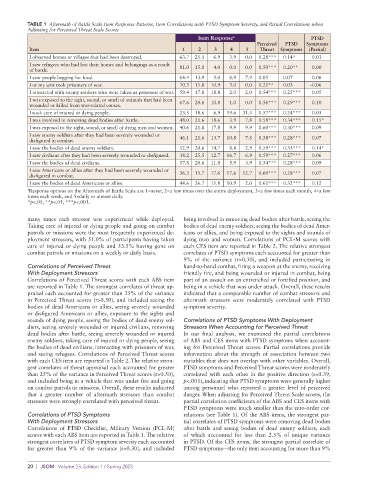
TABLE 1  Aftermath of Battle Scale Item Response Patterns, Item Correlations with PTSD Symptom Severity, and Partial Correlations when
          Adjusting for Perceived Threat Scale Scores
                                                                  Item Response a                      PTSD
                                                                                     Perceived  PTSD  Symptoms
           Item                                              1    2    3    4    5    Threat  Symptoms  (Partial)
           I observed homes or villages that had been destroyed.   63.7  25.5  6.9  3.9  0.0  0.28***  0.14*  0.03
           I saw refugees who had lost their homes and belongings as a result
           of battle.                                       81.0  15.0  4.0  0.0  0.0  0.50***  0.20**  0.00
           I saw people begging for food.                   64.4  13.9  5.0  8.9  7.9  0.05   0.07     0.06
           I or my unit took prisoners of war.              70.3  15.8  10.9  3.0  0.0  0.21**  0.03  –0.06
           I interacted with enemy soldiers who were taken as prisoners of war.  59.4  17.8  18.8  2.0  2.0  0.54***  0.25***  0.05
           I was exposed to the sight, sound, or smell of animals that had been   67.6  20.6  10.8  1.0  0.0  0.56***  0.29***  0.10
           wounded or killed from war-related causes.
           I took care of injured or dying people.          23.5  18.6  6.9  19.6  31.4  0.57***  0.24***  0.03
           I was involved in removing dead bodies after battle.   48.0  21.6  18.6  3.9  7.8  0.58***  0.34***  0.15*
           I was exposed to the sight, sound, or smell of dying men and women.  40.6  21.8  17.8  9.9  9.9  0.60***  0.30***  0.09
           I saw enemy soldiers after they had been severely wounded or
           disfigured in combat.                            46.1  21.6  13.7  10.8  7.8  0.58***  0.28***  0.07
           I saw the bodies of dead enemy soldiers.         52.9  20.6  14.7  8.8  2.9  0.59***  0.33***  0.14*
           I saw civilians after they had been severely wounded or disfigured.   38.2  25.5  12.7  16.7  6.9  0.59***  0.27***  0.06
           I saw the bodies of dead civilians.              57.8  20.6  11.8  5.9  3.9  0.54***  0.28***  0.09
           I saw Americans or allies after they had been severely wounded or   36.3  15.7  17.6  17.6  12.7  0.60***  0.28***  0.07
           disfigured in combat.
           I saw the bodies of dead Americans or allies.    44.6  26.7  15.8  10.9  2.0  0.61***  0.32***  0.12
          a Response options on the Aftermath of Battle Scale are 1=never, 2=a few times over the entire deployment, 3=a few times each month, 4=a few
          times each week, and 5=daily or almost daily.
          *p<.05, **p<.01, ***p<.001.


          many times each stressor was experienced while deployed.   being involved in removing dead bodies after battle, seeing the
          Taking care of injured or dying people and going on combat   bodies of dead enemy soldiers, seeing the bodies of dead Amer-
          patrols or missions were the most frequently experienced de-  icans or allies, and being exposed to the sights and sounds of
          ployment stressors, with 51.0% of participants having taken   dying men and women. Correlations of PCL-M scores with
          care of injured or dying people and 53.5% having gone on   each CES item are reported in Table 2. The relative strongest
          combat patrols or missions on a weekly or daily basis.   correlates of PTSD symptoms each accounted for greater than
                                                             9% of the variance (r>0.30), and included participating in
          Correlations of Perceived Threat                   hand-to-hand combat, firing a weapon at the enemy, receiving
          With Deployment Stressors                          friendly fire, and being wounded or injured in combat, being
          Correlations of Perceived Threat scores with each ABS item   part of an assault on an entrenched or fortified position, and
          are reported in Table 1. The strongest correlates of threat ap-  being in a vehicle that was under attack. Overall, these results
          praisal each accounted for greater than 25% of the variance   indicated that a comparable number of combat stressors and
          in Perceived Threat scores (r>0.50), and included seeing the   aftermath stressors were moderately correlated with PTSD
          bodies of dead Americans or allies, seeing severely wounded   symptom severity.
          or disfigured Americans or allies, exposure to the sights and
          sounds of dying people, seeing the bodies of dead enemy sol-  Correlations of PTSD Symptoms With Deployment
          diers, seeing severely wounded or injured civilians, removing   Stressors When Accounting for Perceived Threat
          dead bodies after battle, seeing severely wounded or injured   In our final analysis, we examined the partial correlations
          enemy soldiers, taking care of injured or dying people, seeing   of ABS and CES items with PTSD symptoms when account-
          the bodies of dead civilians, interacting with prisoners of war,   ing for Perceived Threat scores. Partial correlations provide
          and seeing refugees. Correlations of Perceived Threat scores   information about the strength of association between two
          with each CES item are reported in Table 2. The relative stron-  variables that does not overlap with other variables. Overall,
          gest correlates of threat appraisal each accounted for greater   PTSD symptoms and Perceived Threat scores were moderately
          than 25% of the variance in Perceived Threat scores (r>0.50),   correlated with each other in the positive direction (r=0.39,
          and included being in a vehicle that was under fire and going   p<.001), indicating that PTSD symptoms were generally higher
          on combat patrols or missions. Overall, these results indicated   among personnel who reported a greater level of perceived
          that a greater number of aftermath stressors than combat   danger. When adjusting for Perceived Threat Scale scores, the
          stressors were strongly correlated with perceived threat.  partial correlation coefficients of the ABS and CES items with
                                                             PTSD symptoms were much smaller than the zero-order cor-
          Correlations of PTSD Symptoms                      relations (see Table 1). Of the ABS items, the strongest par-
          With Deployment Stressors                          tial correlates of PTSD symptoms were removing dead bodies
          Correlations  of  PTSD  Checklist,  Military  Version  (PCL-M)   after  battle  and seeing  bodies  of  dead  enemy  soldiers,  each
          scores with each ABS item are reported in Table 1. The relative   of which accounted for less than 2.5% of unique variance
          strongest correlates of PTSD symptom severity each accounted   in PTSD. Of the CES items, the strongest partial correlate of
          for greater than 9% of the variance (r>0.30), and included   PTSD symptoms—the only item accounting for more than 9%

          20  |  JSOM   Volume 23, Edition 1 / Spring 2023

