


Page 14 - JSOM Winter 2022
P. 14
13
            (~110mL/min).  When combined with a Blizzard Blanket,   recommend  the  enFlow  as  the  ideal fluid  warmer  with  cer-
            the Thermal Angel demonstrated effectiveness when infus-  tainty. However, the authors extrapolate that saline and blood
            ing 10°C Hextend and 4°C blood-shed at 150mL/min in a   trials may yield similar warming outputs. A variety of blood
            hemorrhagic swine model under simulated combat condi-  products (LTOWB, PRBCs, and liquid plasma) are cooled to
            tions. Despite a nadir core temperature dropping to 35.2°C   1–6°C  in  combat  theaters,  the  enFlow  is  able  to  warm  ice-
                                                                                              6
            during the experiment, the  Thermal  Angel and Blizzard   cold saline (5°C) to 37.1°C at 100mL/min.  The Thermal An-
            Blanket actively rewarmed swine to >37°C. 14     gel’s standard battery pack component is able to warm cold
                                                             blood to >35°C at 110mL/min, but its battery life has not been
                                                                  13
          Time to Peak Heating, Maximum Flow Rates, and Battery   tested.  The Thermal Angel’s UB1 quick battery depletion lim-
          Characteristics.  No studies have directly measured time to   its its use in a massive blood resuscitation.
          peak heating. Maximum flow rates through a 14-gauge PIV
                                                      8
          pressurized system yields 296mL/min and 345mL/min.  De-  The enFlow demonstrates aluminum elution into IV fluids at
          pending on the model, two different batteries exist with the   varying concentrations dependent upon flow rates, type of
          Thermal Angel. The UB1 (30 wh) offers a weight roughly one-  crystalloid, and type of blood product. The FDA recommends
          sixth of the standard battery and has a significantly smaller   the maximum level of aluminum in IV nutrition to not exceed
                                                                    3,4
          profile. Reported discrepancies in average fluid output tem-  25 µg/L.  Independent of flow rate, blood products demon-
          peratures with cold isotonic solutions revealed the UB1 and a   strated a lesser amount of aluminum elution when compared
          standard battery pack perform differently.         to crystalloids.  Independent of flow rate, 0.9% saline demon-
                                                                        4
                                                             strated a considerably less aluminum elution compared to
                                                                       4
                                                             Plasma-Lyte.  A limitation to the research is that the primary
          Discussion
                                                             flow rates analyzed (i.e., 2mL/min) may not be of practical
          In  battlefield  operations, many  factors  predispose IV  flu-  clinical application during a resuscitation. Regardless of its
          ids to cold temperatures, such as night operations, seasonal   clinical applicability, the enFlow manufacturer is in the pro-
          changes, aeromedical transport, and extremes in altitude. Un-  cess of redesigning their cartridges to eliminate the aluminum
          der these conditions, IV fluid warmers must perform reliably   elution problem.
          with  ice-cold isotonic solutions at a range of flow rates. The
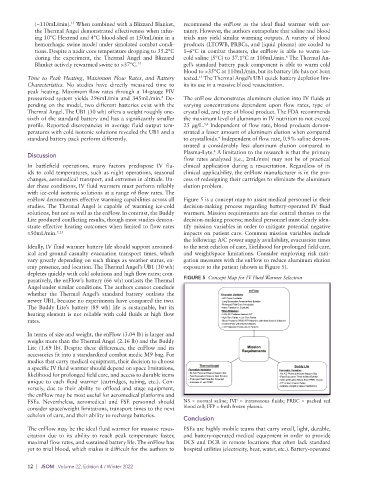
          enFlow demonstrates effective warming capabilities across all   Figure 5 is a concept map to assist medical personnel in their
          studies.  The  Thermal  Angel is capable of warming ice-cold   decision-making process regarding battery-operated IV fluid
          solutions, but not as well as the enFlow. In contrast, the Buddy   warmers. Mission requirements are the central themes to the
          Lite  produced conflicting results, though most studies demon-  decision-making process; medical personnel must clearly iden-
          strate effective heating outcomes when limited to flow rates    tify mission variables in order to mitigate potential negative
          ≤50mL/min. 7,13                                    impacts on patient care. Common mission variables include
                                                             the following: A/C power supply availability, evacuation times
          Ideally, IV fluid warmer battery life should support aeromed-  to the next echelon of care, likelihood for prolonged field care,
          ical and ground casualty evacuation transport times, which   and weight/space limitations. Consider employing risk miti-
          vary greatly depending on such things as weather status, en-  gation measures with the enFlow to reduce aluminum elution
          emy presence, and location. The Thermal Angel’s UB1 (30 wh)   exposure to the patient (shown in Figure 5).
          depletes quickly with cold solutions and high flow rates; com-
          paratively, the enFlow’s battery (66 wh) outlasts the Thermal   FIGURE 5  Concept Map for IV Fluid Warmer Selection

          Angel under similar conditions. The authors cannot conclude
          whether the  Thermal  Angel’s standard battery outlasts the
          newer UB1, because no experiments have compared the two.
          The Buddy Lite’s battery (89 wh) life is sustainable, but its
          heating element is not reliable with cold fluids at high flow
          rates.

          In terms of size and weight, the enFlow (3.04 lb) is larger and
          weighs more than the Thermal Angel (2.16 lb) and the Buddy
          Lite (1.69 lb). Despite these differences, the enFlow and its
          accessories fit into a standardized combat medic M9 bag. For
          medics that carry medical equipment, their decision to choose
          a specific IV fluid warmer should depend on space limitations,
          likelihood for prolonged field care, and access to durable items
          unique to each fluid warmer (cartridges, tubing, etc.). Con-
          versely, due to their ability to offload and stage equipment,
          the enFlow may be most useful for aeromedical platforms and
          FSEs. Nevertheless, aeromedical and FSE personnel should   NS = normal saline; IVF = intravenous fluids; PRBC = packed red
          consider space/weight limitations, transport times to the next   blood cell; FFP = fresh frozen plasma.
          echelon of care, and their ability to recharge batteries.
                                                             Conclusion
          The enFlow may be the ideal fluid warmer for massive resus-  FSEs are highly mobile teams that carry small, light, durable,
          citation due to its ability to reach peak temperature faster,   and battery-operated medical equipment in order to provide
          maximal flow rates, and sustained battery life. The enFlow has   DCS and DCR in remote locations that often lack standard
          yet to trial blood, which makes it difficult for the authors to   hospital utilities (electricity, heat, water, etc.). Battery-operated

          12  |  JSOM   Volume 22, Edition 4 / Winter 2022

