


Page 74 - JSOM Fall 2022
P. 74
A Review of Acute Kidney Injury
Daniel A. Weidner, DO *; Michael J. Yoo, MD 2
1
ABSTRACT
1
Acute kidney injury (AKI) is a serious, often silent, medical fluid and electrolyte balance in the body. AKI is a potentially
condition with diverse etiologies and complex pathophysiol reversible, sudden decrease in kidney function that can lead to
ogy. We discuss the case of a patient injured in a single vehicle a buildup of toxins in the blood, metabolic derangements, and
rollover. Included is a discussion of prevention and supportive fluid overload. AKI is a common complication of several dis
2
care, with a focus on electrolyte repletion, fluid correction, ease processes that increases morbidity and mortality. Early
minimization of nephrotoxic exposures, and identification recognition and treatment of AKI may have the potential to
and treatment of the root cause. improve outcomes. 3
Keywords: acute kidney injury; supportive care; nephrotoxic Historically, AKI was not well defined, causing difficulties
exposures in diagnosis and research. In recent years, clearer guidelines
have been published and define AKI in stages based on serum
4
creatinine and/or urine output over time. Serum creatinine is
the byproduct of creatine and phosphocreatine from skeletal
Case Presentation
muscle and is used as a surrogate for kidney function because
You arrive on scene to a single vehicle rollover and find a it generally maintains a constant volume of distribution in
24yearold man trapped inside with the dashboard compress the body. It is also released into the serum at a relatively con
ing his lower extremities. The patient is alert and oriented but stant rate before being filtered through the kidneys. There
5
in pain. He states that he has been trapped for more than four fore, it can be generally inferred that a sudden rise in serum
hours. After a prolonged extrication, you examine the patient, creatinine is due to decreased kidney function. A baseline
5
noting an elevated heart rate to 118 beats per minute, intact creatinine helps facilitate the diagnosis of AKI as opposed to
pulses in all four extremities, and a stable blood pressure. The chronic kidney disease (CKD), which is a decline in kidney
patient is diffusely tender across his lower back, shoulders, function lasting >90 days. AKI definitions and stages are de
6
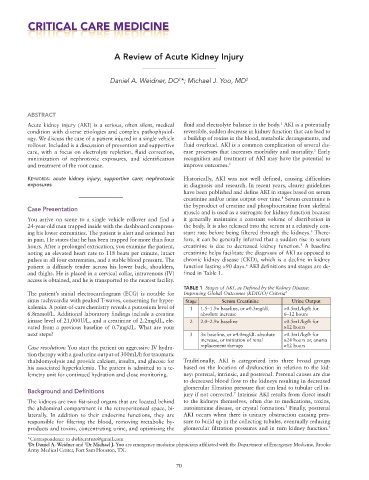
and thighs. He is placed in a cervical collar, intravenous (IV) fined in Table 1.
access is obtained, and he is transported to the nearest facility.
TABLE 1 Stages of AKI, as Defined by the Kidney Disease:
The patient’s initial electrocardiogram (ECG) is notable for Improving Global Outcomes (KDIGO) Criteria 4
sinus tachycardia with peaked Twaves, concerning for hyper Stage Serum Creatinine Urine Output
kalemia. A pointofcare chemistry reveals a potassium level of 1 1.5–1.9× baseline, or ≥0.3mg/dL <0.5mL/kg/h for
6.8mmol/L. Additional laboratory findings include a creatine absolute increase 6–12 hours
kinase level of 21,000U/L, and a creatinine of 2.2mg/dL, ele 2 2.0–2.9× baseline <0.5mL/kg/h for
vated from a previous baseline of 0.7mg/dL. What are your ≥12 hours
next steps? 3 3× baseline, or ≥4.0mg/dL absolute <0.3mL/kg/h for
increase, or initiation of renal ≥24 hours or, anuria
Case resolution: You start the patient on aggressive IV hydra replacement therapy ≥12 hours
tion therapy with a goal urine output of 300mL/h for traumatic
rhabdomyolysis and provide calcium, insulin, and glucose for Traditionally, AKI is categorized into three broad groups
his associated hyperkalemia. The patient is admitted to a te based on the location of dysfunction in relation to the kid
lemetry unit for continued hydration and close monitoring. ney: prerenal, intrinsic, and postrenal. Prerenal causes are due
to decreased blood flow to the kidneys resulting in decreased
glomerular filtration pressure that can lead to tubular cell in
Background and Definitions 7
jury if not corrected. Intrinsic AKI results from direct insult
The kidneys are two fistsized organs that are located behind to the kidneys themselves, often due to medications, toxins,
the abdominal compartment in the retroperitoneal space, bi autoimmune disease, or crystal formation. Finally, postrenal
7
laterally. In addition to their endocrine functions, they are AKI occurs when there is urinary obstruction causing pres
responsible for filtering the blood, removing metabolic by sure to build up in the collecting tubules, eventually reducing
products and toxins, concentrating urine, and optimizing the glomerular filtration pressures and in turn kidney function.
7
*Correspondence to dwliterature@gmail.com
1 Dr Daniel A. Weidner and Dr Michael J. Yoo are emergency medicine physicians affiliated with the Department of Emergency Medicine, Brooke
2
Army Medical Center, Fort Sam Houston, TX.
70

