


Page 70 - JSOM Fall 2022
P. 70
hospital is composed of MNs and MPs assigned both to oper The questionnaires were anonymized by a third party, who col
ational units. lected them.
In the current arrangement of Operation Barkhane, the doc Descriptive statistical analyses were performed by describing
trine of the French defense health service is to ensure medical numerical variables with means, while categorical variables
support of the fighting unit by a level 3 TCCC course holder were described with proportions. All statistical analyses were
when the tactical medical evacuation time to the vital surgery performed using Microsoft Excel version 16.36. This observa
unit is more than 30 minutes. The decision to deploy either an tional study was exempted from ethics board approval by the
MP–MN pair or an MN alone with a combat medic to sup French defense health service institutional review board.
port the fighting unit is made by the medical director in agree
ment with the military unit staff, according to the anticipated
duration and intensity of the combat operation. Given the Results
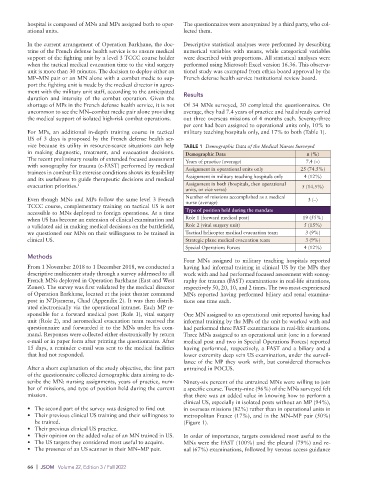
shortage of MPs in the French defense health service, it is not Of 34 MNs surveyed, 30 completed the questionnaires. On
uncommon to see the MN–combat medic pair alone providing average, they had 7.4 years of practice and had already carried
the medical support of isolated highrisk combat operations. out three overseas missions of 4 months each. Seventythree
per cent had been assigned to operational units only, 10% to
For MPs, an additional indepth training course in tactical military teaching hospitals only, and 17% to both (Table 1).
US of 3 days is proposed by the French defense health ser
vice because its utility in resourcescarce situations can help TABLE 1 Demographic Data of the Medical Nurses Surveyed
in making diagnostic, treatment, and evacuation decisions. Demographic Data n (%)
The recent preliminary results of extended focused assessment Years of practice (average) 7.4 (–)
with sonography for trauma (eFAST) performed by medical
trainees in combatlike exercise conditions shows its feasibility Assignment in operational units only 25 (74.5%)
and its usefulness to guide therapeutic decisions and medical Assignment in military teaching hospitals only 4 (12%)
evacuation priorities. 1 Assignment in both (hospitals, then operational 5 (14.5%)
units, or vice versa)
Even though MNs and MPs follow the same level 3 French Number of missions accomplished as a medical 3 (–)
nurse (average)
TCCC course, complementary training on tactical US is not
accessible to MNs deployed to foreign operations. At a time Type of position held during the mandate
when US has become an extension of clinical examination and Role 1 (forward medical post) 19 (55%)
a validated aid in making medical decisions on the battlefield, Role 2 (vital surgery unit) 5 (15%)
we questioned our MNs on their willingness to be trained in Tactical helicopter medical evacuation team 3 (9%)
clinical US. Strategic plane medical evacuation team 3 (9%)
Special Operations Forces 4 (12%)
Methods
Four MNs assigned to military teaching hospitals reported
From 1 November 2018 to 1 December 2018, we conducted a having had informal training in clinical US by the MPs they
descriptive multicenter study through a survey addressed to all work with and had performed focused assessment with sonog
French MNs deployed in Operation Barkhane (East and West raphy for trauma (FAST) examinations in reallife situations,
Zones). The survey was first validated by the medical director respectively 50, 20, 10, and 2 times. The two most experienced
of Operation Barkhane, located at the joint theater command MNs reported having performed biliary and renal examina
post in N’Djamena, Chad (Appendix 2). It was then distrib tions one time each.
uted electronically via the operational intranet. Each MP re
sponsible for a forward medical post (Role 1), vital surgery One MN assigned to an operational unit reported having had
unit (Role 2), and aeromedical evacuation team received the informal training by the MPs of the unit he worked with and
questionnaire and forwarded it to the MNs under his com had performed three FAST examinations in reallife situations.
mand. Responses were collected either electronically by return Three MNs assigned to an operational unit (one in a forward
email or in paper form after printing the questionnaire. After medical post and two in Special Operations Forces) reported
15 days, a reminder email was sent to the medical facilities having performed, respectively, a FAST and a biliary and a
that had not responded. lower extremity deep vein US examination, under the surveil
lance of the MP they work with, but considered themselves
After a short explanation of the study objective, the first part untrained in POCUS.
of the questionnaire collected demographic data aiming to de
scribe the MN: nursing assignments, years of practice, num Ninetysix percent of the untrained MNs were willing to join
ber of missions, and type of position held during the current a specific course. Twentynine (96%) of the MNs surveyed felt
mission. that there was an added value in knowing how to perform a
clinical US, especially in isolated posts without an MP (94%),
• The second part of the survey was designed to find out in overseas missions (82%) rather than in operational units in
• Their previous clinical US training and their willingness to metropolitan France (17%), and in the MN–MP pair (50%)
be trained. (Figure 1).
• Their previous clinical US practice.
• Their opinion on the added value of an MN trained in US. In order of importance, targets considered most useful to the
• The US targets they considered most useful to acquire. MNs were the FAST (100%) and the pleural (79%) and re
• The presence of an US scanner in their MN–MP pair. nal (67%) examinations, followed by venous access guidance
66 | JSOM Volume 22, Edition 3 / Fall 2022

