


Page 129 - JSOM Fall 2022
P. 129
Clinical Disease isolation. 9,23 In event of a suspected outbreak, diagnosis should
be based on clinical presentation (Box 1). 24
The last recorded naturally occurring case of variola major
occurred in 1975 in Bangladesh. As such, all public data char
acterizing the infection precede that date. 2,4 The majority of BOX 1 Smallpox Case Definitions in a Post Event Setting
healthcare providers in the present day have never seen a case Smallpox clinical case definition
of smallpox, so future recognition of cases will require a thor An illness with acute onset of fever > 101°F (38.3°C) followed by
ough understanding of the disease presentation and high level a rash characterized by firm, deepseated vesicles or pustules in the
same stage of development without other apparent cause.
of suspicion.
Laboratory criteria for confirmation
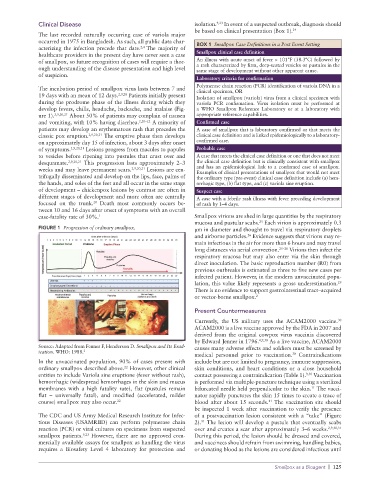
The incubation period of smallpox virus lasts between 7 and Polymerase chain reaction (PCR) identification of variola DNA in a
clinical specimen, OR
19 days with an mean of 12 days. 2,9,20 Patients initially present Isolation of smallpox (variola) virus from a clinical specimen with
during the prodrome phase of the illness during which they variola PCR confirmation. Virus isolation must be performed at
develop fevers, chills, headache, backache, and malaise (Fig a WHO Smallpox Reference Laboratory or at a laboratory with
ure 1). 2,9,20,21 About 50% of patients may complain of nausea appro priate reference capabilities.
and vomiting, with 10% having diarrhea. 2,20–22 A minority of Confirmed case
patients may develop an erythematous rash that precedes the A case of smallpox that is laboratory confirmed or that meets the
classic pox eruption. 2,9,20,21 The eruptive phase then develops clinical case definition and is linked epidemiologically to a laboratory
on approximately day 15 of infection, about 3 days after onset confirmed case.
of symptoms. 2,9,20,21 Lesions progress from macules to papules Probable case
to vesicles before ripening into pustules that crust over and A case that meets the clinical case definition or one that does not meet
desquamate. 2,9,20,21 This progression lasts approximately 2–3 the clinical case definition but is clinically consistent with smallpox
weeks and may leave permanent scars. 2,9,20,21 Lesions are cen and has an epidemiological link to a confirmed case of smallpox.
Examples of clinical presentations of smallpox that would not meet
trifugally disseminated and develop on the lips, face, palms of the ordinary type (preevent) clinical case definition include (a) hem
the hands, and soles of the feet and all occur in the same stage orrhagic type, (b) flat type, and (c) variola sine eruption.
of development – chickenpox lesions by contrast are often in Suspect case
different stages of development and more often are centrally A case with a febrile rash illness with fever preceding development
focused on the trunk. Death most commonly occurs be of rash by 1–4 days.
20
tween 10 and 16 days after onset of symptoms with an overall
casefatality rate of 30%. 1 Smallpox virions are shed in large quantities by the respiratory
25
mucosa and pustular scabs. Each virion is approximately 0.3
FIGURE 1 Progression of ordinary smallpox. µm in diameter and thought to travel via respiratory droplets
26
and airborne particles. Evidence suggests that virions may re
main infectious in the air for more than 6 hours and may travel
long distances via aerial convection. 25–28 Virions then infect the
respiratory mucosa but may also enter via the skin through
direct inoculation. The basic reproduction number (R0) from
previous outbreaks is estimated as three to five new cases per
infected patient. However, in the modern unvaccinated popu
29
lation, this value likely represents a gross underestimation.
There is no evidence to support gastrointestinal tract–acquired
or vectorborne smallpox. 2
Present Countermeasures
Currently, the US military uses the ACAM2000 vaccine.
30
ACAM2000 is a live vaccine approved by the FDA in 2007 and
derived from the original cowpox virus vaccinia discovered
by Edward Jenner in 1796. 4,9,30 As a live vaccine, ACAM2000
Source: Adapted from Fenner F, Henderson D. Smallpox and Its Erad- causes many adverse effects and soldiers must be screened by
ication. WHO: 1988. 2
medical personnel prior to vaccination. Contraindications
30
In the unvaccinated population, 90% of cases present with include but are not limited to pregnancy, immune suppression,
ordinary smallpox described above. However, other clinical skin conditions, and heart conditions or a close household
22
entities to include Variola sine eruptione (fever without rash), contact possessing a contraindication (Table 1). 9,30 Vaccination
hemorrhagic (widespread hemorrhages in the skin and mucus is performed via multiplepuncture technique using a sterilized
membranes with a high fatality rate), flat (pustules remain bifurcated needle held perpendicular to the skin. The vacci
11
flat – universally fatal), and modified (accelerated, milder nator rapidly punctures the skin 15 times to create a trace of
course) smallpox may also occur. 22 blood after about 15 seconds. The vaccination site should
11
be inspected 1 week after vaccination to verify the presence
The CDC and US Army Medical Research Institute for Infec of a postvaccination lesion consistent with a “take” (Figure
tious Diseases (USAMRIID) can perform polymerase chain 2). The lesion will develop a pustule that eventually scabs
31
reaction (PCR) or viral cultures on specimens from suspected over and creates a scar after approximately 3–6 weeks. 2,9,30,31
smallpox patients. 9,23 However, there are no approved com During this period, the lesion should be dressed and covered,
mercially available assays for smallpox as handling the virus and vaccinees should refrain from swimming, handling babies,
requires a Biosafety Level 4 laboratory for protection and or donating blood as the lesions are considered infectious until
Smallpox as a Bioagent | 125

