


Page 125 - JSOM Fall 2022
P. 125
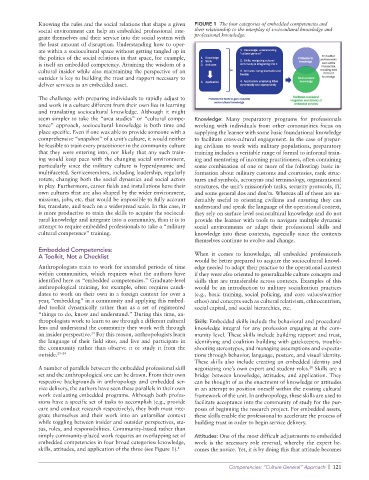
Knowing the rules and the social relations that shape a given FIGURE 1 The four categories of embedded competencies and
social environment can help an embedded professional inte their relationship to the interplay of sociocultural knowledge and
grate themselves and their service into the social system with professional knowledge.
the least amount of disruption. Understanding how to oper
ate within a sociocultural space without getting tangled up in
the politics of the social relations in that space, for example,
is itself an embedded competency. Attaining the wisdom of a
cultural insider while also maintaining the perspective of an
outsider is key to building the trust and rapport necessary to
deliver services as an embedded asset.
The challenge with preparing individuals to rapidly adjust to
and work in a culture different from their own lies in learning
and translating sociocultural knowledge. Although it might
seem simpler to take the “area studies” or “cultural compe Knowledge: Many preparatory programs for professionals
tence” approach, sociocultural knowledge is both time and working with individuals from other communities focus on
place specific. Even if one was able to provide someone with a supplying the learner with some basic foundational knowledge
comprehensive “snapshot” of a unit’s culture, it would neither to facilitate crosscultural engagement. In the case of prepar
be feasible to train every practitioner in the community culture ing civilians to work with military populations, preparatory
that they were entering into, nor likely that any such train training includes a veritable range of formal to informal train
ing would keep pace with the changing social environment, ing and mentoring of incoming practitioners, often containing
particularly since the military culture is hyperdynamic and some combination of one or more of the following: basic in
multifaceted. Servicemembers, including leadership, regularly formation about military customs and courtesies, rank struc
rotate, changing both the social dynamics and social actors tures and symbols, acronyms and terminology, organizational
in play. Furthermore, career fields and installations have their structures, the unit’s mission/job tasks, security protocols, IT,
own cultures that are also shaped by the wider environment, and some general dos and don’ts. Whereas all of these are un
missions, jobs, etc. that would be impossible to fully account deniably useful to orienting civilians and ensuring they can
for, translate, and teach on a widespread scale. In this case, it understand and speak the language of the operational context,
is more productive to train the skills to acquire the sociocul they rely on surface level sociocultural knowledge and do not
tural knowledge and integrate into a community, than it is to provide the learner with tools to navigate multiple dynamic
attempt to require embedded professionals to take a “military social environments or adapt their professional skills and
cultural competence” training. knowledge into these contexts, especially since the contexts
themselves continue to evolve and change.
Embedded Competencies:
A Toolkit, Not a Checklist When it comes to knowledge, all embedded professionals
would be better prepared to acquire the sociocultural knowl
Anthropologists train to work for extended periods of time edge needed to adapt their practice to the operational context
within communities, which requires what the authors have if they were also oriented to generalizable culture concepts and
identified here as “embedded competencies.” Graduatelevel skills that are transferable across contexts. Examples of this
anthropological training, for example, often requires candi would be an introduction to military socialization practices
dates to work on their own in a foreign context for over a (e.g., basic training, social policing, and core values/warrior
year, “embedding” in a community and applying this embed ethos) and concepts such as cultural relativism, ethnocentrism,
ded toolkit dynamically rather than as a set of regimented social capital, and social hierarchies, etc.
“things to do, know and understand.” During this time, an
thropologists work to learn to see through a different cultural Skills: Embedded skills include the behavioral and procedural
lens and understand the community they work with through knowledge integral for any profession engaging at the com
24
an insider perspective. For this reason, anthropologists learn munity level. These skills include building rapport and trust,
the language of their field sites, and live and participate in identifying and coalition building with gatekeepers, trouble
the community rather than observe it or study it from the shooting stereotypes, and managing assumptions and expecta
outside. 25–29 tions through behavior, language, posture, and visual identity.
These skills also include creating an embedded identity and
A number of parallels between the embedded professional skill negotiating one’s own expert and student roles. Skills are a
28
set and the anthropological one can be drawn. From their own bridge between knowledge, attitudes, and application. They
respective backgrounds in anthropology and embedded ser can be thought of as the enactment of knowledge or attitudes
vice delivery, the authors have seen these parallels in their own in an attempt to position oneself within the existing cultural
work evaluating embedded programs. Although both profes framework of the unit. In anthropology, these skills are used to
sions have a specific set of tasks to accomplish (e.g., provide facilitate acceptance into the community of study for the pur
care and conduct research respectively), they both must inte poses of beginning the research project. For embedded assets,
grate themselves and their work into an unfamiliar context these skills enable the professional to accelerate the process of
while toggling between insider and outsider perspectives, sta building trust in order to begin service delivery.
tus, roles, and responsibilities. Communitybased rather than
simply communityplaced work requires an overlapping set of Attitudes: One of the most difficult adjustments to embedded
embedded competencies in four broad categories: knowledge, work is the necessary role reversal, whereby the expert be
skills, attitudes, and application of the three (see Figure 1). 4 comes the novice. Yet, it is by doing this that attitude becomes
Competencies: “Culture General” Approach | 121

