


Page 123 - JSOM Fall 2022
P. 123
learning curve and greater challenges integrating into military Of those competencies required to operate successfully as a
unit communities and their operational settings. military embedded professional, Ogle et al. identified com
munitybased skills as critical to the embedded role and long
2
We recognize a variety of efforts are in place across the DoD term mission success. For instance, unlike traditional health
to prepare embedded assets for community integration. The care, in which services are primarily delivered in a clinic or
goal of this article is to move beyond current efforts in “cul office setting, embedded professionals deliver services primar
tural competence” education, and to address a recognized gap ily within the unit community. This can include conducting
in training focused on building military “embedded” compe “walkabouts,” circulating through work sections, attending
tencies and skills foundational to delivering health and per unit socials, and participating in unitbased training. Whereas
formance services within military unit communities. For this traditional services follow clinical practice guidelines and
article, “embedded” competencies are those community- and utilize standardized instruments, the military embedded pro
culture-based skills identified as critical to successfully inte- fessional must be able to adapt their services and tools to fit
grate and deliver services within military unit communities. the language and culture of the unit community. These are
These competencies can be framed as the knowledge, skills, the aspects of the military embedded service delivery model
attitudes, and applications needed to build the requisite so that professionals, especially civilians with no prior experience
ciocultural knowledge base to work as an embedded profes working with the military or embedded in community settings,
sional. We begin by examining the military embedded service may be underprepared for. 2,6
4
delivery model in comparison to the conventional service deliv
ery model. Next, we will examine foundational competencies,
skills, and tools key to “embedded” service delivery through Sociocultural Knowledge as a Pathway to
professions and models grounded in community and culturally Embedded Service Delivery Integration
based methodology. Finally, we will discuss the importance of Understanding the complexities and dynamics of an individual
embedded training in the DoD, specific to preparing health or group’s social environment is a welldocumented feature of
and performance professionals for delivering services within public health theories and models of health behavior within
7
unit communities. In particular, we advocate for training in a community settings. Although not all embedded practitioners
“culturalgeneral” model of cultural competency, allowing for would identify as public health professionals, they are simi
context dependent flexibility and adjustment. 5 lar in their need to engage with the social environment of the
community members they work with in order to generalize
their professional knowledge and integrate their service deliv
Military Embedded Health ery. For this reason, working as an embedded health or perfor
and Performance Service Delivery
mance professional requires a multilayered set of knowledge,
The DoD’s military embedded health and performance pro skills, and abilities (KSAs) to navigate community settings and
grams are represented by diverse teams, professions, and successfully apply the expertise that comes from academic
missions including but not limited to: US Special Operations training, within a community setting. 2,6,8 These KSAs can be
Command’s (USSOCOM) Preservation of the Force and Fam thought of as mutually reinforcing competencies. Various dis
ily (POTFF) program; Air Force’s Intelligence, Surveillance, ciplines that work with communities outline these competen
and Reconnaissance (ISR) Airman Resiliency Teams (ART); cies in diverse ways. Hays et al. for example, articulated these
Army’s Holistic Health and Fitness (H2F) teams; and Navy layers of KSAs for performance psychology professionals as
Corpsman and Army Combat medics. Although the profes competencies roughly grouped into three tiers:
sional adaptation and technical aspect of service delivery
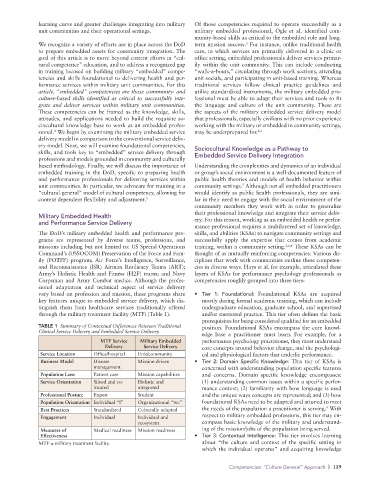
vary based on profession and mission, these programs share • Tier 1: Foundational: Foundational KSAs are acquired
key features unique to embedded service delivery, which dis mostly during formal academic training, which can include
tinguish them from healthcare services traditionally offered undergraduate education, graduate school, and supervised
through the military treatment facility (MTF) (Table 1). and/or mentored practice. This tier often defines the basic
prerequisites for being considered qualified for an embedded
TABLE 1 Summary of Contextual Differences Between Traditional position. Foundational KSAs encompass the core knowl
Clinical Service Delivery and Embedded Service Delivery
edge base a practitioner must learn. For example, for a
MTF Service Military Embedded performance psychology practitioner, they must understand
Delivery Service Delivery core concepts around behavior change, and the psychologi
Service Location Office/hospital Unit/community cal and physiological factors that underlie performance.
Business Model Disease Mission driven • Tier 2: Domain Specific Knowledge: This tier of KSAs is
management concerned with understanding population specific features
Population Lens Patient care Mission capabilities and concerns. Domain specific knowledge encompasses:
Service Orientation Siloed and co Holistic and (1) understanding common issues within a specific perfor
located integrated mance context; (2) familiarity with how language is used
Professional Posture Expert Student and the unique ways concepts are represented; and (3) how
Population Orientation Individual “I” Organizational “we” foundational KSAs need to be adapted and attuned to meet
9
Best Practices Standardized Culturally adapted the needs of the population a practitioner is serving. With
Engagement Individual Individual and respect to military embedded professions, this tier may en
ecosystem compass basic knowledge of the military and understand
Measures of Medical readiness Mission readiness ing of the mission/jobs of the population being served.
Effectiveness • Tier 3: Contextual Intelligence: This tier involves learning
MTF = military treatment facility. about “the culture and context of the specific setting in
which the individual operates” and acquiring knowledge
Competencies: “Culture General” Approach | 119

