


Page 91 - JSOM Summer 2022
P. 91
obstruction and respiratory arrest. Inhalation injury–induced   Guard (Combat Medical, https://combatmedical.com/). If an
              airway obstruction is primarily manifested by dyspnea, hoarse-  active-heating element is used in conjunction with these heat
              ness, and stridor, with low oxygen saturation signaling signifi-  shells, it is critical that it not be placed directly in contact with
              cant progression of the obstruction. Aggressive monitoring of   the skin. Partial thickness burns have resulted from this error. 38
              these signs, in conjunction with monitoring of oxygen satura-
              tion (SpO ) and end-tidal carbon dioxide (EtCO ) if available,   Appropriately treating a burn patient’s pain level  is para-
                     2
                                                   2
              allows for rapid placement of a definitive (subglottic) airway   mount, as good pain control is associated with better wound
              prior to complete obstruction. Except in extreme circum-  healing, sleep, and recovery. Recent literature has highlighted
              stances, analgesia and sedation must be administered before   that analgesics are routinely not administered, or are not ad-
                                                                                                         18
              performing this intervention.                      ministered in high enough doses to burn patients.  For the
                                                                 prehospital provider, ketamine is an excellent analgesic agent.
              Fluid Resuscitation                                For moderate to severe pain, ketamine can be administered at
              For burns greater than 20% TBSA, parenteral fluid resuscita-  0.3mg/kg IV/IO or 0.5–1mg/kg IM/IO, repeated every 5–10
                                                    7
              tion is indicated to treat hypovolemic burn shock. A balanced   minutes as needed.  To induce general anesthesia, the dose is
                                                                               39
              crystalloid solution such as lactated Ringer’s (LR) is preferred.   1–2mg/kg/hr IV/IO.  Typically, ketamine supports the blood
                                                                                40
              In a tactical setting, the US Army Institute of Surgical Research   pressure, but patients in shock may develop hypotension in
              (USAISR) Rule of Ten is used to calculate the initial fluid in-  response to the full anesthetic dose, so the provider should
              fusion rate.  For adults weighing between 40–80 kg, this rate   be prepared  to support  the blood pressure with vasoactive
                      30
              is calculated by multiplying the TBSA × 10mL/hr. For patients   medications. As ketamine is a dissociative anesthetic, airway
              weighing greater than 80 kg, an additional 100mL/hr should   reflexes and spontaneous breathing are usually maintained,
              be added for every 10 kg above 80 kg. For example, a 90-kg   but some patients develop excessive salivation or, rarely, la-
              patient with 30% TBSA burns would receive 400mL/hr (30%   ryngospasm. Nystagmus is a common side effect during use.
              TBSA × 10mL/hr + 100mL/hr). This formula is for adults only;   Agitated emergence reactions are possible in adult patients.
              for children, a weight-based formula such as the modified
              Brooke formula for children must be used.          Escharotomy
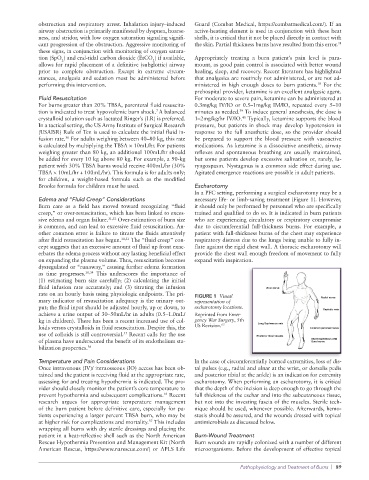
                                                                 In a PFC setting, performing a surgical escharotomy may be a
              Edema and “Fluid Creep” Considerations             necessary life- or limb-saving treatment (Figure 1). However,
              Burn care as a field has moved toward recognizing “fluid   it should only be performed by personnel who are specifically
              creep,” or over-resuscitation, which has been linked to exces-  trained and qualified to do so. It is indicated in burn patients
              sive edema and organ failure. 31,32  Over-estimation of burn size   who are experiencing circulatory or respiratory compromise
              is common, and can lead to excessive fluid resuscitation. An-  due to circumferential full-thickness burns. For example, a
              other common error is failure to titrate the fluids attentively   patient with full-thickness burns of the chest may experience
              after fluid resuscitation has begun. 18,33  The “fluid creep” con-  respiratory distress due to the lungs being unable to fully in-
              cept suggests that an excessive amount of fluid up front exac-  flate against the rigid chest wall. A thoracic escharotomy will
              erbates the edema process without any lasting beneficial effect   provide the chest wall enough freedom of movement to fully
              on expanding the plasma volume. Thus, resuscitation becomes   expand with inspiration.
              dysregulated or “runaway,” causing further edema formation
              as time progresses. 30,34  This underscores the importance of
              (1) estimating burn size carefully; (2) calculating the initial
              fluid infusion rate accurately; and (3) titrating the infusion
              rate on an hourly basis using physiologic endpoints. The pri-  FIGURE 1  Visual
              mary indicator of resuscitation adequacy is the urinary out-  representation of
              put; the fluid input should be adjusted hourly, up or down, to   escharotomy locations.
              achieve a urine output of 30–50mL/hr in adults (0.5–1.0mL/  Reprinted from Emer-
              kg in children). There has been a recent increased use of col-  gency War Surgery, 5th
              loids versus crystalloids in fluid resuscitation. Despite this, the   US Revision. 65
              use of colloids is still controversial.  Recent calls for the use
                                         35
              of plasma have underscored the benefit of its endothelium sta-
              bilization properties. 36
              Temperature and Pain Considerations                In the case of circumferentially burned extremities, loss of dis-
              Once intravenous (IV)/ intraosseous (IO) access has been ob-  tal pulses (e.g., radial and ulnar at the wrist, or dorsalis pedis
              tained and the patient is receiving fluid at the appropriate rate,   and posterior tibial at the ankle) is an indication for extremity
              assessing for and treating hypothermia is indicated. The pro-  escharotomy. When performing an escharotomy, it is critical
              vider should closely monitor the patient’s core temperature to   that the depth of the incision is deep enough to go through the
                                                       18
              prevent hypothermia and subsequent complications.  Recent   full thickness of the eschar and into the subcutaneous tissue,
              research argues for appropriate temperature management   but not into the investing fascia of the muscles. Sterile tech-
              of the burn patient before definitive care, especially for pa-  nique should be used, whenever possible. Afterwards, hemo-
              tients experiencing a larger percent TBSA burn, who may be   stasis should be assured, and the wounds dressed with topical
              at higher risk for complications and mortality.  This includes   antimicrobials as discussed below.
                                                  37
              wrapping all burns with dry sterile dressings and placing the
              patient in a heat-reflective shell such as the North American   Burn-Wound Treatment
              Rescue Hypothermia Prevention and Management Kit (North   Burn wounds are rapidly colonized with a number of different
              American  Rescue,  https://www.narescue.com/)  or APLS  Life   microorganisms. Before the development of effective topical

                                                                               Pathophysiology and Treatment of Burns  |  89

