


Page 96 - JSOM Summer 2022
P. 96
15
          BiPAP is a form of pressure support (PS) ventilation delivering   intubation.  The use of NIV and dissociative doses of ketamine,
          “bi-level” pressure on both inspiration and expiration. BiPAP   a treatment modality referred to as DSI (delayed sequence in-
          is a time or flow-cycled change of the CPAP level. 11,12  This   tubation), is a clinical algorithm used in the critically ill respi-
          mode delivers both a set inspiratory pressure (IPAP) and expi-  ratory patient in an effort to achieve effective preoxygenation
          ratory pressure (EPAP), with the set IPAP delivering the higher   prior to intubation or to allow the patient to achieve a level
          pressure and cycling to the lower EPAP to improve patient   of sedation and comfort to effectively oxygenate without intu-
                                                                  15
          comfort while also maintaining open alveoli. This can also be   bation.  DSI is functionally procedural sedation with the pre-
          conceptualized by defining it as CPAP with PS, in which PS is   dicted outcome being an increase in preintubation oxygenation.
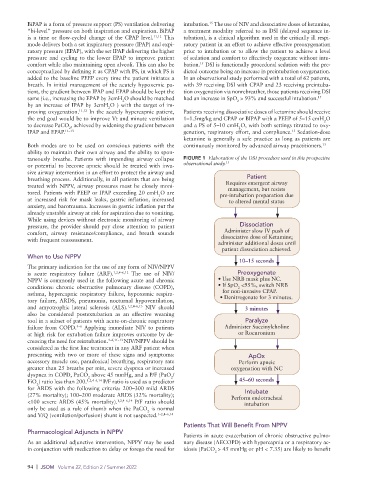
          added to the baseline PEEP every time the patient initiates a   In an observational study performed with a total of 62 patients,
          breath. In initial management of the acutely hypoxemic pa-  with 39 receiving DSI with CPAP and 23 receiving preintuba-
          tient, the gradient between IPAP and EPAP should be kept the   tion oxygenation via nonrebreather, those patients receiving DSI
          same (i.e., increasing the EPAP by 3cmH O should be matched   had an increase in SpO  > 93% and successful intubation. 15
                                         2
                                                                               2
          by an increase of IPAP by 3cmH O ) with the target of im-
                                    2
          proving oxygenation. 11,12  In the acutely hypercapnic patient,   Patients receiving dissociative doses of ketamine should receive
          the end goal would be to improve Vt and minute ventilation   1–1.5mg/kg and CPAP or BIPAP with a PEEP of 5–15 cmH O
                                                                                                           2
          to decrease PaCO , achieved by widening the gradient between   and a PS of 5–10 cmH O, with both settings titrated to oxy-
                                                                               2
                        2
          IPAP and EPAP. 11–13                               genation, respiratory effort, and compliance.  Sedation-dose
                                                                                                15
                                                             ketamine is generally a safe practice as long as patients are
          Both modes are to be used on conscious patients with the   continuously monitored by advanced airway practitioners. 15
          ability to maintain their own airway and the ability to spon-
          taneously  breathe.  Patients  with  impending  airway  collapse   FIGURE 1  Elaboration of the DSI procedure used in this prospective
          or potential to become apneic should be treated with inva-  observational study. 15
          sive airway intervention in an effort to protect the airway and
          breathing process. Additionally, in all patients that are being         Patient
          treated with NPPV, airway pressures must be closely moni-        Requires emergent airway
                                                                            management, but resists
          tored. Patients with PEEP or IPAP exceeding 20 cmH O are       pre-intubation preparation due
                                                     2
          at increased risk for mask leaks, gastric inflation, increased    to altered mental status
          anxiety, and barotrauma. Increases in gastric inflation put the
          already unstable airway at risk for aspiration due to vomiting.
          While using devices without electronic monitoring of airway
          pressure, the provider should pay close attention to patient         Dissociation
          comfort, airway resistance/compliance, and breath sounds        Administer slow IV push of
          with frequent reassessment.                                    dissociative dose of Ketamine;
                                                                        administer additional doses until
                                                                         patient dissociation achieved.
          When to Use NPPV
                                                                               10–15 seconds
          The primary indication for the use of any form of NIV/NPPV
          is acute respiratory failure (ARF). 1,2,4–6,12  The use of NIV/      Preoxygenate
          NPPV is commonly used in the following acute and chronic      • Use NRB mask plus NC.
          conditions: chronic obstructive pulmonary disease (COPD),     •  If SpO  <95%, switch NRB
                                                                               2
                                                                          for non-invasive CPAP.
          asthma, hypercapnic respiratory failure, hypoxemic respira-    • Denitrogenate for 3 minutes.
          tory failure, ARDS, pneumonia, nocturnal hypoventilation,
          and amyotrophic lateral sclerosis (ALS). 1,2,4–6,13  NIV should        3 minutes
          also be considered postextubation as an effective weaning
          tool in a subset of patients with acute-on-chronic respiratory         Paralyze
                          4–6
          failure from COPD.  Applying immediate NIV to patients          Administer Succinylcholine
          at high risk for extubation failure improves outcome by de-          or Rocuronium
          creasing the need for reintubation. 4–6,11–13  NIV/NPPV should be
          considered as the first line treatment in any ARF patient when
          presenting with two or more of these signs and symptoms:                ApOx
          accessory muscle use, paradoxical breathing, respiratory rate        Perform apneic
          greater than 25 breaths per min, severe dyspnea or increased      oxygenation with NC
          dyspnea in COPD, PaCO  above 45 mmHg, and a P/F (PaO /
                              2
                                                         2
          FiO ) ratio less than 200. 1,2,4–6,14  P/F ratio is used as a predictor   45–60 seconds
             2
          for ARDS with the following criteria: 200–300 mild ARDS
                                                                                 Intubate
          (27% mortality); 100–200 moderate ARDS (32% mortality);            Perform endotracheal
          <100 severe ARDS (45% mortality). 1,2,4–6,14  P/F ratio should         intubation
          only be used as a rule of thumb when the PaCO  is normal
                                                 2
          and V/Q (ventilation/perfusion) shunt is not suspected. 1–2,4–6,14
                                                             Patients That Will Benefit From NPPV
          Pharmacological Adjuncts in NPPV
                                                             Patients in acute exacerbation of chronic obstructive pulmo-
          As an additional adjunctive intervention, NPPV may be used   nary disease (AECOPD) with hypercapnia or a respiratory ac-
          in conjunction with medication to delay or forego the need for   idosis (PaCO > 45 mmHg or pH < 7.35) are likely to benefit
                                                                       2
          94  |  JSOM   Volume 22, Edition 2 / Summer 2022

