


Page 86 - JSOM Summer 2022
P. 86
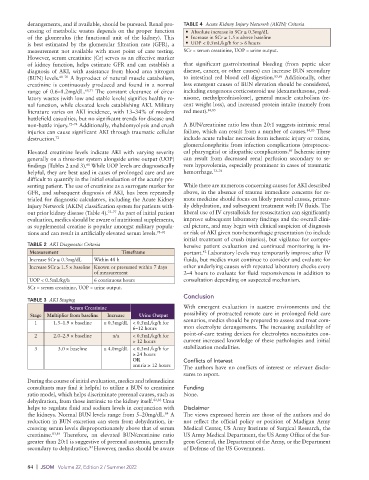
derangements, and if available, should be pursued. Renal pro-  TABLE 4  Acute Kidney Injury Network (AKIN) Criteria
          cessing of metabolic wastes depends on the proper function   •  Absolute increase in SCr ≥ 0.3mg/dL
          of the glomerulus (the functional unit of the kidney). This   •  Increase in SCr ≥ 1.5 × above baseline
          is best estimated by the glomerular filtration rate (GFR), a   •  UOP < 0.5mL/kg/h for > 6 hours
          measurement not available with most point of care testing.   SCr = serum creatinine, UOP = urine output.
          However, serum creatinine (Cr) serves as an effective marker
          of kidney function, helps estimate GFR and can establish a   that  significant  gastrointestinal  bleeding  (from  peptic  ulcer
          diagnosis of AKI, with assistance from blood urea nitrogen   disease, cancer, or other causes) can increase BUN secondary
          (BUN) levels. 68–70  A byproduct of natural muscle catabolism,   to intestinal red blood cell digestion. 85,86  Additionally, other
          creatinine  is continuously produced and found in a normal   less emergent causes of BUN elevation should be considered,
          range of 0.6–1.2mg/dL. 68,71  The constant clearance of circu-  including exogenous corticosteroid use (dexamethasone, pred-
          latory wastes (with low and stable levels) signifies healthy re-  nisone, methylprednisolone), general muscle catabolism (re-
          nal function, while elevated levels establishing AKI. Military   cent weight loss), and increased protein intake (namely from
          literature varies on AKI incidence, with 13–34% of modern   red meat). 84,85
          battlefield casualties, but no significant trends for disease and
          non-battle injury. 72–74  Additionally, rhabdomyolysis and crush   A BUN/creatinine ratio less than 20:1 suggests intrinsic renal
          injuries can cause significant AKI through traumatic cellular   failure, which can result from a number of causes. 84,85  These
          destruction. 72                                    include acute tubular necrosis from ischemic injury or toxins,
                                                             glomerulonephritis from infection complications (streptococ-
                                                                                               85
          Elevated creatinine levels indicate AKI with varying severity   cal pharyngitis) or idiopathic complications.  Ischemic injury
          generally on a three-tier system alongside urine output (UOP)   can result from decreased renal perfusion secondary to se-
                             68
          findings (Tables 2 and 3).  While UOP levels are diagnostically   vere hypovolemia, especially prominent in cases of traumatic
          helpful, they are best used in cases of prolonged care and are   hemorrhage. 72–74
          difficult to quantify in the initial evaluation of the acutely pre-
          senting patient. The use of creatinine as a surrogate marker for   While there are numerous concerning causes for AKI described
          GFR, and subsequent diagnosis of AKI, has been repeatedly   above, in the absence of trauma immediate concerns for re-
          trialed for diagnostic calculators, including the Acute Kidney   mote medicine should focus on likely prerenal causes, primar-
          Injury Network (AKIN) classification system for patients with-  ily dehydration, and subsequent treatment with IV fluids. The
          out prior kidney disease (Table 4). 75–77  As part of initial patient   liberal use of IV crystalloids for resuscitation can significantly
          evaluation, medics should be aware of nutritional supplements,   improve subsequent laboratory findings and the overall clini-
          as supplemental creatine is popular amongst military popula-  cal picture, and may begin with clinical suspicion of diagnosis
          tions and can result in artificially elevated serum levels. 78–81  or risk of AKI given non-hemorrhagic presentation (to include
                                                             initial treatment of crush injuries), but vigilance for compre-
          TABLE 2  AKI Diagnostic Criteria                   hensive patient evaluation and continued monitoring is im-
           Measurement                   Timeframe           portant.  Laboratory levels may temporarily improve after IV
                                                                   42
           Increase SCr ≥ 0.3mg/dL  Within 48 h              fluids, but medics must continue to consider and evaluate for
           Increase SCr ≥ 1.5 × baseline Known or presumed within 7 days   other underlying causes with repeated laboratory checks every
                                of measurement               2–4 hours to evaluate for fluid responsiveness in addition to
           UOP < 0.5mL/kg/h     6 continuous hours           consultation depending on suspected mechanism.
          SCr = serum creatinine, UOP = urine output.
                                                             Conclusion
          TABLE 3  AKI Staging
                        Serum Creatinine                     With emergent evaluation in austere environments and the
           Stage  Multiplier from baseline  Increase  Urine Output  possibility of protracted remote care in prolonged field care
            1     1.5–1.9 × baseline  ≥ 0.3mg/dL < 0.5mL/kg/h for   scenarios, medics should be prepared to assess and treat com-
                                            6–12 hours       mon electrolyte derangements. The increasing availability of
            2     2.0–2.9 × baseline  n/a   < 0.5mL/kg/h for   point-of-care testing devices for electrolytes necessitates con-
                                            > 12 hours       current increased knowledge of these pathologies and initial
            3       3.0 × baseline  ≥ 4.0mg/dL < 0.3mL/kg/h for   stabilization modalities.
                                            ≥ 24 hours
                                            OR               Conflicts of Interest
                                            anuria ≥ 12 hours  The authors have no conflicts of interest or relevant disclo-
                                                             sures to report.
          During the course of initial evaluation, medics and telemedicine
          consultants may find it helpful to utilize a BUN to creatinine   Funding
          ratio model, which helps discriminate prerenal causes, such as   None.
          dehydration, from those intrinsic to the kidney itself. 82,83  Urea
          helps to regulate fluid and sodium levels in conjunction with   Disclaimer
                                                       84
          the kidneys. Normal BUN levels range from 5–20mg/dL.  A   The views expressed herein are those of the authors and do
          reduction in BUN excretion can stem from dehydration, in-  not reflect the official policy or position of Madigan Army
          creasing serum levels disproportionately above that of serum   Medical Center, US Army Institute of Surgical Research, the
          creatinine. 83,84   Therefore,  an  elevated  BUN/creatinine  ratio   US Army Medical Department, the US Army Office of the Sur-
          greater than 20:1 is suggestive of prerenal azotemia, generally   geon General, the Department of the Army, or the Department
                              84
          secondary to dehydration. However, medics should be aware   of Defense of the US Government.

          84  |  JSOM   Volume 22, Edition 2 / Summer 2022

