


Page 173 - JSOM Summer 2022
P. 173
The Foundation has podcasts (ASF on the So Much Pingle   professionals, behavioral health and other categories, conduct
              podcast and ASF on Snake Talk with Dr. Chris Jenkins (The   one-on-one  interviews  with key  personnel  across the  units.
              Orianne Society Podcast) and four videos available at “ASF in   The focus groups are divided by rank ranges and gender, and
              the media”: https://www.snakebitefoundation.org/asf-media  the one-on-one interviews go all the way to the lowest level.
                                                                 “Both colonels emphasized the differences between the CAT
              Blue Star Museums Program                          assessments and existing tools for assessing unit climate, like
              From the San Diego Automotive Museum to the Sawgrass Na-  the mandatory Defense Organizational Climate Survey. ’We’re
              ture Center and Wildlife Hospital in Coral Springs, Florida,   not asking questions about compliance,’ said Teegarden.
              participating museums across the country are again offering   ‘We’re saying, ‘What’s it like for you in this unit? What’s going
              free admission to military personnel and their families, start-  on? What do you look forward to? What’s going well? What
              ing May 21. The free admission program runs through Sept. 5,   do you wish you had more of?’ We’re not only solely focused
              Labor Day. The Blue Star Museums program is a partnership   on the negative or asking them to provide any valuation about
              between the National Endowment for the Arts and Blue Star   their peers or their supervisors.’
              Families, working with the Defense Department and museums
              around the country. Participating museums are from all 50   “McDonough, who is now the People First Task Force’s chief
              states, the District of Columbia and the US Virgin Islands.  of staff, described the project as ‘additive’ to existing measures
                                                                 like the climate surveys.‘The key distinction,’ said Teegarden,
              The program is open to those currently serving in the Air
              Force, Army, Coast Guard, Marine Corps, Navy, Space Force,   ‘is that the CAT works with commanders to address the root
              members  of  the  reserve,  National  Guard,  US  Public  Health   causes of problems it identifies.’
              Commissioned Corps, NOAA Commissioned Corps — plus   “‘[Traditional climate surveys] get back to a commander, they
              up to five family members. Those eligible must show their   look at it, and they have no idea where to intervene to change
              Common Access Card, dependent ID card, or the Next Gen-  those metrics . . . there’s no context to [the underlying fac-
              eration Uniformed Services (Real) ID card for free entrance   tors],’ Teegarden said. ‘[Now], we take [CAT] survey results,
              into participating museums. The venues range from art muse-  marry them up with the context of the environment and what
              ums to children’s museums and zoos and aquariums. Among   we’re seeing and hearing on the ground, and then provide that
              those on the list are the Denver Art Museum, Utah’s Treehouse   back to the commanders.’ ‘The CAT then presents leaders with
              Children’s Museum, and Albuquerque’s Anderson Abruzzo   ‘what actions they can take that have the highest impact . . .
              International Balloon Museum. In the past, more than 2,000   and help them identify where those opportunities are within
              museums have participated in the program.          their unit,’ explained the program director.

              Not every museum in the country participates in this program,   “The team’s feedback also analyzes which changes could have
              so service members and families are urged to check the  list   the highest impact for the least effort from commanders — giv-
              for participating museums and plan ahead for visiting days   ing them the most bang for their buck. ‘We’re really targeted
              and hours and other information. The program is a lifeline   at  the battalion  and  brigade  commanders,’  said  Teegarden.
              for many military families, said Kathy Roth-Douquet, CEO of   ‘There’s more things to do — more problems to solve — than
              Blue Star Families, “offering them the opportunity to connect   daylight allows, and everybody’s limited on resources.’
              with their community, explore new space, enjoy the arts and   ‘As part of making the CATs permanent, Army Training and
              make lifelong memories.”
                                                                 Doctrine Command will take over their implementation on
                                                                 Jan. 1,’ said McDonough. TRADOC officials involved in the
              Army Makes New Cohesion Assessment Teams Permanent  process attended the recent assessment in Alaska. It’s not clear
              On May 20, 2022, Davis Winkie reports in Army Times: “Af-  yet how they will be manned in their permanent form, she
              ter a two-year pilot program, the Army has institutionalized   said. Currently, the CAT pulls its bench of subject matter ex-
              its cohesion assessment teams, a culture and climate assess-  perts — lawyers, counselors, structure analysts and more —
              ment program aimed to arm brigade and battalion command-  from other units on an as-needed basis rather than having
              ers with the information they need to solve tricky problems in   them permanently assigned to the CAT.
              their ranks.
                                                                 “At least one brigade will be happy to see the CAT next year,
              “The CATs, as their Army People First Task Force founders
              call them, consist of about 20 experts who spend roughly 10   whatever their final form may be. McDonough is slated to
              days on the ground assessing brigades from the top down   take brigade command. ‘I will take brigade command next
              to the platoon level through focus groups and interviews.   summer, and I hope to have the opportunity to have the [CAT]
              Army Times interviewed the current CAT director, Col. Lisa   come to my brigade,’ she said.”
              Teegarden and their former lead, Col. Jennifer McDonough.
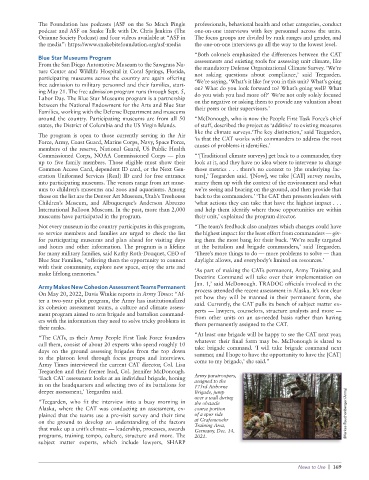
              ‘Each CAT assessment looks at an individual brigade, honing   Army paratroopers,
              in on the headquarters and selecting two of its battalions for   assigned to the
                                                                 173rd Airborne
              deeper assessment,’ Teegarden said.                Brigade, jump
                                                                 over a wall during
              “Teegarden, who fit the interview into a busy morning in   the obstacle
              Alaska, where the CAT was conducting an assessment, ex-  course portion
              plained that the teams use a pre-visit survey and their time   of a spur ride                       (Markus Rauchenberger/Army)
              on the ground to develop an understanding of the factors   at Grafenwoehr
              that make up a unit’s climate — leadership, processes, awards   Training Area,
                                                                 Germany, Dec. 14,
              programs, training tempo, culture, structure and more. The   2021.
              subject matter experts, which include lawyers,  SHARP


                                                                                                  News to Use  |  169

