


Page 171 - JSOM Summer 2022
P. 171
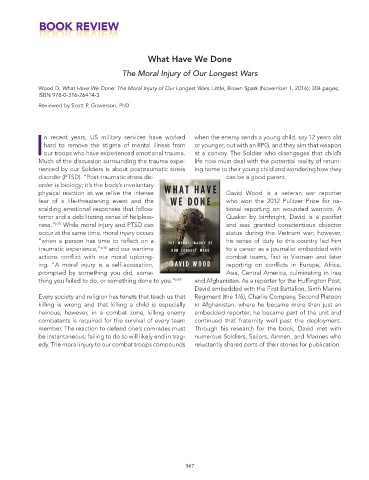
What Have We Done

                                         The Moral Injury of Our Longest Wars

              Wood D. What Have We Done: The Moral Injury of Our Longest Wars. Little, Brown Spark (November 1, 2016); 304 pages;
              ISBN 978-0-316-26414-3
              Reviewed by Scott P. Graverson, PhD


               n recent years, US military services have worked   when the enemy sends a young child, say 12 years old
               hard to remove the stigma of mental illness from   or younger, out with an RPG, and they aim that weapon
             Iour troops who have experienced emotional trauma.   at a convoy. The Soldier who disengages that child’s
              Much of the discussion surrounding the trauma expe-  life now must deal with the potential reality of return-
              rienced by our Soldiers is about posttraumatic stress   ing home to their young child and wondering how they
              disorder (PTSD). “Post-traumatic stress dis-                 can be a good parent.
              order is biology; it’s the body’s involuntary
              physical reaction as we relive the intense                   David  Wood  is  a  veteran  war reporter
              fear of a life-threatening event and the                     who won the 2012 Pulitzer Prize for na-
              scalding emotional responses that follow:                    tional  reporting  on  wounded  warriors.  A
              terror and a debilitating sense of helpless-                 Quaker  by  birthright,  David  is  a  pacifist
                   p15
              ness.”  While moral injury and PTSD can                      and  was granted  conscientious objector
              occur at the same time, moral injury occurs                  status during the Vietnam war; however,
              “when a person has time to reflect on a                      his sense of duty to this country led him
              traumatic experience,”  and our wartime                      to a career as a journalist embedded with
                                  p16
              actions  conflict  with  our  moral  upbring-                combat teams, first in Vietnam and later
              ing. “A moral injury is a self-accusation,                   reporting  on  conflicts  in  Europe,  Africa,
              prompted by something you did, some-                         Asia, Central America, culminating in Iraq
              thing you failed to do, or something done to you.” p18  and Afghanistan. As a reporter for the Huffington Post,
                                                                 David embedded with the First Battalion, Sixth Marine
              Every society and religion has tenets that teach us that   Regiment (the 1/6), Charlie Company, Second Platoon
              killing is wrong and that killing a child is especially   in Afghanistan, where he became more than just an
              heinous;  however,  in  a  combat  zone,  killing  enemy   embedded reporter; he became part of the unit and
              combatants is required for the survival of every team   continued that fraternity well past the deployment.
              member. The reaction to defend one’s comrades must   Through his research for the book, David met with
              be instantaneous; failing to do so will likely end in trag-  numerous Soldiers, Sailors, Airmen, and Marines who
              edy. The moral injury to our combat troops compounds   reluctantly shared parts of their stories for publication.


                                                              167

