


Page 172 - JSOM Summer 2022
P. 172
“A Study of Initial Treatment and Evacuation of Simulated   Republic of the Congo (DRC) during a period of intensified
          Casualties in a Cold Weather Environment”          effort to eliminate smallpox. Since then, monkeypox has been
          Young MB, Bynum GD, Philo LM, Jackson RE, Wolfe DL. A   reported in people in several other central and western African
          scenario was designed to test present medical doctrine, train-  countries: Cameroon, Central African Republic, Cote d’Ivoire,
          ing, force structure and equipment for initial treatment and   Democratic Republic of the Congo, Gabon, Liberia, Nigeria,
          evacuation of wounded personnel in cold weather regions. A   Republic of the Congo, and Sierra Leone. The majority of in-
          platoon size unit, experienced in cold weather operations, was   fections are in Democratic Republic of the Congo. Monkey-
          deployed on a combat mission in Alaska without prior knowl-  pox cases in people have occurred outside of Africa linked to
          edge of the scenario. An observation team from the United   international travel or imported animals, including  cases in
          States Army Research Institute of Environmental Medicine in-  the United States, as well as Israel, Singapore, and the United
          tercepted this unit and tasked them with treatment and evacu-  Kingdom. The natural reservoir of monkeypox remains un-
          ation of five simulated casualties. It was assumed that adverse   known. However, African  rodents and nonhuman primates
          weather conditions and enemy hand-held SAMS precluded air   (like monkeys) may harbor the virus and infect people.
          evacuation. Thirty-six inches of snow cover prevented mech-  Current information on diagnosis, treatment, and prevention
          anized transportation until an access road was attained three   is available at:
          kilometers away. Observations from this exercise led to the   https://www.cdc.gov/poxvirus/monkeypox/index.html
          conclusion that present medical doctrine, training, force struc-
          ture and equipment are totally inadequate for initial treatment
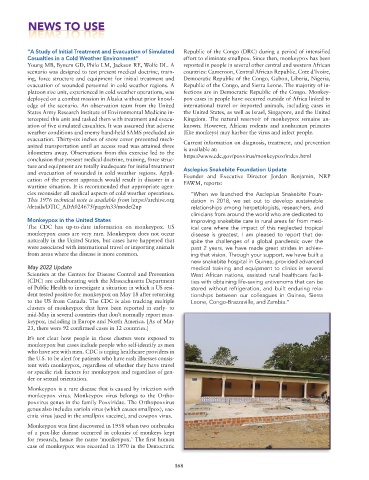
          and evacuation of wounded in cold weather regions. Appli-  Asclepius Snakebite Foundation Update
                                                             Founder and Executive Director Jordan Benjamin, NRP
          cation of the present approach would result in disaster in a   FAWM, reports:
          wartime situation. It is recommended that appropriate agen-
          cies reconsider all medical aspects of cold weather operations.   “When we launched the Asclepius Snakebite Foun-
          This 1976 technical note is available from https://archive.org   dation in 2018, we set out to develop sustainable
          /details/DTIC_ADA024675/page/n33/mode/2up            relationships among herpetologists, researchers, and
                                                               clinicians from around the world who are dedicated to
          Monkeypox in the United States                       improving snakebite care in rural areas far from med-
          The CDC has up-to-date information on monkeypox. US   ical care where the impact of this neglected tropical
          monkeypox cases are very rare. Monkeypox does not occur   disease is greatest. I am pleased to report that de-
          naturally in the United States, but cases have happened that   spite the challenges of a global pandemic over the
          were associated with international travel or importing animals   past 2 years, we have made great strides in achiev-
          from areas where the disease is more common.         ing that vision. Through your support, we have built a
                                                               new snakebite hospital in Guinea, provided advanced
          May 2022 Update                                      medical training and equipment to clinics in several
          Scientists at the Centers for Disease Control and Prevention   West African nations, assisted rural healthcare facili-
          (CDC) are collaborating with the Massachusetts Department   ties with obtaining life-saving antivenoms that can be
          of Public Health to investigate a situation in which a US resi-  stored without refrigeration, and built enduring rela-
          dent tested positive for monkeypox on May 18 after returning   tionships  between  our  colleagues  in  Guinea, Sierra
          to the US from Canada. The CDC is also tracking multiple   Leone, Congo-Brazzaville, and Zambia.”
          clusters of monkeypox that have been reported in early- to
          mid-May in several countries that don’t normally report mon-
          keypox, including in Europe and North America. [As of May
          23, there were 92 confirmed cases in 12 countries.]
          It’s not clear  how people in those clusters  were exposed  to
          monkeypox but cases include people who self-identify as men
          who have sex with men. CDC is urging healthcare providers in
          the U.S. to be alert for patients who have rash illnesses consis-
          tent with monkeypox, regardless of whether they have travel
          or specific risk factors for monkeypox and regardless of gen-
          der or sexual orientation.

          Monkeypox is a rare disease that is caused by infection with
          monkeypox virus. Monkeypox virus belongs to the Ortho-
          poxvirus genus in the family Poxviridae. The Orthopoxvirus
          genus also includes variola virus (which causes smallpox), vac-
          cinia virus (used in the smallpox vaccine), and cowpox virus.
          Monkeypox was first discovered in 1958 when two outbreaks
          of a pox-like disease occurred in colonies of monkeys kept
          for research, hence the name ‘monkeypox.’ The first human
          case of monkeypox was recorded in 1970 in the Democratic


                                                          168

