


Page 43 - JSOM Winter 2021
P. 43
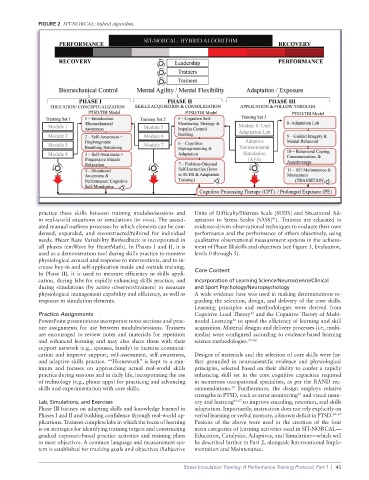
FIGURE 2  SIT-NORCAL: hybrid algorithm.


              practice these skills between training modules/sessions and   Units of Difficulty/Distress Scale [SUDS] and Situational Ad-
                                                                                          41
              in real-world situations or simulations (in vivo). The associ-  aptation to Stress Scales [SASS] ). Trainees are educated in
              ated manual outlines processes by which elements can be con-    evidence-driven observational techniques to evaluate their own
              densed, expanded, and reconstructed/tailored for individual   performance and the performance of others objectively, using
              needs. Heart Rate Variability Biofeedback is incorporated in   qualitative observational measurement systems in the achieve-
              all phases (emWave by HeartMath). In Phases I and II, it is   ment of Phase III skills and objectives (see Figure 1, Evaluation,
              used as a demonstration tool during skills practice to monitor   levels 0 through 5).
              physiological arousal and response to interventions, and to in-
              crease buy-in and self-application inside and outside training.   Core Content
              In Phase III, it is used to measure efficiency in skills appli-
              cation, during labs for rapidly enhancing skills practice, and   Incorporation of Learning Science/Neuroscience/Clinical
              during simulations (by active observers/trainers) to measure   and Sport Psychology/Neuropsychology
              physiological management capability and efficiency, as well as   A wide evidence base was used in making determinations re-
              response to simulation elements.                   garding the selection, design, and delivery of the core skills.
                                                                 Learning principles and methodologies were derived from
              Practice Assignments                               Cognitive Load Theory  and the Cognitive Theory of Multi-
                                                                                   55
                                                                             56
              PowerPoint presentations incorporate notes sections and prac-  modal Learning  to speed the efficiency of learning and skill
              tice assignments for use between modules/sessions. Trainees   acquisition. Material designs and delivery processes (i.e., multi-
              are encouraged to review notes and materials for repetition   media) were configured according to evidence-based learning
              and enhanced learning and may also share them with their   science methodologies. 57–62
              support network (e.g., spouses, family) to increase communi-
              cation and improve support, self-assessment, self- awareness,   Designs of materials and the selection of core skills were fur-
              and adaptive skills practice. “‘Homework” is kept to a min-  ther grounded in neuroscientific evidence and physiological
              imum and focuses on approaching actual real-world skills   principles, selected based on their ability to confer a rapidly
              practice during sessions and in daily life, incorporating the use   enhancing skill set in the core cognitive capacities required
              of technology (e.g., phone apps) for practicing and advancing   in numerous occupational specialties, as per the RAND rec-
                                                                             30
              skills and experimentation with core skills.       ommendations.   Furthermore,  the  design  employs  relative
                                                                                                  63
                                                                 strengths in PTSD, such as error monitoring  and visual mem-
              Lab, Simulations, and Exercises                    ory and learning 64-67  to improve encoding, retention, and skills
              Phase III focuses on adapting skills and knowledge learned in   adaptation. Importantly, instruction does not rely explicitly on
              Phases I and II and building confidence through real-world ap-  verbal learning or verbal memory, a known deficit in PTSD. 64–67
              plications. Trainees complete labs in which the focus of learning   Fusions of the above were used in the creation of the four
              is on strategies for identifying training targets and constructing   main categories of learning activities used in SIT-NORCAL—
              gradual exposure-based practice activities and training plans   Education, Catalytics, Adaptives, and Simulation—which will
              to meet objectives. A common language and measurement sys-  be described further in Part 2, alongside Interventional Imple-
              tem is established for tracking goals and objectives (Subjective   mentation and Maintenance.

                                                             Stress Inoculation Training: A Performance Training Protocol, Part 1  |  41

