


Page 41 - JSOM Winter 2021
P. 41
30
              Following the RAND Study,  the team was expanded (2014–  The model also provided an organizing, unifying structure and
              present) to include subject matter experts in neuropsychology   systematic approach for analyzing the performance of various
              (n = 3), PTSD (n = 9), neuroscience (n = 3), learning science   targets within the protocol, designing and selecting effective
              (n = 2), and sport/performance psychology (n = 2). Comple-  performance improvement interventions, improving and refin-
              tion of the core content and process elements of the PTSD/  ing those interventions, and evaluating results. Furthermore, the
              TBI protocol occurred in 2020, and formal study for use as a   model stresses evaluation and change management within the
              psychological performance protocol with US Military and first   protocol’s content and associated processes at each of the process
              response assets occurred from 2017 to 2020. The final proto-  phases (HPT model) and of the intervention (SIT-NORCAL), in
              col is an interlocking psychological performance and health   a linear and sequential fashion, allowing for the configuration of
              sustainment hybrid structured by a flexible core training al-  a design algorithm and measurement systems. These factors, in
              gorithm: SIT-NORCAL for human performance (Arm 1) and   addition to the model’s deliberate view of challenges as oppor-
              SIT-NORCAL for health sustainment and restoration geared   tunities, have been critical to the success of the protocol’s rapid
              toward PTSD/TBI (Arm 2). The two arms of SIT-NORCAL   transition to telehealth and configuration of distance learning
              have collectively undergone multiple implementations and re-  options in response to coronavirus disease 2019 (COVID-19).
              finement (44 cohorts; n ≥ 300) with provider and trainee-cen-
              tered  feedback,  as well  as standardized  measurement  from   Performance Analysis of Need or Opportunity
              2013 to 2020.
                                                                 Organizational Analysis
                                                                 The vision, mission, and values of key stakeholders in psy-
              Integration of the Performance Improvement/        chological performance, health sustainment, and restoration
              HPT Model
                                                                 within the DoD, Special Operations Forces, and VA are unique,
              Hybridization, Manualization, and Measurement      demanding an independent complex assessment of goals, ob-
              To address the challenges identified in the RAND study  and   jectives, and strategies for effective service alignment along an
                                                         30
              achieve the aims of hybridization, manualization, and sys-  ever-widening span of need. However, among all three entities,
              tematic integration of measurement capability during devel-  overarching themes emerge, and an opportunity to close crit-
              opment, SIT-NORCAL was structured by the performance   ical gaps in suicide prevention, outreach, resilience, and ac-
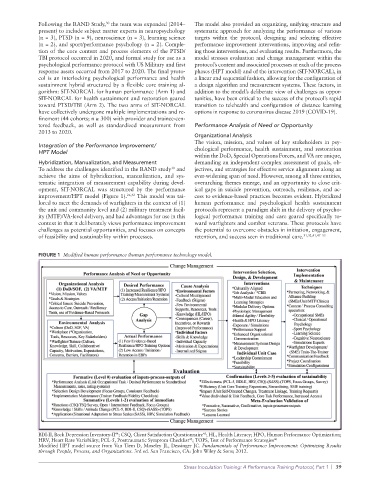
              improvement/HPT model (Figure 1). 26,42  This model was tai-  cess to evidence-based practices becomes evident. Hybridized
              lored to meet the demands of warfighters in the context of (1)   human performance and psychological health sustainment
              the unit and community level and (2) military treatment facil-  protocols represent a paradigm shift in the delivery of psycho-
              ity (MTF)/VA-level delivery, and had advantages for use in this   logical performance training and care geared specifically to-
              context in that it deliberately views performance improvement   ward warfighters and combat veterans. These protocols have
              challenges as potential opportunities, and focuses on concepts   the potential to overcome obstacles in initiation, engagement,
              of feasibility and sustainability within processes.  retention, and success seen in traditional care. 31,32,41,47–53

              FIGURE 1  Modified human performance /human performance technology model.


                                       44
              BDI-II, Beck Depression Inventory-II ; CSQ, Client Satisfaction Questionnaire ; HL, Health Literacy; HPO, Human Performance Optimization;
                                                                   45
                                                               43
              HRV, Heart Rate Variability; PCL-5, Posttraumatic Symptom Checklist ; TOPS, Test of Performance Strategies 46
              Modified HPT model source from Van Tiem D, Moseley JL, Dessinger JC. Fundamentals of Performance Improvement: Optimizing Results
              through People, Process, and Organizations. 3rd ed. San Francisco, CA: John Wiley & Sons; 2012.
                                                             Stress Inoculation Training: A Performance Training Protocol, Part 1  |  39

