


Page 91 - JSOM Fall 2021
P. 91
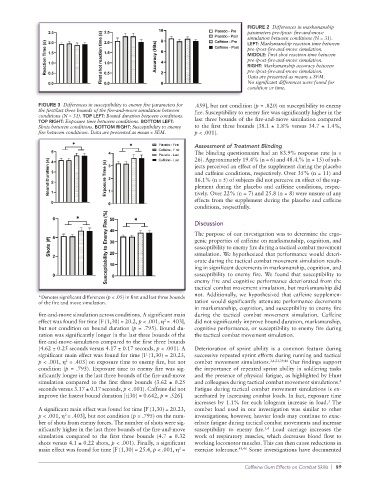
FIGURE 2  Differences in marksmanship
                                                                                  parameters pre-/post- fire-and-move
                                                                                  simulation between conditions (N = 31).
                                                                                  LEFT: Marksmanship reaction time between
                                                                                  pre-/post-fire-and-move simulation.
                                                                                  MIDDLE: First shot reaction time between
                                                                                  pre-/post-fire-and-move simulation.
                                                                                  RIGHT: Marksmanship accuracy between
                                                                                  pre-/post-fire-and-move simulation.
                                                                                  Data are presented as means ± SEM.
                                                                                  No significant differences were found for
                                                                                  condition or time.


              FIGURE 3  Differences in susceptibility to enemy fire parameters for   .459], but not condition (p = .820) on susceptibility to enemy
              the first/last three bounds of the fire-and-move simulation between   fire. Susceptibility to enemy fire was significantly higher in the
              conditions (N = 31). TOP LEFT: Bound duration between conditions.   last three bounds of the fire-and-move simulation compared
              TOP RIGHT: Exposure time between conditions. BOTTOM LEFT:
              Shots between conditions. BOTTOM RIGHT: Susceptibility to enemy   to the first three bounds (38.1 ± 1.8% versus 34.7 ± 1.4%,
              fire between conditions. Data are presented as mean ± SEM.  p < .001).

                                                                 Assessment of Treatment Blinding
                                                                 The blinding questionnaire had an 83.9% response rate (n =
                                                                 26). Approximately 19.4% (n = 6) and 48.4.% (n = 15) of sub-
                                                                 jects perceived an effect of the supplement during the placebo
                                                                 and caffeine conditions, respectively. Over 35% (n = 11) and
                                                                 16.1% (n = 5) of subjects did not perceive an effect of the sup-
                                                                 plement during the placebo and caffeine conditions, respec-
                                                                 tively. Over 22% (n = 7) and 25.8 (n = 8) were unsure of any
                                                                 effects from the supplement during the placebo and caffeine
                                                                 conditions, respectfully.

                                                                 Discussion
                                                                 The purpose of our investigation was to determine the ergo-
                                                                 genic properties of caffeine on marksmanship, cognition, and
                                                                 susceptibility to enemy fire during a tactical combat movement
                                                                 simulation. We hypothesized that performance would deteri-
                                                                 orate during the tactical combat movement simulation result-
                                                                 ing in significant decrements in marksmanship, cognition, and
                                                                 susceptibility to enemy fire. We found that susceptibility to
                                                                 enemy fire and cognitive performance deteriorated from the
                                                                 tactical combat movement simulation, but marksmanship did
                                                                 not. Additionally, we hypothesized that caffeine supplemen-
              *Denotes significant differences (p < .05) in first and last three bounds
              of the fire and move simulation.                   tation would significantly attenuate performance decrements
                                                                 in marksmanship, cognition, and susceptibility to enemy fire
              fire-and-move simulation across conditions. A significant main   during the tactical combat movement simulation. Caffeine
              effect was found for time [F (1,30) = 20.2, p < .001, η = .403],   did not significantly improve bound duration, marksmanship,
                                                       2
              but not condition on bound duration (p = .795). Bound du-  cognitive performance, or susceptibility to enemy fire during
              ration was significantly longer in the last three bounds of the   the tactical combat movement simulation.
              fire-and-move-simulation compared to the first three bounds
              (4.62 ± 0.25 seconds versus 4.17 ± 0.17 seconds, p < .001). A   Deterioration of sprint ability is a common feature during
              significant main effect was found for time [F (1,30) = 20.23,   successive repeated sprint efforts during running and tactical
                       2
              p < .001, η  = .403] on exposure time to enemy fire, but not   combat movement simulations. 3,4,23,39,44  Our findings support
              condition (p = .795). Exposure time to enemy fire was sig-  the importance of repeated sprint ability in soldiering tasks
              nificantly longer in the last three bounds of the fire-and-move   and the presence of physical fatigue, as highlighted by Hunt
              simulation compared to the first three bounds (3.62 ± 0.25   and colleagues during tactical combat movement simulations.
                                                                                                                4
              seconds versus 3.17 ± 0.17 seconds, p < .001). Caffeine did not   Fatigue during tactical combat movement simulations is ex-
              improve the fastest bound duration [t(30) = 0.642, p = .526].  acerbated by increasing combat loads. In fact, exposure time
                                                                                                            3
                                                                 increases by 1.1% for each kilogram increase in load.  The
              A significant main effect was found for time [F (1,30) = 20.23,   combat load used in our investigation was similar to other
              p < .001, η = .403], but not condition (p = .795) on the num-  investigations; however, heavier loads may continue to exac-
                      2
              ber of shots from enemy forces. The number of shots were sig-  erbate fatigue during tactical combat movements and increase
              nificantly higher in the last three bounds of the fire-and-move   susceptibility to enemy fire.  Load carriage increases the
                                                                                        3,4
              simulation compared to the first three bounds (4.7 ± 0.32   work of respiratory muscles, which decreases blood flow to
              shots versus 4.1 ± 0.22 shots, p < .001). Finally, a significant   working locomotor muscles. This can then cause reductions in
              main effect was found for time [F (1,30) = 25.4, p < .001, η  =   exercise tolerance. 45,46  Some investigations have documented
                                                            2
                                                                                 Caffeine Gum Effects on Combat Skills  |  89

