


Page 96 - JSOM Fall 2021
P. 96
Sailors within the enlisted rate of HM work in a variety of   not available. The pediatric clinical vignette was different with
          medical settings, from clinical care to technical lab work to   respect to mechanism of injury, consisting of blunt injury caus-
          surgical settings. Their basic clinical training is equivalent to   ing  tension pneumothorax  and  cardiac  arrest  as secondary
          that of a civilian emergency medical technician. All HMs had   injuries following an IED blast. Participants were mentored
          previously received TCCC training, and none was currently   through tube thoracostomy via the Seldinger technique and
          working in a trauma clinical care setting at the time of the   cardiopulmonary resuscitation (Figure 2).
          exercise. They were, as such, considered novice operators with
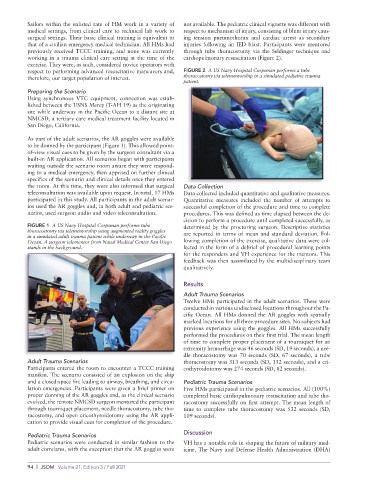
          respect to performing advanced resuscitative maneuvers and,   FIGURE 2  A US Navy Hospital Corpsman performs a tube
          therefore, our target population of interest.      thoracostomy via telementorship in a simulated pediatric trauma
                                                             patient.
          Preparing the Scenario
          Using synchronous VTC equipment, connection was estab-
          lished between the USNS Mercy (T-AH 19) as the originating
          site while underway in the Pacific Ocean to a distant site at
          NMCSD, a tertiary care medical treatment facility located in
          San Diego, California.

          As part of the adult scenarios, the AR goggles were available
          to be donned by the participant (Figure 1). This allowed point-
          of-view visual cues to be given by the surgeon consultant via a
          built-in AR application. All scenarios began with participants
          waiting outside the scenario room aware they were respond-
          ing to a medical emergency, then apprised on further clinical
          specifics of the scenario and clinical details once they entered
          the room. At this time, they were also informed that surgical   Data Collection
          teleconsultation was available upon request. In total, 17 HMs   Data collected included quantitative and qualitative measures.
          participated in this study. All participants in the adult scenar-  Quantitative  measures  included the  number  of attempts  to
          ios used the AR goggles and, in both adult and pediatric sce-  successful completion of the procedure and time to complete
          narios, used surgeon audio and video teleconsultation.  procedures. This was defined as time elapsed between the de-
                                                             cision to perform a procedure until completed successfully, as
          FIGURE 1  A US Navy Hospital Corpsman performs tube   determined by the proctoring surgeon. Descriptive statistics
          thoracostomy via telementorship using augmented reality goggles   are reported in terms of mean and standard deviation. Fol-
          in a simulated adult trauma patient while underway in the Pacific
          Ocean. A surgeon telementor from Naval Medical Center San Diego   lowing completion of the exercise, qualitative data were col-
          stands in the background.                          lected in the form of a debrief of procedural learning points
                                                             for the responders and VH experience for the mentors. This
                                                             feedback was then assimilated by the multidisciplinary team
                                                             qualitatively.

                                                             Results
                                                             Adult Trauma Scenarios
                                                             Twelve HMs participated in the adult scenarios. These were
                                                             conducted in various undisclosed locations throughout the Pa-
                                                             cific Ocean. All HMs donned the AR goggles with spatially
                                                             marked locations for all three procedure sites. No subjects had
                                                             previous experience using the goggles. All HMs successfully
                                                             performed the procedures on their first trial. The mean length
                                                             of time to complete proper placement of a tourniquet for an
                                                             extremity hemorrhage was 46 seconds (SD, 19 seconds), a nee-
                                                             dle thoracostomy was 70 seconds (SD, 67 seconds), a tube
          Adult Trauma Scenarios                             thoracostomy was 313 seconds (SD, 152 seconds), and a cri-
          Participants entered the room to encounter a TCCC training   cothyroidotomy was 274 seconds (SD, 82 seconds).
          manikin. The scenario consisted of an explosion on the ship
          and a closed-space fire leading to airway, breathing, and circu-  Pediatric Trauma Scenarios
          lation emergencies. Participants were given a brief primer on   Five HMs participated in the pediatric scenarios. All (100%)
          proper donning of the AR goggles and, as the clinical scenario   completed basic cardiopulmonary resuscitation and tube tho-
          evolved, the remote NMCSD surgeon mentored the participant   racostomy successfully on first attempt. The mean length of
          through tourniquet placement, needle thoracostomy, tube tho-  time to complete  tube thoracostomy  was 532 seconds (SD,
          racostomy, and open cricothyroidotomy using the AR appli-  109 seconds).
          cation to provide visual cues for completion of the procedure.

          Pediatric Trauma Scenarios                         Discussion
          Pediatric scenarios were conducted in similar fashion to the   VH has a notable role in shaping the future of military med-
          adult correlates, with the exception that the AR goggles were   icine. The Navy and Defense Health Administration (DHA)


          94  |  JSOM   Volume 21, Edition 3 / Fall 2021

