


Page 15 - JSOM Spring 2021
P. 15
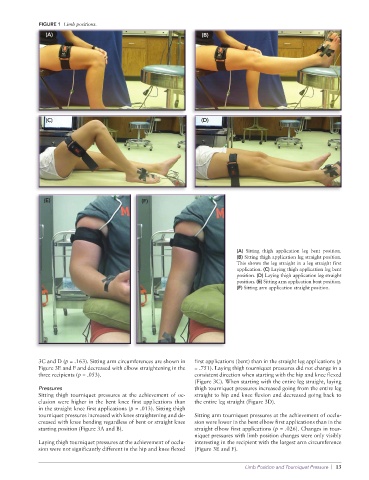
FIGURE 1  Limb positions.
                (A)                                                (B)


                (C)                                                (D)


               (E)                             (F)


                                                                              (A) Sitting thigh application leg bent position.
                                                                              (B) Sitting thigh application leg straight position.
                                                                              This shows the leg straight in a leg straight first
                                                                              application. (C) Laying thigh application leg bent
                                                                              position. (D) Laying thigh application leg straight
                                                                              position. (E) Sitting arm application bent position.
                                                                              (F) Sitting arm application straight position.


              3C and D (p = .163). Sitting arm circumferences are shown in   first applications (bent) than in the straight leg applications (p
              Figure 3E and F and decreased with elbow straightening in the   = .751). Laying thigh tourniquet pressures did not change in a
              three recipients (p = .053).                       consistent direction when starting with the hip and knee flexed
                                                                 (Figure 3C). When starting with the entire leg straight, laying
              Pressures                                          thigh tourniquet pressures increased going from the entire leg
              Sitting thigh tourniquet pressures  at the achievement of oc-  straight to hip and knee flexion and decreased going back to
              clusion were higher in the bent knee first applications than   the entire leg straight (Figure 3D).
              in the straight knee first applications (p = .013). Sitting thigh
              tourniquet pressures increased with knee straightening and de-  Sitting arm tourniquet pressures at the achievement of occlu-
              creased with knee bending regardless of bent or straight knee   sion were lower in the bent elbow first applications than in the
              starting position (Figure 3A and B).               straight elbow first applications (p = .026). Changes in tour-
                                                                 niquet pressures with limb position changes were only visibly
              Laying thigh tourniquet pressures at the achievement of occlu-  interesting in the recipient with the largest arm circumference
              sion were not significantly different in the hip and knee flexed   (Figure 3E and F).

                                                                                 Limb Position and Tourniquet Pressure  |  13

