


Page 10 - JSOM Spring 2021
P. 10
FEATURE ARTICLES                                   Commercial and Improvised Pelvic Compression Devices: Ap-
          Limb position changes are likely during transport from injury   plied Force and Implications for Hemorrhage Control offers
          location to definitive care. Limb Position Change Affects Tour-  a sensor-circuit assessment of applied force for a convenience
                                                                                                ®
          niquet Pressure is an investigation of passive limb position   sample of pelvic compression devices: SAM  Pelvic Sling II
          change effects on tourniquet pressure and occlusion. The au-  and improvised compression devices, including a SAM Splint
                                                                                                            ®
                                                                                                  ®
          thors determined that passive limb position changes can cause   tightened by a Combat Application Tourniquet  and a SAM
          significant changes in tourniquet pressure and, therefore, tour-  Splint tightened by a cravat, as well as two joined cravats and
          niquet adequacy should be reassessed after any limb position   a standard-issue military belt, were assessed in male and fe-
          change.                                            male subjects. As hypothesized, compressive forces applied to
                                                             the pelvis did not vary significantly based on device operator,
                             In  Performance Characteristics of   subject sex, and subject body fat percentage. The use of the
                             Fluid Warming Technology in Aus-  military belt as an improvised method to obtain pelvic stabili-
                             tere Environments, the authors evalu-  zation is not advised.
                             ated four portable fluid warmers that
                             are currently fielded or have potential   Prehospital Needle Decompression Improves Clinical Out-
                             for use in military environments.  comes in Helicopter Evacuation Patients With Multisystem
                                                             Trauma: A Multicenter Study: Prehospital ND should be con-
                             Rationale and Implementation of a   sidered in the appropriate clinical setting. Outcomes are less
                             Novel Special Operations Medical   reliable in cases of cardiopulmonary arrest or hypotension
                             Officer  Course:  the Air Force Spe-  with respiratory symptoms; however, this should not deter
                             cial Warfare Medical Officer Course   prehospital providers from attempting ND when clinically in-
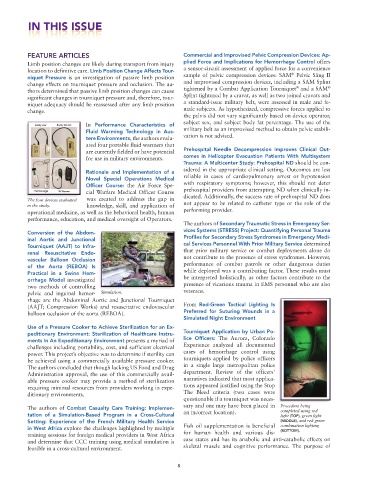
          The four devices evaluated   was created to address  the gap  in   dicated. Additionally, the success rate of prehospital ND does
          in the study.      knowledge, skill, and application of   not appear to be related to catheter type or the role of the
          operational medicine, as well as the behavioral health, human   performing provider.
          performance, education, and medical oversight of Operators.
                                                             The authors of Secondary Traumatic Stress in Emergency Ser-
          Conversion of the Abdom-                           vices Systems (STRESS) Project: Quantifying Personal Trauma
          inal Aortic and Junctional                         Profiles for Secondary Stress Syndromes in Emergency Medi-
          Tourniquet (AAJT) to Infra-                        cal Services Personnel With Prior Military Service determined
          renal  Resuscitative  Endo-                        that prior military service  or combat deployments alone do
          vascular Balloon  Occlusion                        not contribute to the presence of stress syndromes. However,
          of the Aorta (REBOA) Is                            performance of combat patrols or other dangerous duties
          Practical in a Swine Hem-                          while deployed was a contributing factor. These results must
          orrhage  Model  investigated                       be interpreted holistically, as other factors contribute to the
          two  methods  of  controlling                      presence of vicarious trauma in EMS personnel who are also
          pelvic and inguinal hemor-  Simulation.            veterans.
          rhage are the Abdominal Aortic and Junctional Tourniquet
          (AAJT; Compression Works) and resuscitative endovascular   From  Red-Green Tactical Lighting Is
          balloon occlusion of the aorta (REBOA).            Preferred for Suturing Wounds in a
                                                             Simulated Night Environment
          Use of a Pressure Cooker to Achieve Sterilization for an Ex-
          peditionary Environment: Sterilization of Healthcare Instru-  Tourniquet Application by Urban Po-
          ments In An Expeditionary Environment presents a myriad of   lice Officers:  The Aurora, Colorado
          challenges including portability, cost, and sufficient electrical   Experience analyzed all documented
          power. This project’s objective was to determine if sterility can   cases of hemorrhage control using
          be achieved using a commercially available pressure cooker.   tourniquets applied by police officers
          The authors concluded that though lacking US Food and Drug   in a single large metropolitan police
          Administration approval, the use of this commercially avail-  department. Review of the officers’
          able pressure cooker may provide a method of sterilization   narratives indicated that most applica-
          requiring minimal resources from providers working in expe-  tions appeared justified using the Stop
          ditionary environments.                            The Bleed criteria (two cases were
                                                             questionable if a tourniquet was neces-
          The authors of  Combat Casualty Care Training: Implemen-  sary and one may have been placed in  Procedure being
                                                                                             completed using red
          tation of a Simulation-Based Program in a Cross-Cultural   an incorrect location).   light (TOP), green light
          Setting: Experience of the French Military Health Service                          (MIDDLE), and red-green
          in West Africa explore the challenges highlighted by multiple   Fish oil supplementation is beneficial  combination lighting
                                                                                             (BOTTOM).
          training sessions for foreign medical providers in West Africa   for human health and various dis-
          and determine that CCC training using medical simulation is   ease states and has its anabolic and anti- catabolic effects on
          feasible in a cross-cultural environment.          skeletal muscle and cognitive performance. The purpose of

                                                           8

