


Page 104 - JSOM Spring 2020
P. 104
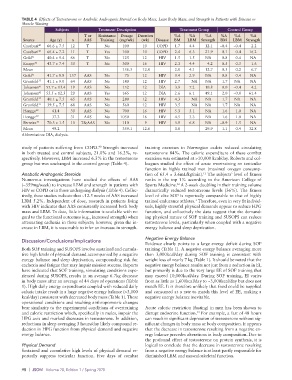
TABLE 4  Effects of Testosterone or Anabolic Androgenic Steroid on Body Mass, Lean Body Mass, and Strength in Patients with Disease or
          Muscle Wasting
                        Subjects          Treatment Description            Treatment Group     Control Group
                                    T or   Resistance  Dosage  Duration   %Δ   %Δ     %Δ    %Δ    %Δ    %Δ
           Source     Age (y)  n    AAS   Training  (mg/wk)  (wk)  Disease  BM  LBM  Strength  BM  LBM  Strength
           Casaburi 40  66.6 ± 7.5  12  T   No      100     10    COPD   1.7   4.4    12.1  –0.4  –0.4   2.2
           Casaburi 40  66.4 ± 7.2  11  T   Yes     100     10    COPD   2.4   6.3    21.9   0.1   0.4   16.2
           Gold 35  40.4 ± 9.4  66   T      No      125     12     HIV   1.5   1.5    NA     0.8   0.4  NA
           Knapp 36  43.7 ± 7.4  30  T      No      300     16     HIV   2.3   4.4     4.2   0.5   0.3   1.6
           Mean                                     156.3   12.0         2.0   4.1    12.7   0.3   0.2   6.7
           Gold 35  41.7 ± 8.8  157  AAS    No       75     12     HIV   3.4   2.9    NA     0.8   0.4  NA
           Grunfeld 37  41.1 ± 9.0  64  AAS  No     140     12     HIV   2.7    NA    NA     1.7  NA    NA
           Johansen 41  55.7 ± 13.4  19  AAS  No    152     12     DIA   3.9   7.2    10.8   0.0  –0.4   4.2
           Johansen 41  55.5 ± 12.5  20  AAS  Yes   165     12     DIA   2.6   6.1    49.1   2.0  –0.8   61.4
           Grunfeld 37  40.1 ± 7.5  65  AAS  No     280     12     HIV   4.3    NA    NA     1.7  NA    NA
           Grunfeld 37  39.5 ± 7.5  68  AAS  No     560     12     HIV   3.5    NA    NA     1.7  NA    NA
           Hengge 38  41.4    30    AAS     No      700     16     HIV   5.3   5.1    NA     1.6   1.0  NA
           Hengge 38  37.3    31    AAS     No     1050     16     HIV   4.5   3.3    NA     1.6   1.0  NA
           Ferreira 39  70.3 ± 1.5  10  T&AAS  No   110      9     HIV   3.9   6.8    NA    –0.9   1.5  NA
           Mean       49.2                          359.1   12.6         3.8          29.9   1.1  0.4   32.8
          Abbreviation: DIA, dialysis.

          study of patients suffering from COPD.  Strength increased   training exercises in Norwegian cadets reduced circulating
                                          40
          in both treated and control subjects, 21.0% and 16.2%, re-  testosterone  84%.  The caloric  expenditure  of these  combat
          spectively. However, LBM increased 6.3% in the testosterone   exercises was estimated at >10,000 kcal/day. Roberts and col-
          group but was unchanged in the control group (Table 4).  leagues studied the effect of acute overtraining on testicular
                                                             function in highly trained men (maximal oxygen consump-
                                                                                     12
          Anabolic Androgenic Steroids                       tion of 65.4 ± 3.6mL/kg/min).  The subjects’ level of fitness
          Numerous investigations have studied the effects of AAS   ranks in the top 1% according to the American College of
          (~359mg/week) to increase LBM and strength in patients with   Sports Medicine.  A 2-week doubling in their training volume
                                                                          42
          HIV or COPD or in those undergoing dialysis (Table 4). Collec-  dramatically reduced testosterone levels (36%). The fitness
          tively, these studies indicate that ~12.5 weeks of AAS increased   level of elite SOF is reportedly comparable to that of highly
          LBM 5.2%. Independent of dose, research in patients living   trained endurance athletes.  Therefore, even in very fit individ-
                                                                                  1
          with HIV indicates that AAS consistently increased both body   uals, highly stressful physical demands appear to reduce HPG
          mass and LBM. To date, little information is available with re-  function, and collectively the data suggest that the demand-
          gard to the functional outcomes (e.g., increased strength) when   ing physical nature of SOF training and SUSOPS can reduce
          attenuating cachexia in these subjects; however, given the in-  testosterone levels, particularly when coupled with a negative
          crease in LBM, it is reasonable to infer an increase in strength.  energy balance and sleep deprivation.

          Discussion/Conclusions/Implications                Negative Energy Balance
                                                             Evidence clearly points to a large energy deficit during SOF
          Both SOF training and SUSOPS involve sustained and cumula-  training (Table 1). A negative energy balance averaging more
          tive high levels of physical demand accompanied by a negative   than 3,000kcal/day during SOF training is consistent with
          energy balance and sleep deprivation, compounding risk for   weight loss of nearly 7 kg (Table 1). It should be noted that the
          cachexia and fatigue that may impair mission success. Reports   negative energy balance results not just from a reduction in EI,
          have indicated that SOF training, simulating conditions expe-  but primarily is due to the very large EE of SOF training that
          rienced during SUSOPS, results in an average 6.7kg decrease   may exceed 10,000kcal/day. During SOF training, EI varies
          in body mass after an average of 44 days of operations (Table   from as little as 1,600kcal/day to ~3,000kcal/day but does not
          1). High daily energy expenditures coupled with reduced daily   match EE. It is therefore unlikely that food could be supplied
          caloric intake result in a large negative energy balance (>3,000   and consumed at a rate to match this level of EE, making a
          kcal/day) consistent with decreased body mass (Table 1). These   negative energy balance inevitable.
          operational conditions and resulting anthropometric changes
          bear similarity to the experimental conditions of overtraining   Acute caloric restriction (fasting) in men has been shown to
          and caloric restriction which, specifically in males, impair the   disrupt endocrine function.  For example, a fast of 48 hours
                                                                                  13
          HPG axis and marked decreases in testosterone. In addition,   can result in significant depression of testosterone without sig-
          reductions in sleep averaging 3 hours/day likely compound re-  nificant changes in body mass or body composition. It appears
          duction in HPG function from physical demand and negative   that the decrease in testosterone resulting from a negative en-
          energy balance.                                    ergy balance precedes alterations in body composition. Due to
                                                             the profound effect of testosterone on protein synthesis, it is
          Physical Demand                                    logical to conclude that the decrease in testosterone resulting
          Sustained and cumulative high levels of physical demand re-  from a negative energy balance is at least partly responsible for
          portedly suppress testicular function. Five days of combat   diminished LBM and musculoskeletal function.


          98  |  JSOM   Volume 20, Edition 1 / Spring 2020

