


Page 108 - JSOM Spring 2020
P. 108
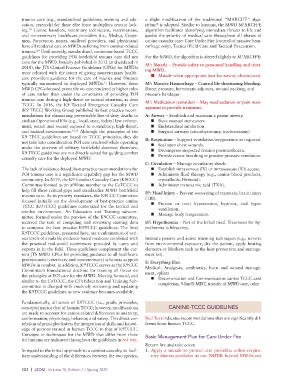
trauma care (e.g., standardized guidelines, training and edu-  a  slight modification of  the  traditional “MARCHE”  algo-
          cation, research) for these elite force multipliers remain lack-  rithm  is adopted. Similar to humans, the MWD M ARCH E
                                                                                                     3
                                                                                                           2
                                                                 14
          ing.   Canine  handlers,  veterinary  technicians,  veterinarians,   algorithm facilitates identifying immediate threats to life and
             10
          and  nonveterinary  healthcare  providers  (i.e.,  Medics,  Corps-  guides the priority of medical care throughout all phases of
          men, Pararescue, nurses, midlevel providers, and physicians)   canine casualty care: Care Under Fire (control of massive hem-
          have all rendered care to MWDs suffering from combat-related   orrhage only), Tactical Field Care and Tactical Evacuation.
          trauma.  Until recently, standardized, consensus-based TCCC
                8,9
          guidelines for providing POI battlefield trauma care did not   For the MWD, the algorithm is altered slightly to M ARCH E:
                                                                                                     3
                                                                                                           2
          exist for the MWD. Initially published in 2012 (and updated in   1
          2018), the JTS Clinical Practice Guidelines (CPGs) for MWDs   M : Muzzle – Provide safety to personnel handling and treat-
          were released with the intent of giving nonveterinary health-  ing MWD.
          care providers guidance for the care of injuries and illnesses   ■   Muzzle when appropriate (not for airway obstruction).
          typically encountered in deployed MWDs.  However, these   M : Massive Hemorrhage – Control life-threatening bleeding.
                                            11
                                                               2
          MWD CPGs focused primarily on care rendered at higher roles   Direct pressure, hemostatic adjuncts, wound packing, and
          of care rather than under the constraints of providing POI   pressure bandages
          trauma care during a high-threat or tactical situation, as does   3
          TCCC. In 2016, the K9 Tactical Emergency Casualty Care   M : Medication (consider) – May need sedation or pain man-
          (K9 TECC) Working Group published its best practice recom-  agement to provide treatment.
          mendations for eliminating preventable line-of-duty deaths in   A: Airway – Establish and maintain a patent airway.
          civilian Operational K9s (e.g., local, state, federal law enforce-  ■   Basic manual maneuvers
          ment, search and rescue) exposed to nonmilitary, high-threat,   ■   Endotracheal intubation
          and tactical environments. 12,13  Although the principles of the   ■   Surgical airways (cricothyrotomy, tracheostomy)
          K9 TECC guidelines are based on TCCC principles, they do
          not take into consideration POI care rendered while operating   R: Respiration – Support ventilation/oxygenation as required.
          under the purview of military battlefield doctrine; therefore,   ■   Seal open chest wounds.
          K9 TECC guidelines are not directly suited for guiding combat   ■   Decompress suspected tension pneumothorax.
          casualty care for the deployed MWD.                  ■   Provide rescue breathing or positive-pressure ventilation.
                                                             C: Circulation – Manage circulatory shock.
          The lack of evidence-based, best-practice recommendations for   ■   Establish intravenous (IV) or intraosseous (IO) access.
          POI trauma care is a significant capability gap for the MWD   ■   Administer fluid therapy (e.g., canine blood products,
          community. In 2019, the K9 Combat Casualty Care (K9CCC)   crystalloids, Hextend).
          Committee formed as an affiliate member to the CoTCCC to   ■   Administer tranexamic acid (TXA).
          help fill these critical gaps and standardize MWD battlefield   1
          trauma care. As its priority mandates, the K9CCC Committee   H : Head Injury – Prevent worsening of traumatic brain injury
          focused  initially on the  development  of  best-practice  canine   (TBI).
          TCCC (K9TCCC) guidelines customized for the tactical and   ■   Prevent or treat hypotension, hypoxia, and hypo -
          combat  environment.  An  Education  and  Training  subcom-  ventilation.
          mittee, formed under the purview of the K9CCC committee,   ■   Manage body temperature.
          received the task of compiling and reviewing existing data   H : Hypothermia - Part of the lethal triad. Treatment for hy-
                                                              2
          to compose the best practice K9TCCC guidelines. The final   pothermia is lifesaving.
          K9TCCC guidelines, presented here, are a culmination of vari-
          ous levels of available evidence-based medicine combined with   Institute passive and active warming techniques (e.g., remove
          the  practical real-world experiences  provided by  users and   from environmental exposure, dry the patient, apply heating
          experts in in the field. These guidelines complement the cur-  elements or blankets such as the heat prevention and manage-
          rent JTS MWD CPGs for providing guidance to all healthcare   ment kit).
          professionals (veterinary and nonveterinary) who may support
          MWDs in combat. In addition, K9TCCC serves as the K9CCC   E: Everything Else:
          Committee’s foundational doctrine for training all forces on   Medical: Analgesia, antibiotics, burn and wound manage-
          the principles of POI care for the MWD. Moving forward, and   ment, splints
          similar to the CoTCCC, the C5’s Education and Training Sub-  ■   Documentation and Communication: canine TCCC card
          committee is charged with routinely reviewing and updating   completion, 9-line/S-MIST, transfer of MWD care, other
          the K9TCCC guidelines as new evidence becomes available.

          Fundamentally, all tenets of K9TCCC (i.e., goals, principles,
          concepts) mirror that of human TCCC; however, modifications   CANINE-TCCC GUIDELINES
          are made to account for canine-related differences in anatomy,
          conformation, physiology, behavior, and safety. This direct cor-  Red Text indicates recommendations that are significantly dif-
          relation of principles fosters the integration of skills and knowl-  ferent from human TCCC.
          edge of persons trained in human TCCC to that of K9TCCC.
          Concepts or techniques for the MWD that differ from those   Basic Management Plan for Care Under Fire
          for humans are indicated throughout the guidelines in red text.
                                                             Return fire and take cover.
          In regard to the initial approach to a combat casualty, to facil-  1.  Apply a  muzzle  to protect  care  providers unless  respira-
          itate understanding of the differences between the two species,   tory distress precludes its use. NOTE: Injured MWDs can


          102  |  JSOM   Volume 20, Edition 1 / Spring 2020

