


Page 110 - JSOM Spring 2020
P. 110
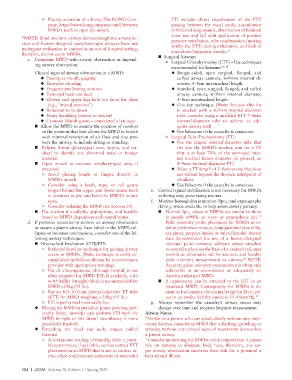
o Placing a portion of a Kong (The KONG Com-       ETI include: direct visualization of the ETT
                     pany, https://www.kongcompany.com/) between        passing between the vocal cords, auscultation
                     MWD’s teeth to open the mouth.                     of bilateral lung sounds, observation of bilateral
                                                                        chest rise and fall with application of positive
          *NOTE: Blind insertion airway device/extraglottic airway de-  pressure ventilation, tube condensation (misting
          vices and human-designed nasopharyngeal airways have not      within the ETT) during exhalation, and lack of
          undergone evaluation in canines in an out-of-hospital setting;   auscultated epigastric sounds. 15
          therefore, do not use in MWDs.                              Surgical Airways
            c.  Conscious MWD with airway obstruction or impend-  ■     o Surgical Cricothyrotomy (CTT) – Use techniques
               ing airway obstruction:
                                                                        recommended for humans: 16–18
               Clinical signs of airway obstruction in a MWD:           ◆   Bougie-aided, open surgical,  flanged, and
                  ◆   Pawing at mouth, gagging                            cuffed  airway  cannula,  6–9mm  internal  di-
                  ◆   Excessive drooling                                  ameter, 5–8cm intratracheal length
                  ◆   Frequent swallowing motions                       ◆   Standard, open surgical, flanged, and cuffed
                  ◆   Extended head and neck                              airway cannula, 6–9mm internal diameter,
                  ◆   Elbows and upper legs held out from the chest       5–8cm intratracheal length
                     (e.g., “tripod position”)                          ◆   Cric-key technique (Note: because this kit
                  ◆   Reluctant to lie down                               is stocked with a 6.0mm internal-diameter
                  ◆   Noisy breathing (stertor or stridor)                tube, consider using a modified ETT 7–8mm
                  ◆   Cyanosis (bluish gums) – considered a late sign     internal-diameter  tube  to  achieve  an  ade-
               ■   Allow the MWD to assume the position of comfort        quate airway seal)
                  or the position that best allows the MWD to breath    ◆   Use lidocaine if the casualty is conscious.
                  with minimal restriction of air flow and that pro-    o Surgical Tube Tracheostomy (TT)
                  tects the airway, to include sitting or standing.     ◆   Use the largest internal-diameter tube that
               ■   Palpate throat (pharyngeal area, larynx, and tra-      fits into the MWD’s trachea; aim for a TT
                  chea) to identify any abnormal mass or foreign          that is at least 70% of the estimated inter-
                  material.                                               nal tracheal lumen diameter (in general, an
               ■   Open mouth to examine oropharyngeal area, if           8–9mm internal-diameter TT).
                  practical:                                            ◆   Select a TT length of 5–8cm or one that does
                     o Avoid placing hands or fingers directly in         not extend beyond the thoracic inlet/point of
                     MWD’s mouth.                                         shoulder.
                     o Consider  using a leash, rope, or roll gauze     ◆   Use lidocaine if the casualty is conscious.
                     looped behind the upper and lower canine teeth   e.  Cervical spinal stabilization is not necessary for MWDs
                     in attempts to pry and hold the MWD’s mouth   suffering only penetrating trauma.
                     open.                                     f.  Monitor hemoglobin saturation (Spo ) and capnography
                                                                                              2
                     o Consider sedating the MWD (see Section 10).  (Etco ), when available, to help assess airway patency.
                                                                       2
               ■   Use suction if available, appropriate, and feasible   ■   Normal Spo  values in MWDs are similar to those
                                                                               2
                  based on MWD disposition and mental status.        in people (>94%  on  room or  atmospheric  air).
                                                                                                            19
            d.  If previous measures to remove an airway obstruction   Pulse oximetry probe placement for MWDs in or-
               or secure a patent airway have failed or the MWD col-  der of preference: tongue, nonpigmented area of lip,
               lapses or becomes unconscious, consider one of the fol-  ear pinna, prepuce (male) or vulva (female). Recent
               lowing airway techniques:                             data demonstrated the use of a human-designed
               ■   Orotracheal Intubation (OTI)/ETI:                 neonatal pulse oximetry adhesive sensor attached
                     o Preferred first-line technique for gaining airway   to ventral surface on the base of a canine’s tail, may
                     access in MWDs. (Note: technique is easily ac-  provide an alternative site for accurate and feasible
                     complished in field conditions by nonveterinary   pulse oximetry measurement in canines.  NOTE:
                                                                                                     20
                     provider with appropriate training).            Accurate pulse oximetry measurement is often only
                     o Use of a laryngoscope, although helpful, is not   achievable in an unconscious or adequately se-
                     often required for MWD ETI; if available, a #4   dated/anesthetized MWD.
                     or #5 Miller (straight) blade is recommended for   ■   A capnometer can be attached to the ETT in an
                     MWD >25kg (55 lb.).                             intubated MWD. Capnography for MWDs is the
                     o Use an 8.0–10.0mm internal-diameter ET tube   same as for humans; the normal range for Etco val-
                                                                                                         2
                     (ETT) for MWD weighing > 25kg (55 lb.).         ues in an awake healthy canine is 35–45mmHg. 19
                     o ETI is performed most easily by:        g.  Always remember the casualty’s airway status may
               ◆   Placing the MWD in sternal or prone position, pref-  change over time and requires frequent reassessment.
                  erably (Note: provider can perform ETI with the   Airway Notes:
                  MWD in right or left lateral recumbency if more   *Similar to a person who can speak clearly without any respi-
                  practically feasible)                      ratory distress, consider an MWD that is barking, growling, or
               ◆   Extending the head and neck, tongue pulled   whining without any clinical signs of respiratory distress has
                  forward                                    a patent airway.
                     o A continuous reading >10mmHg from a porta-  *Consider monitoring the MWDs rectal temperature.  Canines
                     ble capnometer, if available, verifies correct ETT   rely on panting to dissipate body heat; therefore, any up-
                     placement in an MWD that is not in cardiac ar-  per airway obstruction increases their risk for a potential a
                     rest; other confirmatory indicators of successful   heat-related illness.


          104  |  JSOM   Volume 20, Edition 1 / Spring 2020

