


Page 102 - JSOM Spring 2020
P. 102
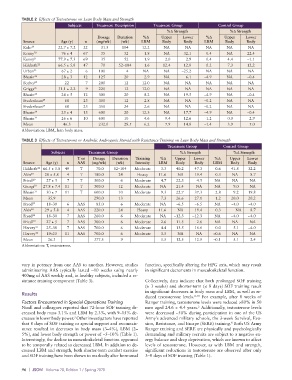
TABLE 2  Effects of Testosterone on Lean Body Mass and Strength
                             Subjects    Treatment Description  Treatment Group            Control Group
                                                                      %Δ Strength               %Δ Strength
                                         Dosage   Duration   %Δ     Upper   Lower     %Δ      Upper   Lower
           Source         Age (y)   n    (mg/wk)   (wk)    LBM      Body     Body    LBM      Body     Body
           Kido 19       22.7 ± 7.2  22    31.3    104      12.2     NA      NA       NA       NA      NA
           Kenny 20       76 ± 4   67      35        52      1.8     NA      32.1      0.4     NA       22.4
           Kenny 21      77.9 ± 7.3  69    35        52      1.9     2.0      2.9      0.4     4.4      –1.1
           Hildreth 22   66.5 ± 5.8  47    70     52–104     1.6    12.4     12.8      0.2     7.3     12.2
           Urban 23       67 ± 2     6    100         4     NA       NA      –25.2    NA       NA      NA
           Bhasin 24      28 ± 3   12     125        20      2.9     NA       6.1     –4.9     NA       –0.4
           Forbes 25        22       7    200       12      12.0     NA      NA       NA       NA      NA
           Griggs 26     31.1 ± 2.2   9   220       12      12.0     NA      NA       NA       NA      NA
           Bhasin 24      24 ± 5   12     300        20      8.2     NA      19.5     –4.9     NA       –0.4
           Frederiksen 27   68     23     350       12       2.8     NA      NA       –0.2     NA      NA
           Frederiksen 27   68     23     350        24      2.6     NA      NA       –0.2     NA      NA
           Bhasin 24      25 ± 4   13     600        20     12.3     NA      17.7     –4.9     NA       –0.4
           Bhasin 31      26 ± 6   10     600        10      4.6      9.4    12.6      1.2     0.0       2.9
           Mean            46.3           232.0      28.5    6.2      7.9    14.8     –1.4     3.9       5.0
          Abbreviation: LBM, lean body mass.

          TABLE 3  Effects of Testosterone or Anabolic Androgenic Steroid with Resistance Training on Lean Body Mass and Strength
                                                                      Treatment Group        Control Group
                      Subjects       Treatment Group                       %Δ Strength           %Δ Strength
                                 T or   Dosage   Duration   Training   %Δ    Upper   Lower   %Δ   Upper   Lower
           Source   Age (y)  n   AAS   (mg/wk)   (wk)    Intensity  LBM   Body   Body    LBM    Body    Body
           Hildreth 22  66.5 ± 5.8  49  T   70.0  52–104  Moderate   3.3   40.2   47.3     0.6   41.8   32.2
           Alén 28  28 ± 5.8   4  T     180.0      24     Heavy    11.6   NA      19.4     0.3   NA      8.7
           Friedl 29  27 ± 5   7  T     300.0      6     Moderate   4.7   22.3     4.5    NA     NA     NA
           Giorgi 30  27.8 ± 7.4  11  T   300.0    12    Moderate  NA     21.4    NA      NA      9.0   NA
           Bhasin 31  30 ± 7  11  T     600.0      10    Moderate   9.3   22.7    37.3     2.8    9.2   19.8
           Mean      35.9               290.0      13               7.3   26.6    27.1     1.2   20.0   20.2
           Freed 32  18–30   6   AAS     85.0      6     Moderate  NA     ~6.5    ~6.5    NA     ~4.0   ~4.0
           Alén 28  29 ± 5.8   4  AAS   220.0      24     Heavy    11.6   NA      19.4     0.3    NA     8.7
           Freed 32  18–30   7   AAS    260.0      6     Moderate  NA    ~12.3   ~12.3    NA     ~4.0   ~4.0
           Friedl 29  27 ± 5   7  AAS   300.0      6     Moderate   2.6   11.5     2.6    NA     NA     NA
           Hervey 33  25–38   7  AAS    700.0      6     Moderate   4.4   13.5    16.6     0.0    5.1   –4.0
           Hervey 34  19–25  11  AAS    700.0      6     Moderate   3.5   NA      NA      –0.6   NA     NA
           Mean      26.3               377.5      9                5.5   12.5    12.9    –0.1    5.1    2.4
          Abbreviation: T, testosterone.


          vary in potency from one AAS to another. However, studies   function, specifically altering the HPG axis, which may result
          administering AAS typically lasted ~10 weeks using nearly   in significant decrements in musculoskeletal function.
          400mg of AAS weekly and, in healthy subjects, included a re-
          sistance training component (Table 3).             Collectively, data indicate that both prolonged SOF training
                                                             (≥ 3 weeks) and shorter-term (≤ 8 days) SOF training result
                                                             in significant decreases in body mass and LBM, as well as re-
          Results
                                                             duced testosterone levels. 2–10  For example, after 8 weeks of
          Factors Encountered in Special Operations Training  Ranger training, testosterone levels were reduced >80% in 50
                                                                                   2
          Nindl and colleagues reported that 72-hour SOF training de-  men aged 24.6 ± 4.4 years.  Additionally, testosterone levels
          creased body mass 3.1% and LBM by 2.3%, with 9–15% de-  were decreased ~50% during participation in one of the US
                                3
          creases in lower body power.  Other investigators have reported   Army’s advanced military schools, the 3-week Survival, Eva-
          that 8 days of SOF training or special support and reconnais-  sion, Resistance, and Escape (SERE) training.  Both US Army
                                                                                                8
          sance resulted in decreases in body mass (3–4%), LBM (2–  Ranger training and SERE are physically and psychologically
          5%), and lower body strength or power of ~5–10% (Table 1).   demanding and military recruits are subject to a negative en-
          Interestingly, the decline in musculoskeletal function appeared   ergy balance and sleep deprivation, which are known to affect
          to be temporally related to decreased LBM. In addition to de-  levels of testosterone. However, as with LBM and strength,
          creased LBM and strength, both shorter-term combat exercise   significant reductions in testosterone are observed after only
          and SOF training have been shown to markedly alter hormonal   3–8 days of SOF training (Table 1).


          96  |  JSOM   Volume 20, Edition 1 / Spring 2020

